Downloads
 Login
Login
 Register


Tags
Aromatic rice prices skyrocket after fresh export approvals
ANM Mohibub Uz Zaman
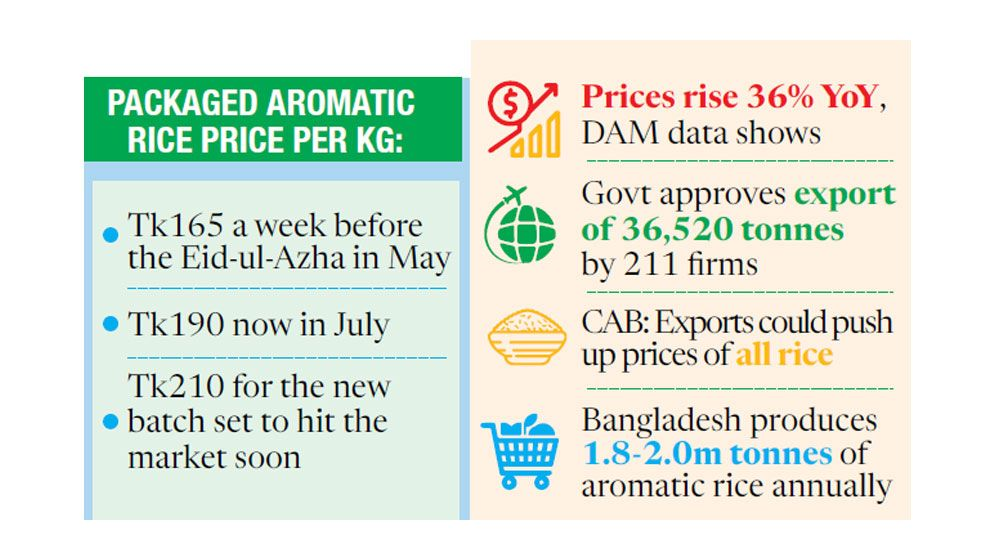
Prices of both packaged and loose aromatic rice have surged following the government’s repeated approval of exports, with traders warning that further increases are imminent.
Packaged aromatic rice, which sold for Tk165 per kg before Eid-ul-Azha, is now retailing at Tk190 and is expected to rise to Tk210, according to market sources. Traders said 1kg packs carrying the new Tk210 price have already been prepared for distribution.
“Prices have been rising since the Eid-ul-Azha holidays. Packaged Chinigura rice from companies such as Akij, Square, Meghna, City and Pran is now selling at Tk190 per kg, while loose rice is being sold at Tk170 per kg,” said Md Polash, owner of Motlab Trader in Mirpur-13, Dhaka.
He added that suppliers are now accepting fresh orders at the higher Tk210 price.
According to the Department of Agricultural Marketing (DAM), aromatic rice prices have risen by 36.36% over the past year and 11.11% in the past month. A year ago, the variety sold for Tk90-Tk130 per kg.
Market insiders attributed the sharp increase to the government’s decision to resume exports, arguing that overseas shipments have tightened domestic supply and fuelled retail prices.
Last week, the Ministry of Commerce authorised 211 companies to export 36,520 tonnes of aromatic rice until 31 December, subject to nine conditions.
The approvals were communicated to the Office of the Chief Controller of Imports and Exports (CCI&E) following a recommendation from the Ministry of Food.
The interim government first lifted the nearly two-year export ban in April 2025, allowing 133 companies to export 25,000 tonnes of aromatic rice.
The ban had been imposed in June 2022 after the Ministry of Food urged the commerce ministry to halt exports to contain soaring domestic prices. Export permits issued to 41 companies were also cancelled at the time. An earlier suspension had also been imposed in October 2013 for the same reason.
SM Nazer Hossain, vice-president of the Consumers Association of Bangladesh (CAB), said exports would inevitably put additional pressure on the domestic market.
“Exports will have some impact on prices because they create additional pressure on the market. Another issue is that companies are adding value to the rice through packaging, and this value addition is responsible for a significant portion of the price increase,” he said.
“However, I do not think the government made the right decision by allowing exports at this particular time. Rice prices have already been rising steadily. If exports of aromatic rice increase or its price rises, the prices of other rice varieties will also increase proportionately,” he added.
“There is already a degree of crisis because production declined last year. The government should have considered domestic production and demand before making the decision. Had those factors been properly assessed, this situation might have been avoided.”
Criticising the role of large millers, Nazer said, “When a five-kilogram pack of rice is sold, the price increases by around Tk20 to Tk40 per kilogram, but the actual packaging cost would not exceed Tk5 per kilogram.
“What we are seeing is that the corporate groups’ packaged rice business is keeping the rice market unstable. Rice kept in ordinary sacks cannot be stored for very long, whereas packaged rice can be preserved for an extended period.”
Commerce ministry sources said Bangladesh first exported aromatic rice in FY10, shipping 663 tonnes. Exports rose steadily to 10,879 tonnes in FY20 before declining to $2.06 million in export earnings in FY21 from $2.88 million a year earlier, and to $1.07 million in FY22, according to the Export Promotion Bureau (EPB). Exports were suspended in FY23.
Under the latest approvals, 12 companies, including Square Food & Beverage, Ispahani Foods, IFAD Multiproducts, Tanveer Food, Bombay Sweets & Co. and Banshi Millers, have each been allowed to export the maximum allocation of 500 tonnes.
Bangladesh produces around 1.8-2.0 million tonnes of aromatic rice annually, while average exports are about 10,000 tonnes. According to the Ministry of Food, aromatic rice production stood at 10.23 lakh tonnes in FY24.
https://www.daily-sun.com/index.php/business/883950Published Date: July 6, 2026


 READ
READ