Downloads
 Login
Login
 Register

Tags
Revaluing Vietnamese rice: steady steps forward
In early May 2026, farmers in Hung My Commune, Vinh Long Province, were harvesting the remaining plots of the winter-spring rice crop.
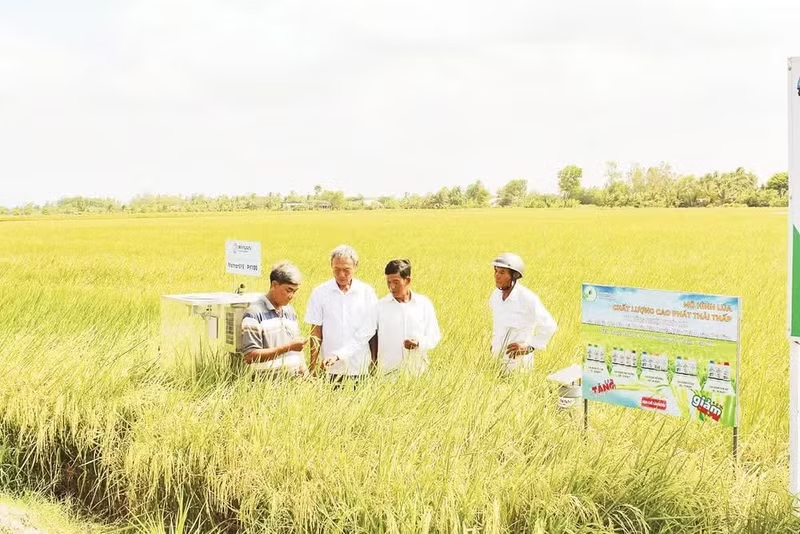
The same field presented two contrasting scenes. On one side, rice plants grew thick under traditional cultivation methods. On the other, rice was planted in neat rows with wider spacing, the result of new farming technology.
Phuoc Hao Agricultural Cooperative in Hung My Commune was selected by the Ministry of Agriculture and Environment to pilot a high-quality, low-emission rice cultivation model covering 50 hectares. Some 46 members took part, growing the ST24 variety.
Although the trial period has been short, the initial results are already promising. Seed use has fallen by 60% and fertiliser use by 20%. Average yields have reached seven to eight tonnes per hectare, while profits have risen by some six to eight million VND per hectare.
From technical pilot to regional economic structure
The project, aimed at sustainably developing one million hectares of specialised, high-quality, low-emission rice cultivation linked with green growth in the Mekong Delta by 2030, seeks to establish rice fields with a 30% reduction in input costs, a 20% increase in profits, and lower greenhouse gas emissions. To date, the area under implementation has reached nearly twice the target set for the initial phase.
At a review conference held by the Ministry of Agriculture and Environment in Can Tho, marking two years of implementation, Tran Duc Thang – Politburo member, Secretary of the Ha Noi Party Committee and former Minister of Agriculture and Environment – stressed that the project was not merely a production development programme. It represented, he said, an important step in restructuring the Mekong Delta’s rice sector towards greener, more sustainable agriculture.
The project did not begin as an entirely new experiment. Instead, it built on a technical and organisational foundation established over nearly a decade through the VnSAT project, supported by the World Bank and implemented from 2015 to 2022.
VnSAT aimed to restructure the agricultural sector, focusing on rice production in the Mekong Delta and coffee cultivation in the Central Highlands
VnSAT is widely regarded as the forerunner of the later one-million-hectare project, the bridge from a pilot technical model to a region-wide economic structure.
Back at the high-quality, low-emission rice fields, the land surface is noticeably drier and flatter. Rather than keeping fields continuously flooded as under traditional methods, farmers here apply alternate wetting and drying (AWD) irrigation techniques.
Cracks often appear in the soil, yet the rice plants develop deeper, stronger root systems. Yields are higher and greenhouse gas emissions lower. Laser land-levelling technology is also used, smoothing out uneven patches across the fields.
The concept of reducing greenhouse gas emissions remains relatively unfamiliar to many farmers. Yet when seed use drops by as much as 60% and profits rise significantly, the benefits become far more concrete.
Reduced fertiliser use is especially significant at present. The crisis in the Strait of Hormuz has not only disrupted oil prices but also pushed fertiliser costs, urea in particular, up by 10-15% within days of the conflict’s outbreak. Rising production costs have left many farmers relying on traditional methods in a difficult position.
One million hectares is more than just a number
Rice has long been one of Viet Nam’s key strengths. Yet its role both within the crop structure and in agricultural exports more broadly has been diminishing. Reassessing the value of Vietnamese rice has therefore become a pressing priority.
Whereas rice was once measured mainly by yield, volume or export turnover, it is now increasingly evaluated against reduced emissions, soil sustainability, ESG standards and carbon footprint.
Pham Thai Binh, Board Chairman of Trung An High-Tech Agriculture Joint Stock Company, said the company was among the first enterprises to participate in low-emission rice production models under the one-million-hectare project.
The company has already exported its first shipment of low-emission rice, 500 tonnes, to Japan, a demanding market but one willing to pay significantly higher prices provided all quality standards are met.
During the 2025-2026 winter-spring season, the company continued to expand low-emission rice production across all its contracted fields in the Mekong Delta.
Viet Nam is pursuing a project large enough to turn a technical innovation into a full-scale market shift. If the target of one million hectares of high-quality, low-emission rice is met by 2030, it could rank among the world’s largest rice sector initiatives.
It would not only serve as a model for extending similar approaches to other crops, but also offer a replicable pathway for other nations grappling with the growing complexity of food security.
These early results not only help raise the value of the rice sector, but also align with Viet Nam’s commitment to achieving net-zero emissions by 2050.
At the same time, they contribute to building the Vietnamese rice brand around the values of “green, clean, high-quality and sustainable.”
Nam Thanh- Translated by NDO
https://en.nhandan.vn/revaluing-vietnamese-rice-steady-steps-forward-post162342.htmlPublished Date: May 20, 2026


 READ
READ