Downloads
 Login
Login
 Register


Tags
Gov’t enforces new price limits on rice
Third Anne Peralta-Malonzo
Summary
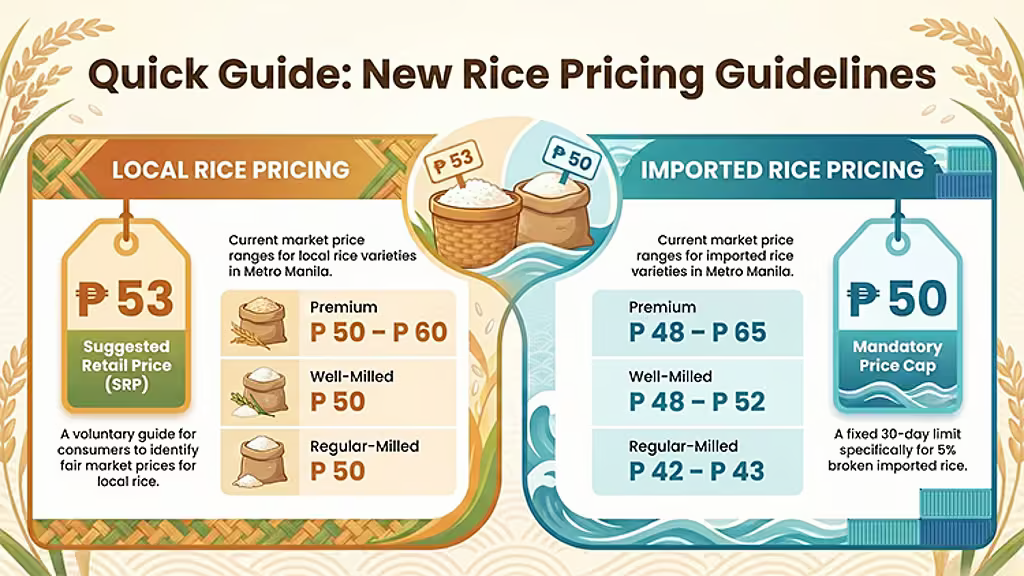
- The Department of Agriculture announced a proposed P53 per kilogram voluntary suggested retail price guide for local rice to protect consumers and maintain fair producer returns.
- A mandatory maximum price ceiling of P50 per kilogram for imported five-percent broken rice took effect for a 30-day window, with field enforcement starting next week.
- While the P50 import cap carries regulatory penalties for violations, the P53 domestic target is an advisory benchmark allowing vendors to adjust prices based on market competition or supply disruptions.
THE cost of putting food on the table is shifting as the National Government deploys two separate financial strategies to control the price of the country’s most vital staple. By introducing a rigid price limit on imported grain alongside a flexible pricing guide for domestic crops, agricultural authorities are attempting a high-stakes balancing act.
For ordinary households, these policy shifts are not abstract economic choices. They dictate how much disposable income remains at the end of the week. When food prices climb, the ripple effects alter everything from banking policies to the survival choices of families trying to stretch a daily wage.
A split system for market shelves
The Department of Agriculture announced a proposed suggested retail price of P53 per kilogram for local rice. Agriculture Secretary Francisco Tiu Laurel Jr. said that the benchmark emerged from discussions with commercial millers and industry organizations to protect public purchasing power while maintaining viable returns for agricultural producers.
“This is not a price ceiling. It’s just a guide for consumers on fair local rice prices,” Laurel clarified. “I’ve consulted rice millers and industry groups, and P53 per kilo is acceptable,” he added, noting that market players may still sell lower, allowing others in the value chain to earn reasonable margins.
This domestic price guideline arrives on the heels of a more aggressive market intervention. The government previously instituted a mandatory maximum price limit of P50 per kilogram on imported five-percent broken rice. That compulsory ceiling took effect for a designated 30-day window, with comprehensive field enforcement scheduled to begin across retail hubs next week.
The mechanics
To understand how these changes influence local grain stalls, consumers must distinguish between a mandatory price cap and a voluntary pricing guide. The P50 limit on imported grain is a hard legal ceiling. Retailers who sell imported five-percent broken rice above this threshold face regulatory penalties.
Conversely, the P53 target for domestic rice functions as an advisory benchmark rather than an absolute law. “This is not a price ceiling. It’s just a guide for consumers on fair local rice prices,” Laurel clarified. Under this framework, vendors are permitted to adjust prices lower to stay competitive, or higher if localized supply chain disruptions drive up their operating expenses.
The structural risk
While the dual pricing system aims to lower grocery bills, economic interventions often generate unintended consequences in public markets. The immediate danger rests with the strict P50 import cap.
When imported options diminish, consumer demand shifts entirely to local grain. Because the P53 local benchmark is voluntary, a sudden surge in demand can cause domestic prices to drift upward, overriding the government’s advisory target.
For urban centers dependent on stable inflows of food supplies, these supply chain frictions can quickly translate into thin market shelves or hidden price increases. / TPM
https://www.sunstar.com.ph/cebu/govt-enforces-new-price-limits-on-ricePublished Date: May 19, 2026



 READ
READ