Downloads
 Login
Login
 Register

Tags
Rice prices are unstable, farmers face difficulties
PHƯƠNG ANH – THÀNH NHÂN
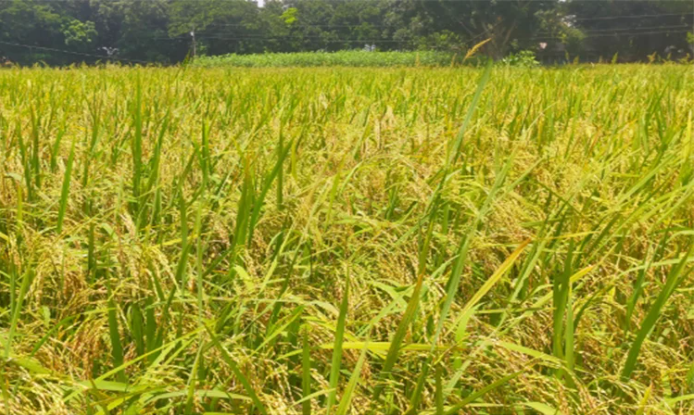
Although it is the main crop of the Mekong Delta region, the profit from rice is increasingly shrinking. Precarious rice prices and high input costs have caused many farmers to fall into the situation of “doing a lot, making little profit”, even just hoping to break even to maintain the profession.
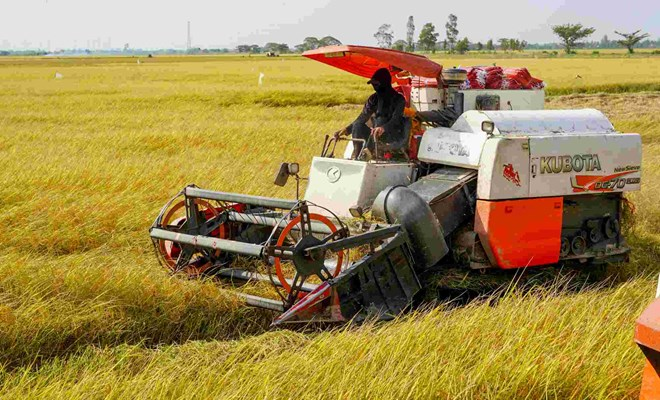
Profits are gradually shrinking on each cong of rice
In Luong Tam commune (Can Tho City), Mr. Nguyen Van Con has been attached to the fields for more than 40 years. From 3 cong of land (1 cong is equivalent to 1,300m2) initially, he accumulated and expanded to more than 10 cong, raising 5 children to study.
However, in recent years, especially the Winter-Spring crop of 2026, the efficiency has decreased significantly. With a yield of more than 1 ton/cong, priced at 5,800 VND/kg (OM18 rice variety), after expenses, he only makes a profit of about 3 million VND.
Mr. Con said that at the time of harvest (March 20), OM18 rice seeds were sold for 5,800 VND/kg, but have now decreased to 5,500 – 5,600 VND/kg. Meanwhile, before Tet, the price once reached 6,300 – 6,500 VND/kg, meaning farmers lost a significant amount of income.
What is worrying is that while rice prices decrease, input costs increase. Fertilizer currently increases by an average of about 100,000 VND per bag; rice harvesting costs increase by an additional 50,000 – 70,000 VND/cong due to rising oil prices; rice milling labor from 100,000 – 120,000 VND/day has increased to about 250,000 VND/day.
Other expenses such as tilling the soil are about 130,000 VND/cong, the labor cost of sowing the soil is about 70,000 VND, not including incurred costs. Notably, most farmers buy materials in the form of deferred payment until the end of the crop, so they have to bear additional “price gouging” costs of about 3%.
Currently, on average, each cong of rice is sold for about 6 million VND, costs have accounted for 2.7 – 2.8 million VND, the lowest is also about 2.5 million VND. Not to mention, after the Winter-Spring crop, many farmers have to abandon land to avoid saltwater intrusion, until about May – June when there is rain, the next crop begins, and 3 more months to have income. In about 5 months, there is no source of income.
In An Giang, Mr. Pham Cong Minh said that production costs have increased to 3 – 3.5 million VND/cong, of which fertilizers and pesticides account for 50 – 60%. Despite stable yields and unstable rice prices, farmers are not assured of production.
Now farming, everything has to be rented, no longer taking labor as profit as before,” Mr. Minh said.
Bottleneck” lies in the value chain
At the Conference to promote rice exports in 2026 held on March 24 in Can Tho City recently, many opinions said that the difficulties of the rice industry come not only from the market but also from the production structure itself.
Mr. Tran Quoc Tuan – Director of Vinh Long Department of Industry and Trade – said that the rice industry is facing a “reverse wind” when major markets such as Indonesia and the Philippines adjust import policies. Domestically, logistics costs increased by about 30%, and agricultural materials increased by 15 – 20%, continuing to put pressure on the entire chain.
According to Mr. Pham Thai Binh – Chairman of the Board of Directors of Trung An High-Tech Agriculture Joint Stock Company (Can Tho City), Vietnam still exports 7-8 million tons of rice per year, so the problem is not in the market but in the production organization stage.
The most important thing is to closely link production and consumption through the role of businesses. Without long-term solutions, old difficulties will continue to repeat,” Mr. Binh said.
Talking to Lao Dong Newspaper, Dr. Tran Huu Hiep – an economic expert of the Mekong Delta region said that each year the Mekong Delta supplies more than 50% of the country’s rice output and over 90% of the country’s rice exports, but farmers’ incomes are still not commensurate. He pointed out the paradox when output is large, exports are high but added value is low.
According to Mr. Hiep, the biggest “bottleneck” lies in the value chain when farmers mainly sell raw rice, standing at the lowest position, while most of the profit falls into the following stages. Linkage with businesses is still loose, the export market depends on some large markets, causing risks to fall on rice farmers.
From a production perspective, Assoc. Prof. Dr. Le Anh Tuan – Senior Lecturer of the Faculty of Environment and Natural Resources, Can Tho University – said that the rice farming model in the Mekong Delta has made a great contribution to food security and exports, but in the long term, it is revealing many sustainability issues.
According to Mr. Tuan, intensive farming 3 crops/year puts pressure on soil and water sources, reducing fertility, while closed dykes limit alluvium, forcing production to depend heavily on chemical fertilizers.
Mr. Tuan also warned that water sources are increasingly unstable due to the impact of hydropower and climate change, causing drought and saltwater intrusion to increase, causing rice production to face many risks.
According to Dr. Tran Huu Hiep, for farmers to survive with rice, a comprehensive approach is needed. First of all, it is necessary to reorganize production in a cooperative, large-scale direction; and at the same time develop deep processing, build brands to increase value. In addition, there needs to be a risk-sharing mechanism in the value chain, switching to a “favorable” production model, reducing chemicals, and adapting to climate change. “To save rice grains, we must look at the entire economic ecosystem, not just rice,” Mr. Hiep emphasized.
Assoc. Prof. Dr. Le Anh Tuan also said that it is necessary to shift from the thinking of “increasing output” to “optimizing efficiency and sustainability”. Applying models such as “1 must, 5 reductions”, using drought-tolerant and salt-tolerant varieties, and increasing chain linkages will help reduce costs and improve quality. “The most important thing is to put farmers at the center. When they see the benefits clearly, they will proactively change,” Mr. Tuan emphasized.
At the macro level, the Project to develop 1 million hectares of high-quality, low-emission rice in the Mekong Delta is showing positive results. After 2 years, the implemented area reached more than 354,000 hectares, nearly double the initial plan. The application of technical advances helps reduce 30-50% of seeds, about 30% of fertilizers and 2-3 times of spraying, thereby reducing costs and increasing farmers’ income by over 13%. The Project also promotes the formation of a linkage chain with more than 1,100 cooperatives and more than 200 participating businesses. 100% of farmers produce through cooperatives, creating a foundation for large-scale, transparent and convenient market connection production. Notably, the level of mechanization has been improved, helping to reduce labor costs and improve production management efficiency.
At Nghia Thang Agricultural Cooperative (My Xuyen ward, Can Tho city), farmers producing ST24 and ST25 rice in association with businesses are guaranteed full product consumption. Thanks to the application of synchronous farming processes, reducing chemical pesticides, yield reaches over 7 tons/ha, profit is about 50-60 million VND/ha per year. “With guaranteed businesses, farmers both reduce costs and improve quality, profits are more stable,” Mr. Hua Thanh Nghia – Director of the Cooperative – said.
https://news.laodong.vn/kinh-doanh/gia-lua-bap-benh-nong-dan-gap-kho-1678468.ldo#&gid=1&pid=1Published Date: April 2, 2026


 READ
READ