Downloads
 Login
Login
 Register

Tags
Japan, IRRI strengthen rice emissions research with upgraded lab
New facility aims to improve data on greenhouse gas emissions from rice farming systems.
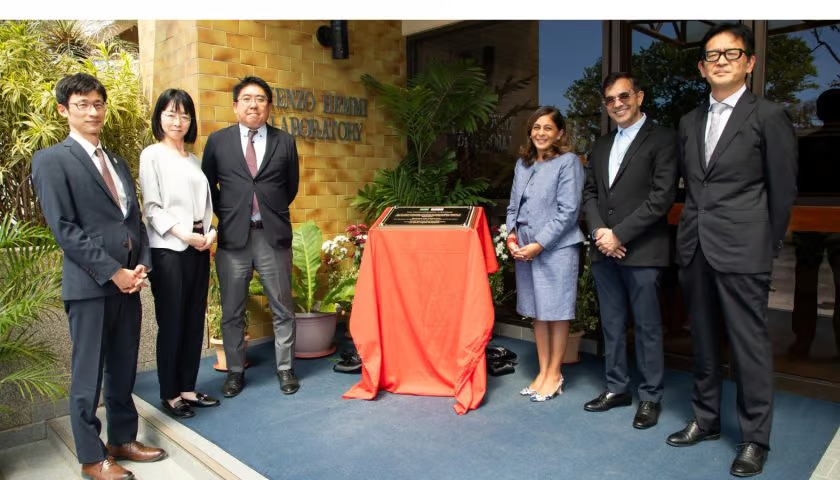
JAPAN – The International Rice Research Institute has upgraded its Gas Chromatography Laboratory to improve how scientists measure greenhouse gas emissions from rice farming.
The upgrade took place at IRRI headquarters in Los Baños, Philippines, with support from Japan’s Ministry of Agriculture, Forestry and Fisheries under the AGRI project. The project focuses on reducing emissions from agriculture across ASEAN countries.
Rice feeds more than 20 percent of the world’s population, but it also produces a large share of methane emissions. Farmers and researchers face a key challenge. They must cut emissions while still maintaining strong yields. Reliable data has remained a major gap, which has slowed progress in finding and scaling solutions.
Improving measurement and data quality
The new system allows scientists to measure gases released from rice fields with higher accuracy. It replaces older systems that relied on manual handling with four new units that include autosamplers. This change improves speed, consistency, and precision.
“Today we celebrate more than new equipment. We celebrate an investment in science that will help transform rice systems for a changing climate,” said Dr. Yvonne Pinto, Director General of IRRI.
The lab will support field measurements, data analysis, and joint research with partners. It will also help scientists compare results across different regions and farming methods.
“The upgraded GC laboratory will allow us to generate high-quality, standardized data and work closely with partners to test and scale solutions that reduce emissions,” said Dr. Kazuki Saito, Senior Scientist at IRRI and AGRI Project Lead.
Building skills and partnerships
Since March 2025, IRRI has trained 32 participants in greenhouse gas measurement. These programs bring together researchers, government staff, and partners. They focus on practical skills such as field sampling, lab work, and data interpretation.
The lab also supports closer ties between IRRI and Japan. Officials from both sides attended the opening, along with partners from research and the private sector.
“Addressing climate change in agriculture requires both mitigation and adaptation,” said Mr. Satoshi Nozawa from Japan’s agriculture ministry. “We expect this laboratory to strengthen regional capacity and support sustainable agricultural production.”
As the AGRI project moves forward, IRRI plans to expand joint research and training. Partners will use the facility to test low-emission farming methods and build stronger data systems.
With better tools and stronger partnerships, IRRI and its partners aim to help countries cut emissions from rice farming while protecting food supply.
https://millingmea.com/japan-irri-strengthen-rice-emissions-research-with-upgraded-lab/Published Date: March 29, 2026


 READ
READ