Downloads
 Login
Login
 Register

Tags
Cameroonian rice farmers caught between national ambition and rural realities
Rice accounts for more than half of Cameroon’s foreign grain supplies.
Written (Français) by Jean Sovon
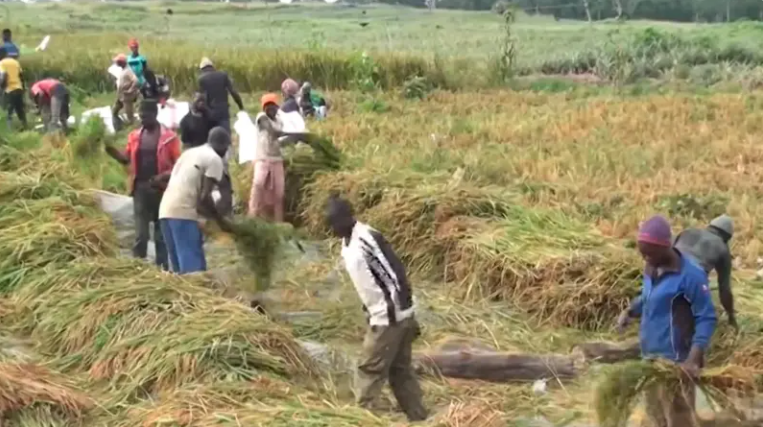
In January 2023, the Cameroonian government announced a policy of rice self-sufficiency, the population’s staple food. In the country’s northwest region, rice farmers combine courage with determination to fulfil these national promises.
In Cameroon, rice is one of the most consumed foods in cities and rural areas alike, as evidenced by the national demand among this country’s population of over 30 million. In 2023, Cameroon’s rice consumption was 25 kilograms per capita, while the estimated national demand was more than 600,000 tons per year.
Although consumption figures are increasing significantly, national production remains largely insufficient. Over the first 10 months of 2022, the country imported more than 650,000 tons of rice for FCFA 162.5 billion (USD 282 billion), compared to 580,000 tons in 2021.
The quest to end rice dependency
As such, rice accounts for more than half of foreign grain supplies, mainly coming from India and Thailand. In May 2023, the government adopted a rice self-sufficiency strategy with the specific goal of increasing production rates, backed by a budget of FCFA 385 billion (USD 677 million). The ambitious objective is to triple national production to 460,000 tons by 2027, then 750,000 tons by 2030. According to projections, this volume should help achieve a 97 percent self-sufficiency rate within Cameroon.
However, rice farmers, who grapple with dilapidated roads, insufficient seed supplies, and market disruptions every day, have mixed feelings about these ambitious objectives. Felix Mangwa, Ayong Odette, and Tanchia Ngwendoline are rice farmers who own vast rice cultivation fields. In an interview with Global Voices, they shared their hopes for achieving food security for their country and challenges in getting there.
Reform as a turning point
In the humid lowlands of northwest Cameroon, people’s lives are oriented around the rhythm of the rainy season, which lasts from March/April to October. Cultivations, primarily coffee, potatoes, corn, beans, yams, taro, rice, and palm oil, are rotated throughout the year, depending on the season.
But since the national rice self-sufficiency policy was announced, there has been a significant change in how farmers in the region plan their crop output. Félix Mangwa explained that rice farming has become his top priority:
- Original Quote
“Since the introduction of this policy, rice farming has become the main focus of my days, taking priority over all other agricultural tasks. More members of my family are now involved, lightening the workload.”
This family’s enthusiasm for rice exemplifies a deeper transformation. For Ayong Odette, a farmer by trade for many years, this is a validation of her life choices, as she was involved in rice farming long before this government announcement. She explained:
- Original Quote:
“This policy had a positive impact on my work. It encouraged me to continue focusing on rice farming as a sustainable source of income.”
For Tanchia Ngwendoline, another rice farmer, the most tangible impact is on her family’s budget, where there has been a modest but real improvement in their income:
- Original Quote:
“This policy has improved my income, helping me improve my family’s living conditions.”
Daily shortages and impassable roads
However, behind this enthusiasm, the three farmers describe a production environment fraught with difficulties. The challenges are technical, logistical, and economic, which starkly overlap from one farm to another.
Felix Mangwa provided a detailed picture of these obstacles. Paddy rice prices are too low to sustain motivation; access to certified seeds and tractors is insufficient; and water management is poor due to the lack of developed plots. But it’s the road conditions that concern him most:
- Original Quote:
“During rainy seasons, the roads connecting our fields to the markets are impassable. Transporting the crops is, therefore, challenging. And when we finally find a husker (a machine used to remove the husks from paddy rice), the quality of the white rice is often poor, far from the standard of imported rice.”
Ayong Odette also raised two fundamental issues:
- Original Quote:
“Water shortages impact production. And there’s practically no orderly marketing system, making it very difficult to sell rice at a fair and stable price.”
Labor resources are another challenge. Without machinery, production remains confined to manual labor. Post-harvest losses, exacerbated by poor storage systems, further undermine their efforts. Tanchia Ngwendoline summarized the challenges:
- Original Quote:
“Limited access to high-quality agricultural inputs (fertilizers or phytosanitary products), poor infrastructure that leads to significant post-harvest losses, dependence on manual labor, and extremely poor road conditions.”
Insufficient institutional support
Since announcing the new rice policy, association programs and non-governmental organizations operating in the farming sector have stepped in to support Cameroonian rice farmers. The Upper Nun Valley Development Authority (UNVDA) provides certified seeds to farmers in this northwest region, and the Commodity Value Chain Development Support Project (PADFA II) provides technical support and regular training. Although this support is welcome, it is not enough to overcome the challenges expounded upon above.
For instance, significant environmental issues relating to water and land use persist. Rice farming is water-intensive, and in northwest Cameroon, water management is a major daily challenge for farmers far beyond their individual plots. A preventive strategy is, therefore, required for these farmers to manage environmental issues and, most importantly, ensure healthy crops. Félix Mangwa explained:
- Original Quote:
“I start growing early to reduce water-related problems. I also participate in local water resource maintenance activities organized by the agricultural management committee and the rice cooperative. What’s more, we reinforce field banks using elephant grass to prevent erosion.”
Tanchia Ngwendoline has a more forward-looking vision, focusing on climate resilience. She calls for the construction of formal irrigation canals and the distribution of resistant varieties, such as Nerica L56 (an interspecific hybrid rice variety specifically developed for Africa’s rainfed and irrigated lowlands).
What it will take for this policy to deliver on its promises
When asked what tangible measures could bring lasting change to their situation, all three rice farmers made proposals with a similar vision. Felix Mangwa calls for investment in basic infrastructure: the development of new rice fields, input subsidies, the construction of storage depots, and rural road tarring. He emphasized the need for a formal market and protective minimum prices, as well as the modernization of processing units.
Ayong Odette focused on marketing. She calls for more accessible markets and formal sales channels for the sector’s long-term sustainability.
For Tanchia Ngwendoline, self-sufficiency cannot be imposed, but built:
- Original Quote:
“The government must implement vigorous measures to reduce rice imports and encourage local rice consumption. It must also foster machinery to improve productivity. For me, sustainability means consistently guaranteeing food and creating jobs.“
The testimonies of these rice farmers provide an overview of an ever-changing Cameroonian rice sector, supported by political will but weakened by decades of underinvestment in rural infrastructure.
https://globalvoices.org/2026/03/24/cameroonian-rice-farmers-caught-between-national-ambition-and-rural-realities/Published Date: March 25, 2026


 READ
READ