Downloads
 Login
Login
 Register


Tags
Middle East conflict threatens Thailand’s rice export target
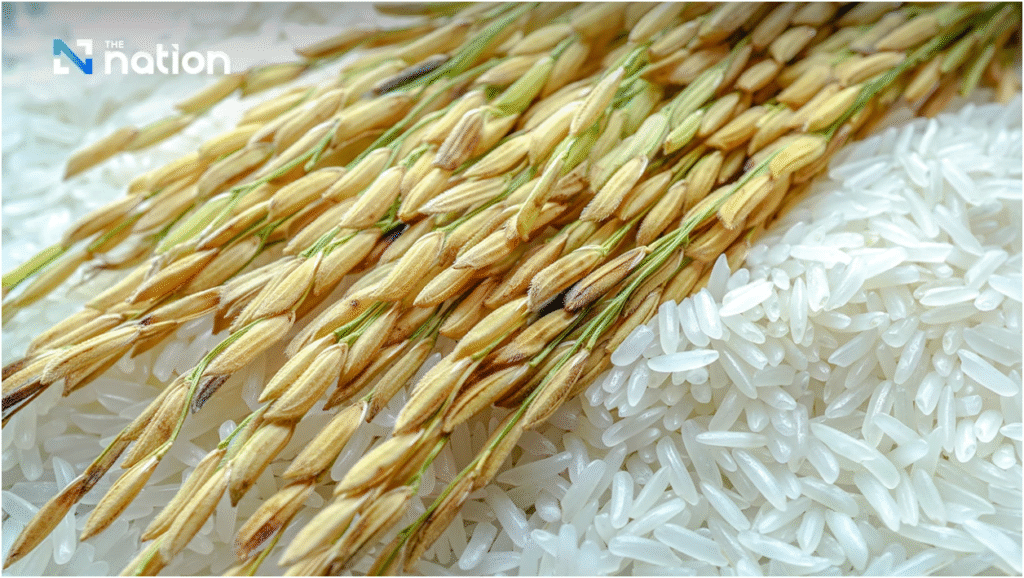
- The conflict in the Middle East is disrupting strategic shipping routes like the Strait of Hormuz and the Red Sea, causing freight rates to increase by over 40% and raising overall transport costs.
- Shipping disruptions and longer delivery times have prompted importers in the Middle East, Thailand’s third-largest rice market, to delay or postpone orders.
- Rice exports to the Middle East have already fallen by 52.58% in the first two months of the year, with shipments to Iraq, the region’s largest importer, being severely disrupted.
- If the situation persists, Thailand risks losing approximately 1 million tonnes of rice exports to the Middle East, which could cause it to miss its annual export target of 7 million tonnes.
Arada Fuangtong, director-general of the Department of Foreign Trade under the Ministry of Commerce, said the department had been closely monitoring the fighting involving the US, Israel and Iran because the area is a strategic route for global shipping, particularly around the Strait of Hormuz and the Red Sea.
Tensions in the Middle East have also pushed up transport costs, energy costs, oil prices, freight charges and insurance premiums.
Freight rates for March 15-30 have been raised by more than 40%, with shipping lines citing special surcharges and higher fuel costs.
The situation has also affected shipping routes and delivery times, prompting some importers to delay orders while they assess the situation.
The situation has affected Thai rice exports to key markets, especially the Middle East, which is Thailand’s third-largest market.
Thailand exports about 1.34 million tonnes of rice to the Middle East each year, worth THB20 billion.
Iraq alone accounts for 75% of imports in the region, followed by Yemen, Saudi Arabia, Iran and others.
Rice exports to Iraq have now been disrupted.
In the first two months of 2026 (January-February), exports totalled 92,000 tonnes, down 52.58% from the same period last year.
In the remaining countries, longer routes and shipping times have led some importers to delay orders while they assess the situation, and it remains unclear whether those orders will return.
Arada said, however, that if the situation in the Middle East drags on and shipping through the Strait of Hormuz remains problematic, it could affect Thailand’s 2026 rice export target of 7 million tonnes, with around 1 million tonnes potentially lost as exports to the Middle East stall.
“The department will continue pressing ahead by protecting key markets while expanding into new potential markets, and by promoting high-quality rice and value-added rice. We are preparing to step up efforts in Africa to partly replace the Middle East market,” Arada said.
Exports to the US in the first two months also fell 25.16% to just 116,000 tonnes because uncertainty over US tariffs led trading partners to delay decisions.
After the Supreme Court voided the 19% retaliatory tariff and the rate was subsequently lowered, orders were expected to resume. However, the renewed conflict in the Middle East has compounded the problem, so it remains to be seen whether orders from the US will return.
If the war drags on for several more months, Thai rice exports this year could miss the 7 million-tonne target.
The department will try to help exporters find alternative shipping routes, although it remains unclear whether that will be cost-effective.
As for G2G negotiations on Thai rice sales to China, China has gradually been sending ships to collect the first 40,000-tonne lot, which is scheduled to be fully delivered in March.
Then, in mid-April, further G2G talks are set to be held with COFCO on another 50,000-60,000 tonnes.
Arada said the main concern now was rising costs on every front.
Although domestic rice prices remain stable, Thai 5% white rice is currently priced at US$360 per tonne, slightly higher than rice from Vietnam, India and Pakistan.
In the first two months of 2026, Thailand exported about 1.153 million tonnes of rice, down 4.16%, worth more than US$651 million (about THB20.2 billion), down 15.45%.
Both volume and prices declined because global market stocks remained high, intensifying price competition.
Import restrictions by major buyers such as Indonesia and the Philippines have also weighed on exports.
As for the baht, although it has recently started to weaken, it is still considered relatively strong, affecting the price competitiveness of Thai rice exports.
Arada said that for Thai cassava products, Thailand had recently exported cassava products to Saudi Arabia.
Although shipments were affected to some extent by transport route problems caused by the fighting in the Middle East, the department had worked with exporters and importers to solve the problem by changing shipping routes, allowing delivery to Saudi Arabia to proceed.
Even though costs rose significantly, both exporters and importers agreed to share the additional burden.
Saudi Arabia has nevertheless confirmed that it will continue importing cassava products from Thailand.
In the first two months of 2026, Thailand exported 70,000 tonnes of cassava pellets worth THB419.50 million, up 133.33% in volume and 132.87% in value.
Overall cassava exports stood at 900,000 tonnes worth THB12,310.14 million, down 32.33% and 27.24% respectively.
Even so, demand from the animal feed industries in China and Saudi Arabia continues to provide support, and exports this year are still expected to meet the 6-7 million-tonne target.
https://www.nationthailand.com/blogs/business/economy/40064200Published Date: March 24, 2026


 READ
READ