Downloads
 Login
Login
 Register


Tags
India’s basmati exports to be hit by Strait of Hormuz restrictions? Top 5 leading destinations from Middle East
TOI Business Desk / TIMESOFINDIA.COM

exports. (AI…)
India’s rice exports may take a hit in wake of the deteriorating situation in the Middle East –
the country’s five leading export destinations are in the area! After US and Israel’s strikes on
Iran, the Middle East is embroiled in a war with one the most crucial trade transit channels
in the world – the Strait of Hormuz – being affected.
The Strait of Hormuz is a narrow maritime passageway which is not only important for the
transit of around 202-25% of the world’s crude oil trade, but also for trade in other crucial
commodities. While there is no official word on the closure of the Strait of Hormuz, tankers
and ships passing through it face danger from possible attacks by Iran.
India’s Rice Exports To Be Hit?
The Indian Rice Exporters Federation (IREF) has circulated an advisory to its members in
response to the worsening situation in Iran and parts of the Gulf region, along with reports
that shipping movements through the Strait of Hormuz may face restrictions.
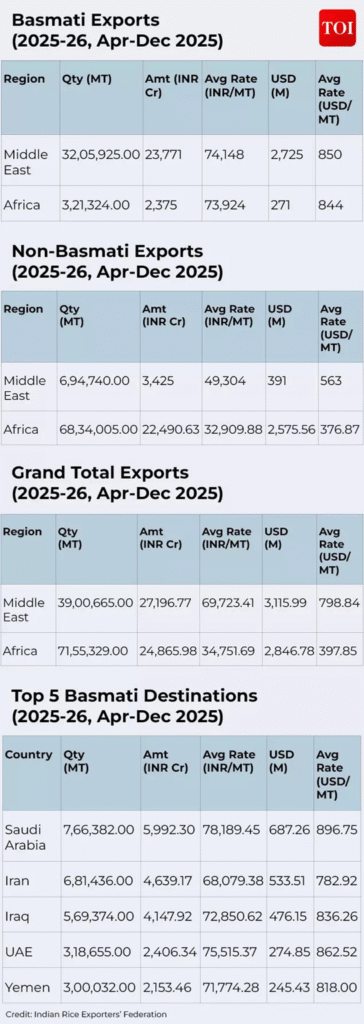
- Shipments to Africa and the Middle East together account for nearly half of India’s
total rice exports. - Between April and December 2025, exports to Middle Eastern countries were at
3.90 million metric tonnes, while shipments to Africa stood at 7.16 million metric
tonnes. - The main basmati markets are concentrated in the Middle East – including Saudi
Arabia, Iran, Iraq, the UAE and Yemen – and these destinations account for roughly
half of India’s overall basmati exports, making them particularly exposed to current
disruptions.
Exporters have been urged to avoid entering into new CIF (cost, insurance and freight)
contracts for these markets and, wherever possible, to structure transactions on FOB (free
on board) terms so that freight, insurance and associated risks remain the responsibility of
overseas buyers.
IREF has said that developments in Iran and the United Arab Emirates could quickly influence
bunker fuel costs and, if crude prices increase, may also affect the availability of both
container vessels and bulk carriers.
Under such conditions, freight rates for containers and bulk shipments could rise sharply at
short notice, creating the risk of financial losses for exporters who have committed to fixed
delivered-price contracts. Insurance costs may also climb significantly.
Exporters have therefore been advised to proceed cautiously when finalising new deals and
to avoid taking unhedged or open-ended positions.
IREF said it is closely tracking the situation and remains in contact with exporters whose
cargoes are either en route or awaiting clearance at destination ports.
With basmati wholesale prices having risen by 10–15 per cent over the past month and Iran
remaining a major market, IREF expects heightened price volatility in the near term.
Published Date: March 1, 2026


 READ
READ