Downloads
 Login
Login
 Register


Tags
‘It would only burden our children’: Aging farmers quit rice production
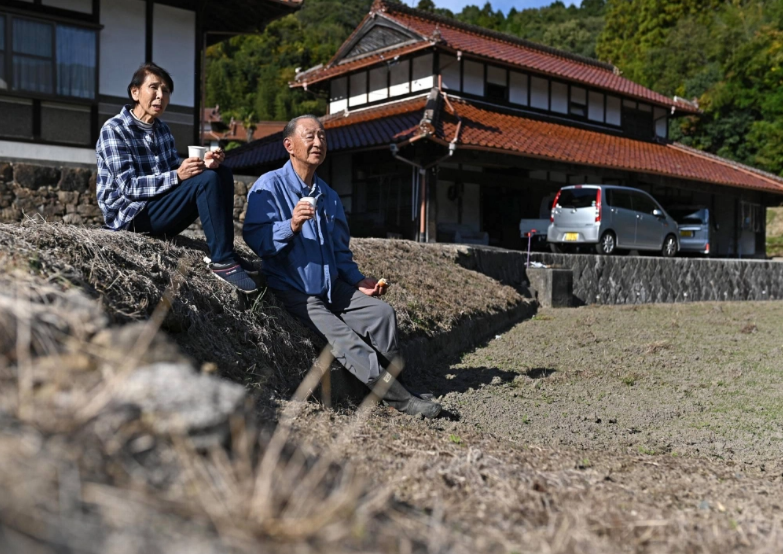
For Takeyuki Satokawa, 81, and his wife Masako, 77, the past autumn was the first season in which they bought rice grown by someone else.
The couple, living in Higashihiroshima, Hiroshima Prefecture, stopped growing rice in their small family paddies in 2024 due to old age and rising costs.
“Let’s eat,” they said together as they held their bowls of freshly cooked rice one day in early November.
After a bite, the husband paused and said, “It’s a bit hard.”
The wife studied the rice before saying, “Maybe it’s how we cooked it.”
The taste of newly harvested rice — once a seasonal pleasure they looked forward to every year — felt a little unsatisfying for them.
As the meal went on, Satokawa muttered, “My hands go numb, and I can’t eat properly. I worked too hard.” He underwent surgery about a year ago, but the symptoms remain. “I can’t lift a 30-kilogram bag of rice anymore, or handle the fertilizer sprayer the way I used to.”
Reaching his limit
After graduating from junior college, Satokawa worked as a local civil servant in the former town of Shiwa (now part of the city of Higashihiroshima) while continuing to farm about 40 paddies — roughly 2.4 hectares — that had been passed down through generations of his family. Even after retiring from civil service, he kept the fields going for more than 20 years before finally reaching his limit.
“I feel half relieved, half guilty,” he said.
His wife, who had watched him struggle for years, smiled gently. “It was painful to watch. I just wanted him to rest,” she said.
They have already sold their combine harvester and rice-planting machine. Inside the now-empty shed stand two cold-storage containers for rice. Opening their doors, Satokawa gave a wry smile.
“The one on the right is the new rice we bought for the first time — ¥12,000 for 30 kg. The one on the left is the rice we grew ourselves for the last time — ¥5,000 for 30 kg,” he said.
In 2023, before rice prices surged in what became known as the “Reiwa rice crisis,” the couple ran a deficit of about ¥600,000 due to rising machinery-maintenance and fertilizer costs. “If we replaced the machines, the deficit would have been ¥1 million. It would only burden our children,” Satokawa said. Worsening profitability pushed him toward the decision to quit.
The couple have three daughters, all with families of their own. Over the past five or six years, they have sold some of their paddies to solar power developers and others, reducing their holdings to about 30 fields.
Satokawa said he will sell more if buyers emerge but hopes to leave at least a minimum amount of farmland to their third daughter, Noriko Takahashi, 49, who is the only one of the daughters living nearby in Higashihiroshima. Yet, Takahashi has some reservations about taking over farmland.
“I don’t want the land to go to waste, but between work and raising children … I wonder if I can really manage mowing weeds in the midsummer heat,” she said.
Most of the family paddies lie along the mountains, but there is a vast, open view in front of their house. Masako Satokawa looked out while sitting on a ridge alongside one of the couple’s rice paddies.
“I love this view we shared while working together,” she said. “It brings back happy memories.”
“I wonder what will happen to this land in the future,” her husband said, gazing on the landscape dotted with rice fields and red-tiled rooftops. “That’s my only concern.”
Across the Chugoku region, mountainous rural communities continue to shrink. As populations decline and residents age, livelihoods and traditions handed down for generations are changing with the times.
Cooperative dissolution
One agricultural cooperative corporation in Onan, Shimane Prefecture, has decided to liquidate itself.
“If everything goes well, I think this cooperative will be completely finished,” Chikao Moriwaki, 80, said one night in late November as he wrapped up an hourlong discussion. Nine men and women in their 50s to 80s seated around a long table nodded quietly.

Chikao Moriwaki (second from right) talks about the liquidation procedures for the agricultural cooperative corporation he manages in Onan, Shimane Prefecture. | Chugoku Shimbun
The liquidation procedures for the corporation, called Manoharashimo, were set to be completed by the end of December.
The idea of dissolving the cooperative, founded in 2008, emerged after members finished planting rice in 2024.
“There are no young people coming in, and there’s no future,” one member said. Others agreed, with comments such as “It can’t be helped. Let’s bring things to an end” and “Let’s do it before we all get too frail.” The cooperative was dissolved at the end of that year.
Moriwaki, who took on the role of liquidator, spent the following year returning leased farmland to individual owners and selling or transferring the corporation’s machinery and buildings.
Moriwaki had worked as an auctioneer at a wholesale fruit and vegetable market in Hiroshima. He returned to his hometown at age 68 when his father, a carpenter and farmer, died.
At its peak, the cooperative grew rice, chili peppers and eggplants, with annual sales exceeding ¥10 million.
“Everyone had energy back then,” Moriwaki recalled.
Over time, however, a labor shortage as farmers grew older, along with rising costs, squeezed management. In 2021, when Moriwaki became secretary-general of the corporation, machinery such as combine harvesters had to be replaced. The corporation cut the wages of workers, but by 2023, it could no longer afford to pay rent to landowners.
Returning farmland
After deciding on the dissolution, the most grueling task was returning about 7.5 hectares of farmland owned by roughly 20 households. Owners generally gave cold responses, with one saying, “Even if you give it back, there’s nothing we can do with it.”
Moriwaki sent letters to five households in Osaka or Hiroshima, explaining the cooperative’s structure and the reasons for dissolution to those who had inherited the land, but they seemed unable to grasp the situation.
About 5 hectares that were too difficult for individuals to manage were entrusted, for at least one year, to a local company growing rice for livestock feed. The conditions attached to the deal included weed-cutting and water control by members of the cooperative. In the end, nine men and women — mostly in their 70s — divided the work among themselves.
However, no one knows what will happen in the following year. In fact, over the past year, there were fields for which they simply lacked enough hands to keep up with mowing.
Moriwaki said he keenly feels the importance of training successors alongside day-to-day operations. But at the same time, he wonders whether cooperative members could have even imagined doing so 10 years ago, when they were too busy just keeping things afloat.
“I feel that it’s thanks to everyone working together that we made it this far,” Moriwaki said while organizing the documents reporting the completion of liquidation procedures. “We did a good job.”
https://www.japantimes.co.jp/news/2026/02/02/japan/japan-aging-rural-rice-farming/Published Date: February 2, 2026


 READ
READ