Downloads
 Login
Login
 Register


Tags
Việt Nam rice exports face shipping delays as Middle East tensions raise costs
Rising freight costs and shipping delays linked to escalating tensions in the Middle East are disrupting Việt Nam’s rice exports, forcing traders to delay deliveries and adopt a more cautious approach to new contracts, officials said on Tuesday.
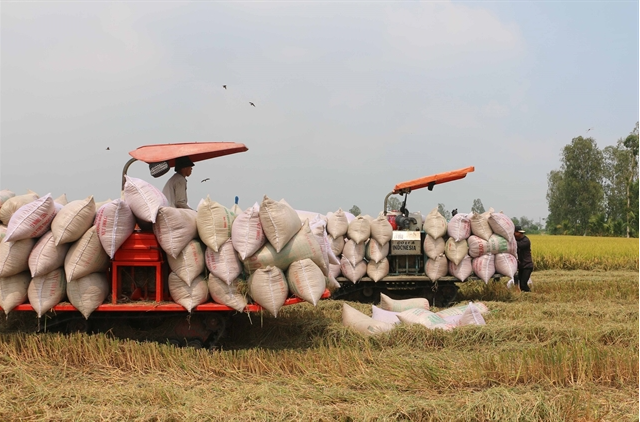
CẦN THƠ — Rising freight costs and shipping delays linked to escalating tensions in the Middle East are disrupting Việt Nam’s rice exports, forcing traders to delay deliveries and adopt a more cautious approach to new contracts, officials said on Tuesday.
The logistical challenges are emerging even as Việt Nam, one of the world’s largest rice exporters, expects strong supply in 2026, with exports projected to reach about 7.73 million tonnes this year.
Việt Nam exported about 1.74 million tonnes of rice worth US$826.2 million by March 15, according to customs data presented at a Government conference on rice exports held in the Mekong Delta city of Cần Thơ.
While export volumes rose 2.3 per cent year-on-year, export revenue fell 8.7 per cent as global prices declined. The average export price dropped 10.7 per cent to $477.6 per tonne, reflecting increased supply from major exporters such as India and Thailand.
At the same time, exporters are facing growing logistical disruptions as shipping routes and costs are affected by the conflict in the Middle East.
“Rice exports in 2026 are likely to be affected by the conflict in the Middle East,” said Nguyễn Anh Sơn, director general of the Import-Export Department under the Ministry of Industry and Trade.
Shipping insurance premiums have increased and delivery times have lengthened by 10-15 days, while domestic transport costs for rice shipments have risen by about VNĐ20,000-30,000 ($0.8-$1.2) per tonne, he said.
Exporters are also dealing with shortages of empty containers and frequent adjustments to shipping schedules as some carriers cut or reroute services to the Middle East, making it harder to secure cargo space and meet delivery deadlines.
Several traders have had to renegotiate contracts or delay shipments, while some companies are postponing new orders amid continued uncertainty in global markets.
The Philippines remained Việt Nam’s largest rice market, accounting for nearly 56 per cent of shipments in the first months of 2026 with about 711,000 tonnes, up roughly 30 per cent from a year earlier after the country resumed imports.
China ranked second, importing around 178,000 tonnes, more than doubling from the same period last year as demand rose ahead of the Tết (Lunar New Year) holiday.
Other markets such as Malaysia and Australia recorded strong growth, while exports to several African countries declined after a surge in demand last year.
Strong supply expected in 2026
Despite the short-term disruptions, Việt Nam is expected to maintain strong export capacity this year.
According to the Ministry of Agriculture and Environment, Việt Nam’s paddy output in 2026 is projected to reach about 45.6 million tonnes, slightly higher than last year due to improved yields averaging 6.14 tonnes per hectare, even though the total planting area has declined.
The Mekong Delta, the country’s main rice-growing region, will continue to supply the bulk of export volumes, with around 24.3 million tonnes of paddy expected from the region.
Of the estimated 15.46 million tonnes of marketable paddy, about 7.73 million tonnes of rice could be available for export in 2026.
High-quality and fragrant rice is expected to account for about 75 per cent of shipments, while glutinous rice will make up roughly 10 per cent.
Rice exports are forecast to reach about four million tonnes in the first half of the year, with shipments peaking during major harvest periods between July and September, the ministry said.
Việt Nam exported 8.06 million tonnes of rice worth $4.1 billion in 2025, according to customs data.
Shift toward higher-value rice
The conference, organised by the Ministry of Industry and Trade, discussed measures to stabilise exports and help businesses navigate market volatility.
Authorities are encouraging exporters to diversify markets, make greater use of free trade agreements and strengthen branding for Vietnamese rice.
The government is also promoting a programme to develop one million hectares of high-quality, low-emission rice in the Mekong Delta, aimed at improving sustainability, traceability and the global competitiveness of Vietnamese rice.
Industry officials say the shift toward higher-quality production will be key to reducing exposure to price volatility and maintaining Việt Nam’s position in global rice markets. — VNS
https://vietnamnews.vn/economy/1778023/viet-nam-rice-exports-face-shipping-delays-as-middle-east-tensions-raise-costs.htmlPublished Date: March 25, 2026



 READ
READ