Downloads
 Login
Login
 Register


Tags
Rising paddy MSP keeps domestic rice prices firm
- Supply-demand mismatch drag down ex-mill trade prices
- Approaching elections encouraging increase in MSP?
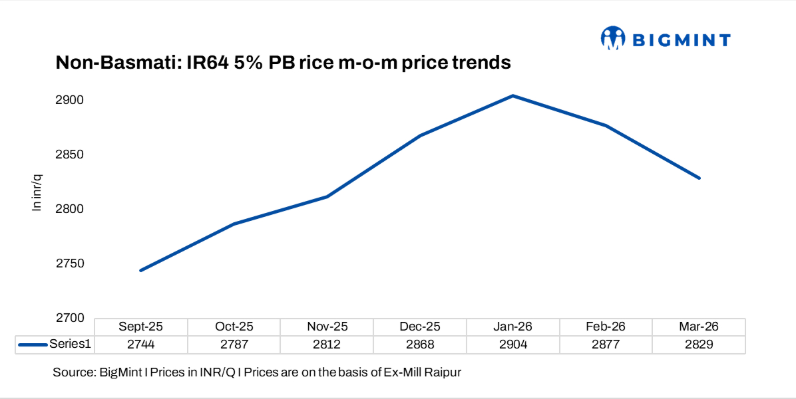
The minimum support price (MSP) for paddy has been steadily rising, and, in turn, pushing up Indian domestic non-basmati rice prices. Data maintained with BigMint reveals that prices of the IR-64 5% par-boiled (PB), ex-Raipur (Chhattisgarh) have crept up by over 5% in these last six months. For instance, prices of this dominant grade ruled at an average of INR 2,744/quintal (Q) in September 2025, climbed up 6% to INR 2,904/Q in January 2026, but fell back marginally to INR 2,898/Q in the current month of February, which is still almost 6% higher compared to September 2025 levels.
MSP rising trend
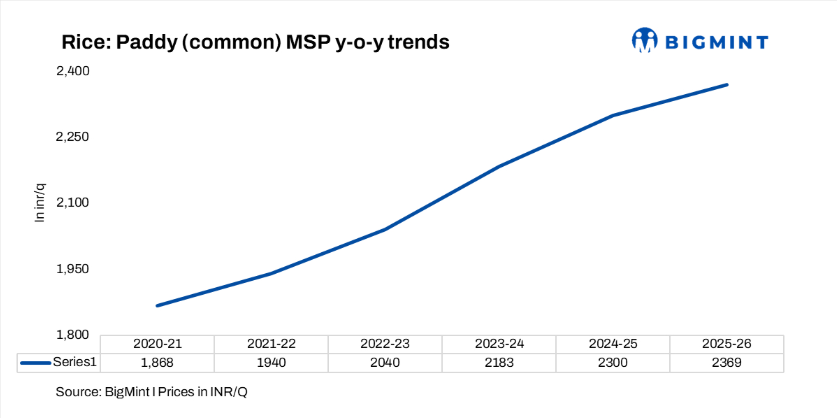
The MSP has risen from INR 1,868/quintal in 2020-21 to INR 2,369/quintal in 2025-26, a 27% increase over the past six years.
Why is the MSP rising?
Govt eye on elections in 2026? The MSP for paddy is set by the Government of India each year before each sowing season to ensure farmers receive a remunerative minimum price. It has been rising steadily across seasons, directly lifting the price floor for rice. Often, vote-bank politics are at play and with the state Assembly elections slated to be held across the five states of Assam, West Bengal, Tamil Nadu, Kerala and Puducherry, remunerative support to farmers can become an election winning tool.
Trade prices drop amid weak demand, supply glut: Ex-mill trade prices are under sustained pressure. These had risen in September but are now at an all-time low, possibly because of two factors. 1) Ex-mill prices from Raipur, Vizag, and Kakinada continue to decline due to weak demand from buyer markets. 2) Importers currently hold sufficient inventories for the next 30-45 days, as major global suppliers have already delivered substantial volumes. This decline is further encouraging an increase in the MSP.
Vizag remains the least active port at present. Kakinada is witnessing limited movement, with barely one vessel every 3-4 days. Prices are softening in both Vizag and Kakinada by around $2-3/day, and most transactions are happening at offer levels rather than firm bids.
Volatile freights keep margins under pressure: A strong export demand has been triggered ever since the removal of the export ban in September 2025. Exports are ongoing from Mundra, Kandla, and JNPT, but freights remain volatile, adding further uncertainty to trade viability, encouraging the MSP cushion. Chhattisgarh-origin material is not significantly participating in export flows at very low level, and some exporters are evaluating west coast shipments despite viability challenges and the absence of pre-booked vessels.
Data maintained with BigMint reveals, freights on most rice exporting sectors have been up over the last two months or even from the beginning of 2026. Freights to Kenya and Madagascar were up by $9/t to $49/t in the second week of February compared to the first week of January. On the Somalia route, freights rose $5-6/t to $44/t in this period and on the UAE sector by $2-6/t to $9-14/t. But on the Guinea and Ivory Coast routes these halved to around $32/t.
Outlook
Despite underlying demand in certain markets, restricted paddy circulation in Chhattisgarh is limiting supply response. Mill realisations are at multi-month lows, leaving minimal margins in the present scenario. A meaningful recovery is expected only after a month or once buyer inventories begin to normalise.
https://www.bigmint.co/insights/detail/rising-paddy-msp-keeps-domestic-rice-prices-firm-729673Published Date: March 10, 2026


 READ
READ