Downloads
 Login
Login
 Register


Tags
Rice prices climb 24% as government purchase rules could boost demand
By Kim Min-jeong
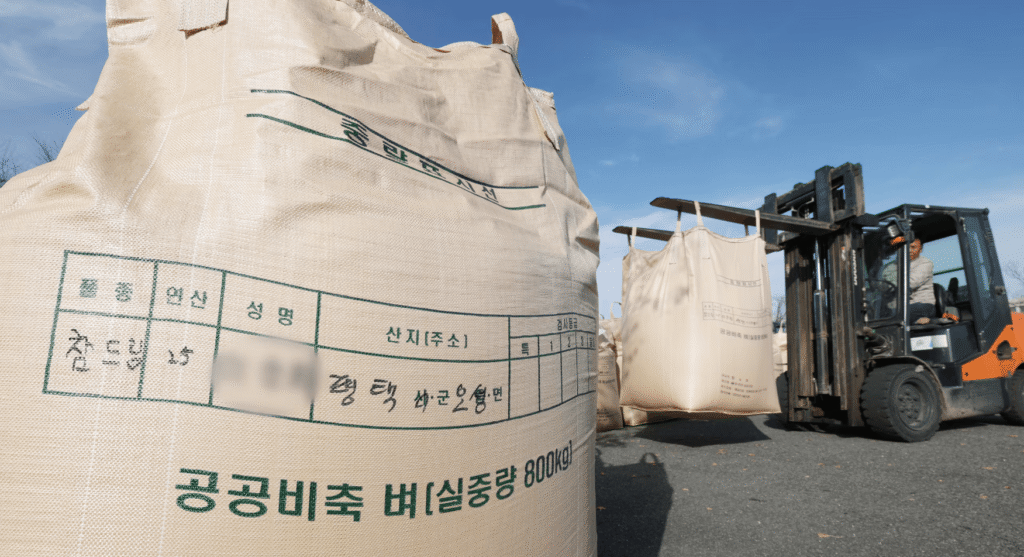
Last month’s farm-gate rice price rose 24% from a year earlier. Normally, prices fall starting in October, when new-crop rice is harvested, but this year the opposite is happening. Some analysts say expectations formed in the market that “government purchases could expand” after the government decided to isolate 100,000 tons of the surplus expected this year. The industry sees rice prices rising further if the Grain Management Act, which requires the government to purchase surplus rice, takes effect next year.
According to the National Data Office on the 1st, as of the 25th of last month, the farm-gate rice price (wholesale) was 57,046 won for 20 kilograms. That is a 24% increase from a year earlier (46,021 won).
Typically, rice prices rise steadily from the start of the year and then fall when rice floods the market during the October harvest. This year, however, an unusual phenomenon is occurring in which prices are rising during the harvest season.
An official at the Ministry of Agriculture, Food and Rural Affairs said, “Large-scale farms are using storage facilities to delay shipments.” Earlier, the government decided to purchase 100,000 tons, most of the annual surplus production (130,000 tons). As competition for purchases by private rice processing complexes (RPCs) has intensified, some say the decline in prices has also narrowed.
The industry expects the rise in rice prices could accelerate if the revised Grain Management Act takes effect in Aug. next year. The revision requires the government to implement mandatory market isolation if production and prices meet certain criteria. Until now, the government determined whether and how much to purchase at its own discretion, but starting next year, if certain criteria are met, the structure becomes one in which the government makes “automatic purchases.” As a result, the government’s rice purchase volume is more likely to expand than before.
Rising rice prices can push up consumer prices. It also does not help the government’s push to reduce the cultivation area. Kim Han-ho, a professor of agricultural and resource economics at Seoul National University, said, “If rice prices remain high, reducing the cultivation area will be delayed and shifting to other crops will not be easy,” and added, “Unless the budget for transition direct payments is expanded more aggressively, structural imbalances will recur.”
https://biz.chosun.com/en/en-policy/2025/12/01/NKYUEVMZAFAXPFLHY6Q5NGXDC4/Published Date: December 1, 2025



 READ
READ