Downloads
 Login
Login
 Register


Tags
Rice price nearly doubles from farm to shop
Finds CPD study
Staff Correspondent
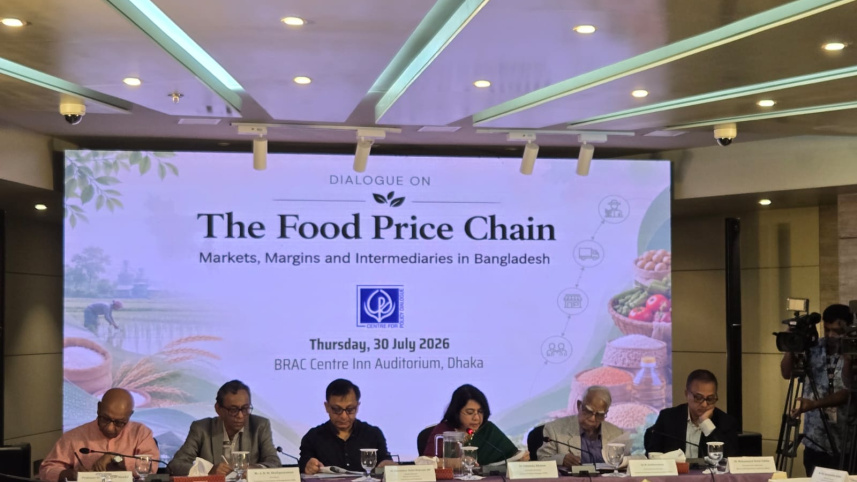
The price of rice nearly doubles by the time it moves from the farmer or farm level to the retail or consumer level, according to a study by the Centre for Policy Dialogue.
At the farmer level, per kilogramme of Paijam rice (medium grain) sells for an average of Tk 30.65. After passing through traders, millers and wholesalers, that rice is sold at the retail level for Tk 59.69.
The study also examined other commodity price trends, finding similarly steep markups between farm and retail levels.
The price of lentils rises by 78 percent, onions by 87 percent, potatoes by 50 percent, green chillies by 116 percent, aubergines by 72 percent, eggs by 25 percent, beef by 13 percent, fish by 10 percent, and broiler chicken by 22 percent.
The findings of the study were presented yesterday at an event titled “The Food Price Chain: Markets, Margins and Intermediaries in Bangladesh” by Foqoruddin Al Kabir, senior research associate at CPD.
Food inflation is influenced by several supply-side factors, including market concentration, the role of warehouse owners, the influence of commission agents and intermediaries, supply disruptions caused by natural disasters and weather conditions, and weaknesses in storage and communication infrastructure, Kabir said.
The CPD recommended cutting unnecessary supply chain layers, increasing market choices for farmers and retailers, and ensuring greater transparency in prices and market information.
Fahmida Khatun, executive director of the CPD, stressed the need for stronger monitoring and evidence-based reforms.
Commerce Minister Khandakar Abdul Muktadir said inflation is not declining in Bangladesh.
To bring down food inflation, special emphasis must be placed on three issues: reducing logistics costs, controlling the cost of production inputs and increasing agricultural productivity, he added.
MA Sattar Mandal, former vice-chancellor of Bangladesh Agricultural University, said increasing agricultural productivity depends on higher levels of investment.
Using rice as an example, he said that there remains a substantial gap between the yield potential of improved varieties and the average yields achieved by farmers.
“Bridging this gap will require farmers to invest more, but the current level of profitability is unlikely to generate such investment, particularly when most farms consist of only one or two bighas divided into several small plots, with much of the land cultivated under lease or sharecropping arrangements.”
Sattar, however, questioned whether the CPD findings truly reflect reality. He pointed out that the study was not based on data collected over a full year. Instead, it relied on data from only five months.
“Had the research been conducted using data from an entire year, it would have provided a more complete and accurate picture of the overall situation.”
In response, the organisers said they have taken the issue into account and added that they would look into it.
M Asaduzzaman, former research director, Bangladesh Institute of Development Studies, said while rising food prices increase pressure on households, the burden falls disproportionately on lower-income groups, who spend a larger share of their income on food.
The key issue lies in the agricultural marketing system, particularly the process of moving products from farmers to consumers.
This system faces several structural and technological challenges, including transportation problems, cold chain requirements, market inefficiencies, extortion and syndicate-related issues, he added.
Taslima Akter Lima, president at the Bangladesh Garments Sramik Sanghati, said the challenges faced by consumers and producers cannot be blamed solely on middlemen. The government’s management of the food system is a critical factor in addressing the difficulties experienced by farmers, workers and consumers.
She called for a transparent pricing system where price determination at every stage of the supply chain is visible to both producers and consumers.
AHM Shafiquzzaman, president of the Consumers Association of Bangladesh, said the government support aimed at reducing production costs often does not reach genuine farmers.
Referring to agricultural loans, he stressed the need for research to determine how much of the allocated credit actually reaches real producers.
Without proper monitoring of loan distribution, efforts to reduce production costs and improve farmer support will remain ineffective. Intermediaries often take advantage of government support systems, he added.
https://www.thedailystar.net/news/bangladesh/news/rice-price-nearly-doubles-farm-shop-4236871Published Date: July 31, 2026



 READ
READ