Downloads
 Login
Login
 Register

Tags
Rice grown in dry fields harvested in 1st year of test cultivation in Japan’s Niigata
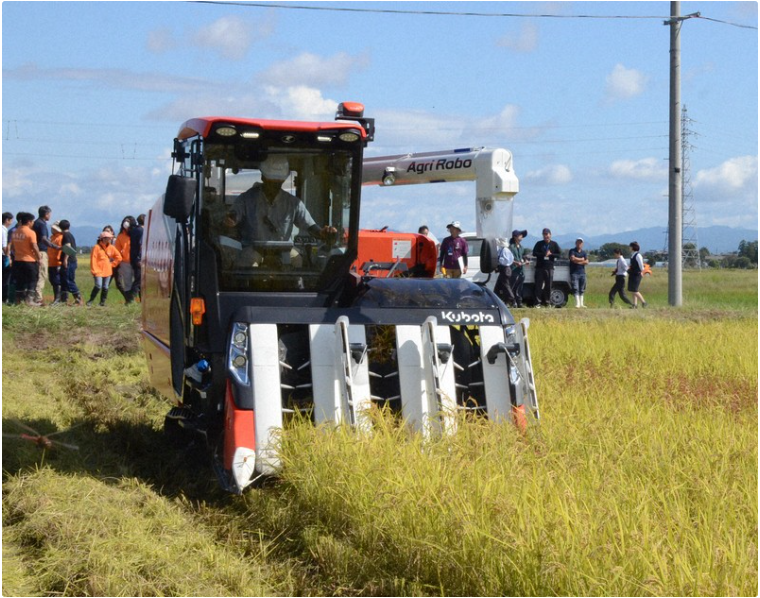
NIIGATA — Rice grown in dry fields in the first year of trial cultivation has been harvested here recently to the joy of the people involved in the project.
The “water-saving dry direct seeding” method, which involves sowing rice seeds directly into dry fields without flooding them, has shown promising results in the central Japan city of Niigata. This method, compared to conventional paddy rice cultivation, allows for labor savings and efficiency improvements, enabling scale expansion and increased production to meet demand. On Oct. 2, the Niigata-based agricultural corporation Vege Abio, part of the NSG Group, showcased the harvest of rice grown using this technique.
Vege Abio initiated the trial after forming a project team with organizations including Niigatashi Agricultural Cooperatives and Niigata-Kubota Corp. In the first year, they planted rice seeds across approximately 0.57 hectares.
On Oct. 2, the heat-resistant rice variety “Niji no Kirameki” was harvested with a combine harvester in fields located in Niigata’s Kita Ward.
According to Vege Abio and others, compared to conventional paddy rice cultivation, the direct seeding method eliminates steps like seedling preparation and transplanting. Water is only applied minimally when necessary, significantly reducing the time required for water management. As a result, the overall workload is estimated to be reduced by about 60%.
Additionally, since the fields are not flooded, the emission of methane, a greenhouse gas from rice paddies, is also minimized, offering environmental benefits.
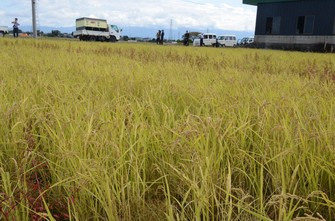
Kazuhiko Kato, 42, a director at Vege Abio who observed the harvest, expressed his eagerness to expand the project, saying, “We are pleased to have achieved a harvestable state in the first year. We’d like to gradually increase the cultivation area.” He further expressed expectations, adding, “As idle land increases, if this cultivation method can be socially implemented, it would allow each farmer to manage twice the area, addressing labor shortages and reducing costs.”
The Japanese government is supporting the spread of dry-field direct seeding with subsidies, and the Niigata Prefectural Government also plans to collect data on yields to promote cultivation expansion. However, challenges remain, such as yield instability and the effort required for weed control.
Masuro Sakata, a manager at BASF Japan, a chemical manufacturer that collaborated on the Vege Abio project, noted, “In the absence of water, various weeds tend to grow more easily. We intend to continue supporting the project in the coming years by means such as teaching optimal timing for herbicide application.”
(Japanese original by Shuichi Kanzaki, Niigata Bureau)
https://mainichi.jp/english/articles/20251008/p2a/00m/0sc/010000cPublished Date: October 9, 2025


 READ
READ