Downloads
 Login
Login
 Register


Tags
Poll: Philippine inflation steady at 6.4% in July
By Katherine K. Chan, Reporter
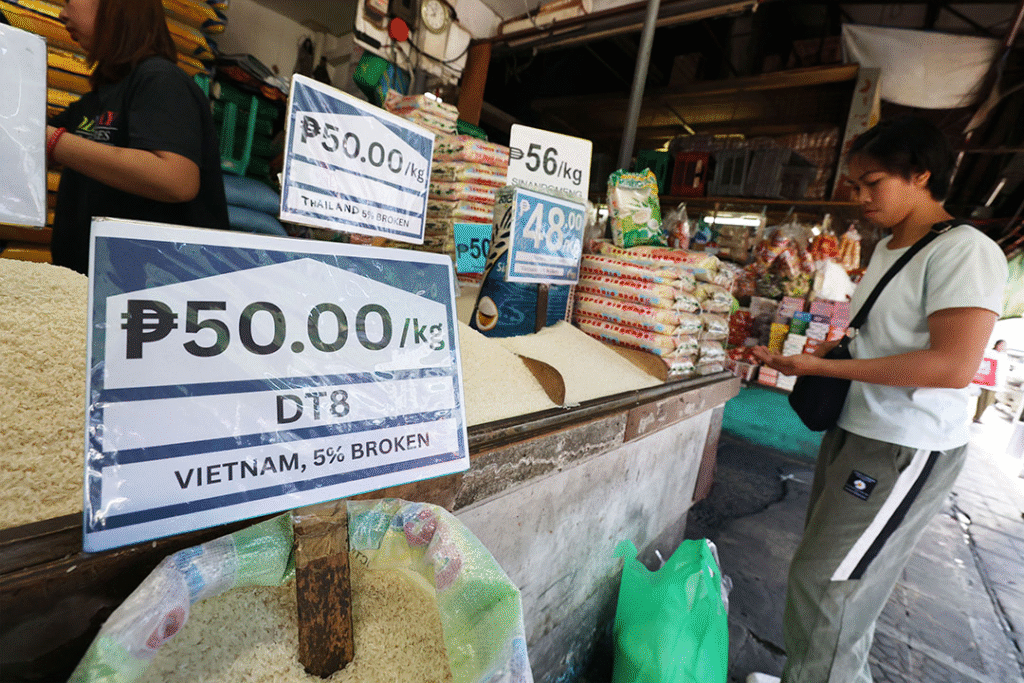
PHILIPPINE headline inflation likely held steady in July as lower food prices, particularly rice, offset higher fuel and electricity costs, analysts said.
A BusinessWorld poll of 21 analysts and economists yielded a median forecast of 6.4% for July inflation, the same as in June but sharply higher than the 0.9% recorded a year earlier.
This would make July the fifth month in a row that the headline inflation breached the central bank’s 4% ceiling.

The median estimate likewise falls within the Bangko Sentral ng Pilipinas’ (BSP) 5.6%-6.6% forecast for the month.
The Philippine Statistics Authority (PSA) will release the July inflation data on Wednesday (Aug. 5).
Philippine National Bank Chief Economist Alvin Joseph A. Arogo said headline inflation likely remained unchanged in July amid offsetting price pressures.
“The higher cost of petroleum and electricity could have been offset by lower prices of major food commodities such as rice and vegetables,” he said in an e-mail.
Deepali Bhargava, regional head of research for Asia-Pacific at ING Bank, noted that lower rice prices likely kept the headline inflation steady, but pressures remained from higher retail pump prices and sticky services inflation.
“Services inflation is expected to remain sticky, reflecting persistent underlying price pressures in the sector,” she said in a report.
However, most analysts surveyed were split on the inflation reading for July, with 10 anticipating a softer headline figure and nine expecting a faster one.
For Oxford Economics Assistant Economist Jun Hao Ng, headline inflation may have picked up to 6.6%, largely driven by costlier fuel, especially diesel.
“The main driver was likely a renewed increase in fuel prices, following higher global oil prices amid renewed tensions between the US and Iran,” he told BusinessWorld in an e-mail. “Domestic pump prices, particularly for diesel, rose sharply during the month, with diesel prices now at its highest level since April after the recent large broad-based fuel price hike.”
Meanwhile, University of Asia and the Pacific Economist Marco Antonio C. Agonia sees July inflation heating up to 6.9% due to the continued transmission of second-order price effects and base effects from the significantly slower headline print in July 2025.
“We think inflation moved faster in July, mostly reflecting second-round inflationary effects, the immediate rebound in oil prices with the resurgence of tensions in the Middle East, and some base effects from last year’s below-target inflation,” he told BusinessWorld in an e-mail.
In July, local fuel retailers raised pump prices by as much as P11.70 per liter for gasoline, P26.19 per liter for diesel, and P23.89 per liter for kerosene during the month, nearly reversing the price rollback delivered in the prior weeks.
Manila Electric Co. likewise hiked electricity rates by 34.28 centavos per kilowatt-hour (kWh) to P14.8261 per kWh in July from P14.4833 per kWh in June. Its second straight month of increase translated to an additional P69 in the total electricity bill of households consuming 200 kWh monthly.
On the other hand, Marites M. Tiongco, a professor at the De La Salle University Carlos L. Tiu School of Economics, said softer rice prices may have eased inflation slightly last month.
“Food inflation showed mixed movements,” she told BusinessWorld via Viber. “Rice prices continued to stabilize, helping moderate overall food inflation. However, vegetables, processed food, and other commodities remained vulnerable to weather-related disruptions and higher transport costs.”
In the second half of July, the price of regular milled rice dipped by 0.74% to P49.30 a kilo from P49.67 in the same month-ago period, while well-milled rice fell by 0.82% at P55.69 a kilo from P56.15 in the previous month, PSA data showed.
“Rice prices continued to decline month on month for a third consecutive month even amid El Niño concerns,” China Banking Corp. Chief Economist Domini S. Velasquez also said in an e-mail. “Prices of other food items, including meat, fish, fruits, vegetables, eggs, sugar, and spices, also softened during the period.”
STICKY CORE INFLATION
Core inflation likely continued to quicken for the seventh consecutive month in July despite a potentially slower headline print, which analysts said would warrant at least one more rate hike from the BSP.
For Oxford Economics’ Mr. Ng, high energy prices likely continued to feed into other commodities.
“We also expect core inflation to quicken for a seventh straight month,” he said. “Elevated energy costs have likely continued to generate second-round effects, feeding into a broader range of consumer prices. The recent minimum wage increase may have added some pressure to underlying inflation.”
On July 25, the first tranche or P60 of the P85 minimum wage hike in Metro Manila took effect, bringing the daily rate to P755 for nonagricultural workers and to P718 for agricultural workers and employees of retail, service, and small manufacturing establishments.
However, it was later suspended after a Pasig City Regional Trial Court issued a 20-day temporary restraining order on its implementation.
The second tranche or P25 of the wage hike was supposed to take effect on Jan. 20 next year.
Ms. Tiongco also attributed the potentially faster core inflation to stickier prices in the services sector and the peso’s weakness.
“Restaurants, accommodation, education, healthcare, and personal services continue to face higher labor, utility, rental, and transportation costs, making price adjustments more likely,” she said.
“The depreciation of the peso further increases replacement costs for imported intermediate goods, encouraging firms to revise prices as inventories are replenished,” she added.
Strong US dollar and inflation concerns amid soaring oil prices dragged the peso to a new low against the greenback this month.
It sank to a historic low of P61.847 per dollar on July 24, weakening by 9.7 centavos to break its previous record-low finish of P61.75 on July 23.
Core inflation, which excludes volatile food and fuel prices, accelerated to 4.4% in June, the fastest pace seen in nearly three years or since the 4.7% in November 2023.
FURTHER TIGHTENING
Analysts see underlying pressures prompting the central bank to deliver at least one more rate hike this year, with a third straight increase at its upcoming Aug. 27 meeting.
For Maybank Investment Bank Economist Azril Rosli, the door for another 25-basis-point (bp) hike remains open for the BSP even as he expects a softer headline clip last month.
“(U)pside risks from the recent minimum wage hike, peso depreciation, higher US tariffs and geopolitical uncertainties continue to cloud the inflation outlook. As such, we expect the BSP to deliver at least a 25-bp rate hike at its upcoming meeting in August to contain mounting inflationary pressures and prevent second-round effects from becoming more entrenched,” he said in an e-mail.
Union Bank of the Philippines Chief Economist Ruben Carlo O. Asuncion also noted that their base case points to another round of tightening this month, adding that the BSP must remain vigilant amid underlying price pressures.
“Another hike in the August Monetary Board meeting remains the base case, especially if no durable US-Iran ceasefire emerges and oil prices continue to trade within elevated ranges,” he said in an e-mail.
However, Moody’s Analytics Economist Sarah Tan and Pantheon Macroeconomics Chief Emerging Asia Economist Miguel Chanco are pricing in a pause this month, citing cooler inflation and still weak growth.
“The moderation in headline inflation should allow the BSP to remain on hold at its next policy meeting, although we would not rule out a rate hike later in the year should inflation reaccelerate or underlying price pressures prove more persistent than expected,” Ms. Tan said in an e-mail.
BSP Governor Eli M. Remolona, Jr. said last week that there is a slim chance for a 50-bp hike, citing emerging inflationary pressures from the renewed conflict in the Middle East and weak peso.
He added that he still expects the economy to rebound in the second half of the year, giving them room to tighten further.
In June, the central bank raised its key policy rate for a second straight meeting by 25 bps to 4.75%, bringing its total hikes to 50 bps.
The BSP wants inflation to stay near its 3% target, but its latest projection shows the headline print may average 6.4% this year.
https://bworldonline.com/top-stories/2026/08/03/767550/poll-philippine-inflation-steady-at-6-4-in-july/Published Date: August 3, 2026


 READ
READ