Downloads
 Login
Login
 Register


Tags
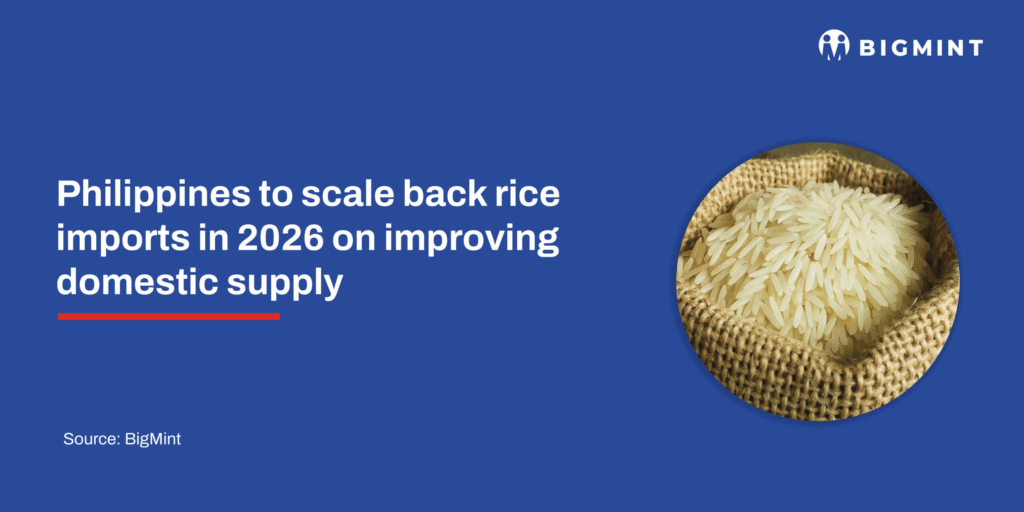
Philippines to scale back rice imports in 2026 on improving domestic supply
- Import volumes seen easing after 2024 surge
- Policy focus shifts to price stability, farmer protection
The Philippines is expected to reduce rice imports in 2026 to below 4 million tonnes (mnt) as domestic palay (unmilled rice) production rebounds from weather-related setbacks, signalling a more calibrated approach to supply management after last year’s record import volumes.
The Department of Agriculture estimates imports next year at 3.6-3.8 mnt, a level officials say will adequately cover consumption requirements while avoiding excessive pressure on farmgate prices. The revised outlook reflects lessons from 2024, when aggressive front-loaded imports weighed heavily on domestic prices and farmer incomes.
Production recovery supports tighter import management
Palay output in 2026 is projected at around 20.3 mnt, close to the government’s original target for 2025 that was disrupted by flooding and other climatic disturbances. The Philippines harvested a record 20.06 mnt in 2023, providing a benchmark for the government’s medium-term production goals.
Authorities say import volumes will be aligned more closely with domestic harvest cycles to prevent imported rice from depressing prices during peak marketing periods.
Import resumption to be tightly controlled
Ahead of the lifting of the four-month import freeze at year-end, the Bureau of Plant Industry will process applications for Sanitary and Phytosanitary Import Clearances covering about 500,000 tonnes, including 50,000 t earmarked for government agencies. Shipments under these clearances must arrive by mid-February to avoid coinciding with the summer harvest.
Imports during the January-February window will be channelled through 17 designated ports nationwide, tightening monitoring of arrivals and limiting market congestion.
To ease cash-flow constraints, the agriculture department will waive the usual 10% down payment requirement for SPIC issuance.
Tariff hike reflects currency and global price risks
When imports resume, tariffs will rise to 20% from 15%, aligning with the government’s broader macroeconomic strategy. Officials cited peso depreciation and the likelihood of firmer global rice prices once the Philippines re-enters the market as key considerations behind the increase.
The move marks a shift away from the more accommodative trade stance seen earlier, as policymakers seek to balance consumer affordability with producer sustainability.
Source diversification encouraged
Importers have been urged to diversify sourcing beyond Vietnam, encouraging greater participation from Cambodia, Myanmar, and other non-traditional origins to reduce supply concentration risks.
While rice trade remains liberalised under the Rice Tariffication Law, officials have signalled stricter volume management going forward.
Imports retreat after 2024 peak
Rice imports reached a record 4.8 mnt in 2024, up 33% y-o-y, as traders accelerated purchases amid concerns over El Nio and La Nia impacts on domestic output. Heavy arrivals in late 2024 and early 2025 contributed to a sharp decline in palay prices.
For 2025, the Bureau of Plant Industry estimates imports at around 3.5 mnt, significantly lower than last year, largely due to the four-month import suspension imposed from September.
While external forecasts place Philippine rice imports at higher levels for the 202526 marketing year, the agriculture department’s tighter policy stance suggests those projections are increasingly unlikely to materialise.
https://www.bigmint.co/insights/detail/philippines-rice-imports-2026-production-recovery-706771Published Date: December 19, 2025



 READ
READ