Downloads
 Login
Login
 Register


Tags
Periphyton closes the nitrogen budget gap in rice paddies
Peer-Reviewed Publication – Science China Press
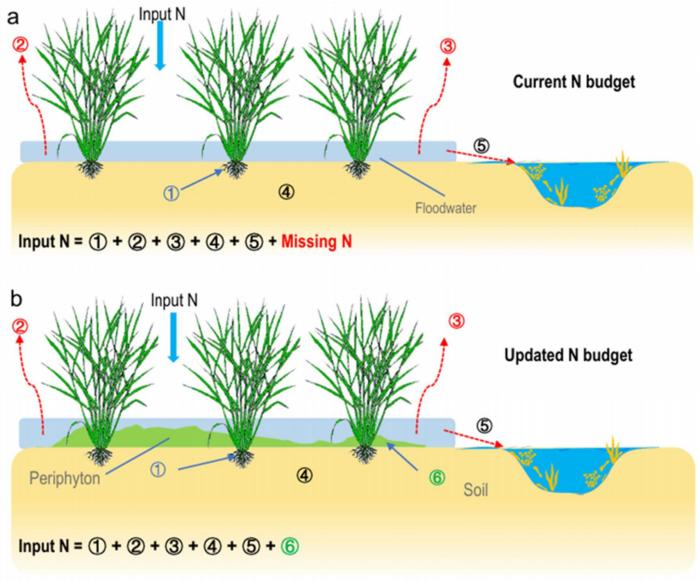
Nitrogen budget closed by periphyton in paddy fields
Rice paddies are among the world’s most important agroecosystems, feeding more than half of the global population. Nitrogen (N) fertilizer is essential for high yields, yet low N-use efficiency leads to substantial environmental costs, including ammonia volatilization, greenhouse-gas emissions, and downstream eutrophication. A major obstacle to improving N management is that many paddy-field N budgets do not fully close: despite careful accounting of crop uptake, soil retention, and gaseous and hydrological losses, the fate of about 4–22% of applied fertilizer N remains uncounted for.
In the paper newly published in National Science Review, a team led by Dr. Yonghong Wu at the Institute of Soil Science, Chinese Academy of Sciences, identifies a previously overlooked microbial N sink that can account for this missing fraction. periphyton, a thin microbial community that develops at the soil–water interface in flooded paddies. Periphyton is composed of algae, bacteria, and extracellular polymeric substances, forming a dense microhabitat with strong capacities for nutrient uptake, transformation, and temporary storage.
To quantify the fraction of fertilizer N intercepted by periphyton and to resolve its subsequent fate, we combined a nationwide field survey with 15N isotope tracer experiments. From 2016 to 2019, periphyton was sampled from 840 rice fields spanning more than 93% of China’s rice-growing area. Periphyton biomass and nitrogen content were measured and subsequently upscaled to provincial and national levels. In parallel, in situ 15N-labeled urea experiments were conducted across three representative climatic zones—temperate, subtropical, and tropical—to track the incorporation of fertilizer-derived N into periphyton throughout the rice-growing season.
The results demonstrate that periphyton consistently captures a substantial fraction of applied fertilizer N. Across provinces, periphyton accounted for 6–24% of fertilizer inputs, with a national average of approximately 12%. When scaled up, periphyton was estimated to store about 0.8 teragrams of N annually in China’s paddy fields—closely matching the magnitude of the long-standing “unaccounted” N fraction reported in previous budget analyses.
The 15N tracer experiments provided direct, mechanistic support for this inference. Periphyton recovered 9.3 ± 1.6% of fertilizer N at the tropical site, 11.4 ± 1.6% at the subtropical site, and 21.3 ± 3.8% at the temperate site, yielding a cross-site mean of approximately 14%. The close agreement between national-scale upscaling and independent isotope tracing reinforces the conclusion that periphyton represents a widespread and quantifiable component of paddy-field N cycling.
Beyond the quantity captured, the chemical form of stored N indicates that periphyton functions as a transient and potentially recyclable N pool. Across all sites, ammonium (NH4⁺) dominated inorganic N within periphyton and exceeded nitrate (NO3⁻) by at least one order of magnitude. Moreover, NH4⁺ accumulation exhibited a clear climatic gradient (temperate > subtropical > tropical), suggesting that temperature-sensitive microbial processes regulate periphyton N dynamics.
Using 15N-based partitioning, we further estimated that periphyton-associated N is subsequently redistributed along multiple pathways. Approximately 19–24% returns to the soil residual N pool, 8–29% is lost via ammonia volatilization, and 7–16% is associated with denitrification-related gaseous losses. The remaining fraction persists temporarily within periphyton biomass and can later re-enter the paddy system through periphyton decomposition.
By explicitly incorporating periphyton as a short-term N reservoir and redistribution hub, this study closes the paddy-field N budget gap and refines both the conceptual and quantitative frameworks used to evaluate fertilizer fate. These findings further suggest that synchronizing periphyton N release with crop demand,through targeted water management or optimized fertilization timing, could enhance internal N recycling, reduce unnecessary fertilizer inputs, and minimize trade-offs associated with gaseous N losses.
https://www.eurekalert.org/news-releases/1118275Published Date: March 3, 2026


 READ
READ