Downloads
 Login
Login
 Register

Tags
Pending DA budget short of rice self-sufficiency demands
By: Kurt Dela Peña – Content Researcher Writer
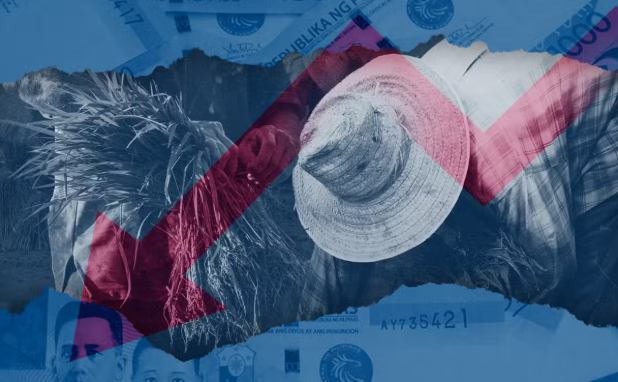
With almost 20 typhoons lashing at the Philippines every year, farmers, especially those tilling lands for palay, find themselves stricken even more by poverty – poor yield, low sales, and piling debt.
Last month, as Nando (Ragasa) battered northern Luzon with maximum sustained winds of 215 kph, local producers braved the intense wind and rain to save their palay, even if a kilo is sold at a low of P8 to P12.
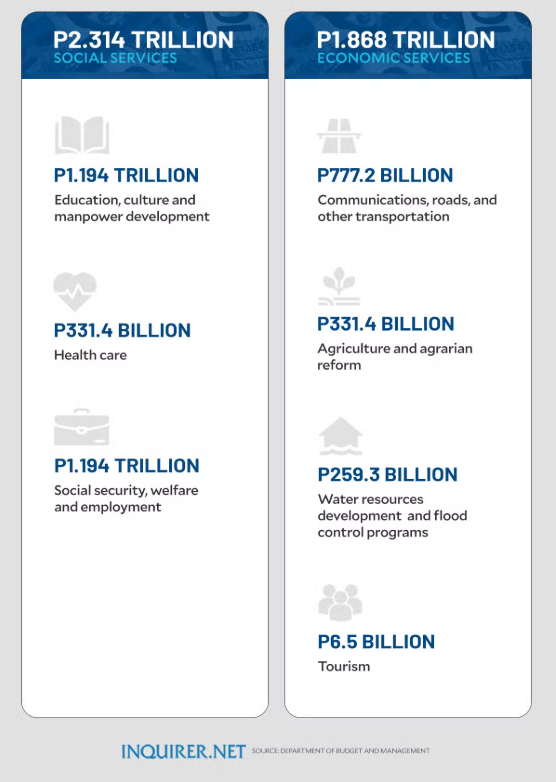
Based on the message of President Ferdinand Marcos Jr. on the proposed 2026 budget, the government is set to strengthen the agriculture sector, which is the sixth priority recipient of next year’s budget with over P200 billion.
This, especially since his administration is seeking to reach 97.4 percent rice self-sufficiency by 2028, considering that the rate fell to a 24-year low of 77 percent in 2022, the year his presidency started.
Marcos, back in 2022, also promised to bring down the price of rice to P20 a kilo.
This, especially since his administration is seeking to reach 97.4 percent rice self-sufficiency by 2028, considering that the rate fell to a 24-year low of 77 percent in 2022, the year his presidency started.
Marcos, back in 2022, also promised to bring down the price of rice to P20 a kilo.
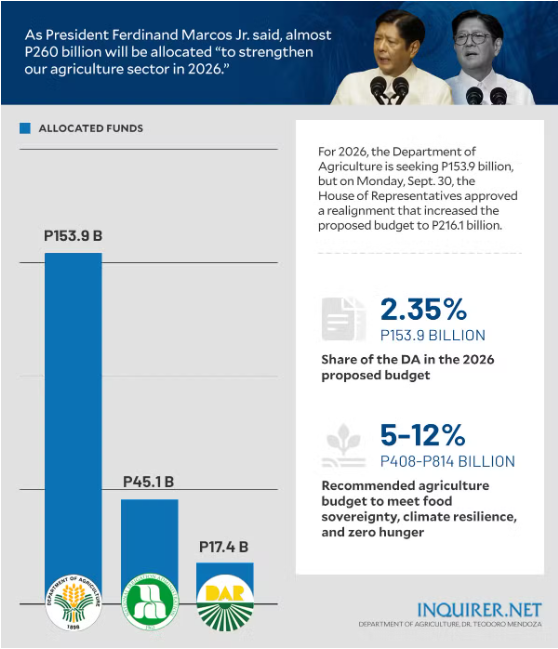
As reflected in the 2026 National Expenditure Program (NEP), agriculture and agrarian reform programs will receive P256.5 billion, with the Department of Agriculture (DA) set to be financed with P153.9 billion.
However, Dr. Teodoro Mendoza, a retired professor of crop science at the University of the Philippines – Los Baños, stressed that the budget, “if passed without reform, risks institutionalizing food insecurity, farmer impoverishment, and climate vulnerability.”
He pointed out in an analysis sent to INQUIRER.net that while “agriculture remains a cornerstone of the economy and rural livelihood,” its fiscal prioritization still lags behind its economic contribution.
Here’s a closer look.
Based on the 2026 NEP, the National Rice Program, which is expected to boost rice production, is given P29.9 billion, while the Rice Competitiveness Enhancement Fund is set to receive P30 billion from rice import tariffs to fund these:
- Modernization of farm machinery and equipment
- Development of rice seeds
- Expansion of credit assistance
- Provision of rice extension service
The Rice for All Program, which includes the Benteng Bigas Meron Na, will receive P10 billion to expand access to cheap rice from both importers and local traders at public markets and Kadiwa ng Pangulo outlets.
Some P11.2 billion has been allocated, as well, for the Buffer Stocking Program for the procurement of 300,000 metric tons of palay that will be used in emergencies and disasters, such as typhoons and earthquakes.
As Marcos pointed out, “with the goal of sourcing from local farmers, the program has increased the country’s buffer stock capacity from nine days to 15 days—strengthening food security during emergencies and disasters.”
But for Mendoza, “a transformative pivot—budgeting, structural legislation, and SDG (Sustainable Development Goal) alignment—is essential to reclaim food sovereignty and intergenerational justice.”
‘Below the threshold’
Mendoza explained that the trajectory of DA’s budget from 2024 to 2026 shows a “nominal growth” from P111.12 billion to P153.93 billion.” “It remains below transformative thresholds,” he said.
As of the second quarter of 2025, agriculture, forestry, and fishing sector accounted for 7.5 percent of the gross domestic product (GDP), higher than the 7.4 percent share in the same period last year.
However, Mendoza stressed that the P153.9 billion allocated for the DA “falls short of global standards,” stressing that the Food and Agriculture Organization recommends a minimum of 10 percent of national expenditure in food-insecure and agrarian economies.
The low investment on agriculture, which is only 2.35 percent of the NEP, “starkly contrasts with global benchmarks and ASEAN peers, where agriculture receives 3 percent to 6.5 percent share of the national budget.”
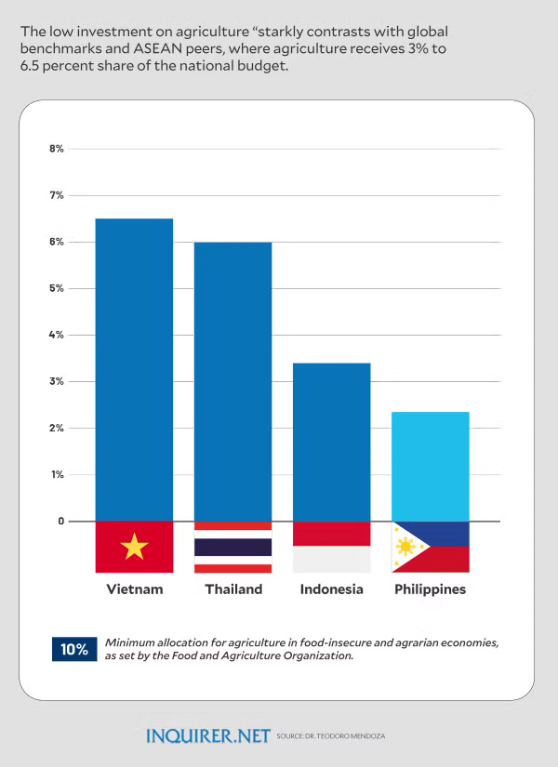
The comparative ASEAN data reveals that Vietnam allocates 6.5 percent of its national budget to agriculture; Thailand, 5.99 percent; and Indonesia, 3.4 percent, all exceeding the percentage the sector receives in the Philippines.
Mendoza pointed out that “these countries integrate irrigation, rural development, and market stabilization into their core agricultural strategies, enabling food security and export competitiveness.”
“Vietnam leads in account prioritization, reflecting its aggressive rural development and export-oriented strategy, while Thailand and Indonesia maintain consistent support above 3 percent, especially for rice and irrigation,” he said.
Recalibrating investment
As Mendoza stated, the Philippines is lagging behind, considering that it has “fragmented allocations and limited market stabilization mechanisms,” stressing that investment should be recalibrated to 3 percent of the GDP, or P839 billion.
The recommended budget, he said, is 5 percent to 12 percent of the NEP or 3 percent to 5 percent of the GDP, “to meet food sovereignty, climate resilience, and the SDG 2 goal,” which is Zero Hunger.
Especially for the rice crisis, Mendoza pointed out that P200 billion should be allocated—P100 billion for NFA procurement at P25 a kilo and P100 billion for postharvest infrastructure.
This, as he stressed that the NFA’s allocation covers only 1.6 percent of palay output, saying that NFA should be mandated not only to buy rice, but to buy dignity for our farmers. “At P23 to P26 a kilo, we guarantee a 30 percent profit above production costs.”
“Achieving rice sufficiency requires investing P678 billion to P814 billion yearly and restoring NFA’s market role of buying palay at 20 percent of harvest at floor price of P25 a kilo,” he said.
The low investment, Mendoza stressed, “perpetuates farmers’ losses, trader dominance, and systemic food insecurity.”
“If the agriculture budget shall be approved and signed by the President, it will legalize the root cause of farmers’ impoverishment and injustice. Without bold fiscal reform, the country risks deepening rural poverty and the nation’s failure to achieve its SDG commitments,” he said.
https://newsinfo.inquirer.net/2121411/pending-da-budget-short-of-rice-self-sufficiency-demandsPublished Date: October 8, 2025


 READ
READ