Downloads
 Login
Login
 Register


Tags
North Koreans credit rice price stability, but quality and affordability remain concerns
North Korean people credit state grain stores for keeping rice prices in check, but say quality controls and affordability remain unresolved problems.
By Seulki Jang, Lee Chae Eun
More than five years after North Korea’s state-run grain stores were introduced, North Korean people say the outlets are operating more smoothly than in the early days, when erratic supply often left shelves bare or stores shuttered entirely. Yet as rice prices have climbed and the price gap between state stores and open markets has narrowed sharply, satisfaction with the program is giving way to frustration over affordability and inconsistent quality.
The grain stores, known in Korean as yanggok pansomso (state-subsidized grain retail outlets established by the North Korean government to sell rice and other staples at below-market prices), were created to cushion North Korean people against food price volatility. According to sources who spoke with Daily NK in June 2026, most stores now maintain a relatively steady supply, a marked improvement from their early years of operation.
Some households have found a way to stretch their purchasing power further by buying rice at the subsidized state store price and reselling it on the open market, then using the proceeds to buy cheaper grains such as corn. A Pyongyang resident described the practice as common: in about three out of five households in the immediate vicinity, families sell state-store rice and use the proceeds to buy corn or mixed grains that last longer.
A typical state store purchase covers roughly two weeks of food for a single household. Families in difficult circumstances have managed to stretch that supply to nearly 20 days by rationing carefully.
Price gap narrows, quality complaints mount
The primary draw of the state stores has always been price. In late April 2026, state stores in Pyongyang and Hyesan were selling rice at 30,000 North Korean won and 29,000 North Korean won per kilogram, respectively, undercutting nearby market prices by 3.2% in Pyongyang and 7.9% in Hyesan. Those discounts, while real, pale against the roughly 30% price advantage the stores offered when they first opened.
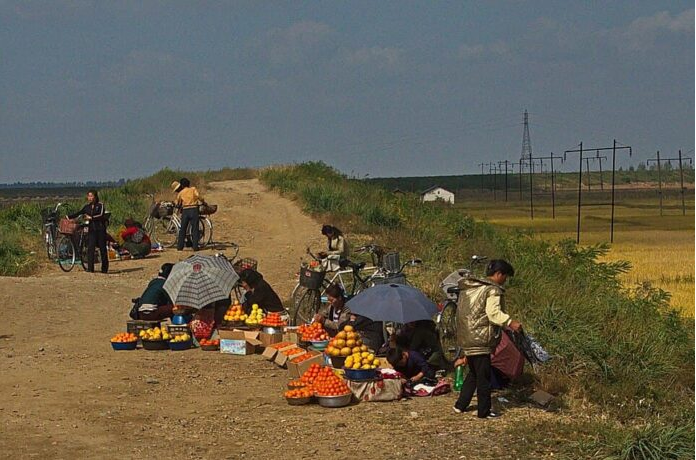
As the gap has closed, some North Korean people have begun to prefer market rice outright. In the jangmadang (informal markets that have become a central feature of North Korea’s semi-private economy), buyers can inspect grain quality before purchasing and negotiate or return substandard goods. At state stores, such recourse is essentially unavailable, and quality is inconsistent, a recurring grievance among shoppers.
A Hyesan resident put it plainly: at the market, buyers can complain or ask for an exchange if the rice is in poor condition, but that option does not exist at the state store. Those with slightly more financial flexibility, seeing little price difference, increasingly prefer to buy quality rice from the market instead.
Despite those shortcomings, the prevailing view among North Korean people is that the stores have helped anchor rice prices across the board. Sources indicated that since the state stores opened, market traders have been less able to raise prices arbitrarily, because buyers have a subsidized alternative. Even people skeptical of the program’s benefits tend to credit it with moderating overall price swings.
That consensus breaks down at the lowest income levels. For the most economically vulnerable North Korean people, even the discounted state store price is out of reach. Neighborhood watch units, the grassroots surveillance and social management cells that operate under party direction at the block level, have responded to complaints about rising food costs by urging patience, invoking the name of Kim Jong Un and his stated commitment to improving people’s lives. But the most hard-pressed families say that a below-market price is still a price they cannot pay.
https://www.dailynk.com/english/north-korea-grain-stores-rice-prices-quality/Published Date: June 9, 2026


 READ
READ