Downloads
 Login
Login
 Register

Tags
My Say: Time for a reset as rice crisis approaches
By Fatimah Mohamed Arshad / The Edge Malaysia
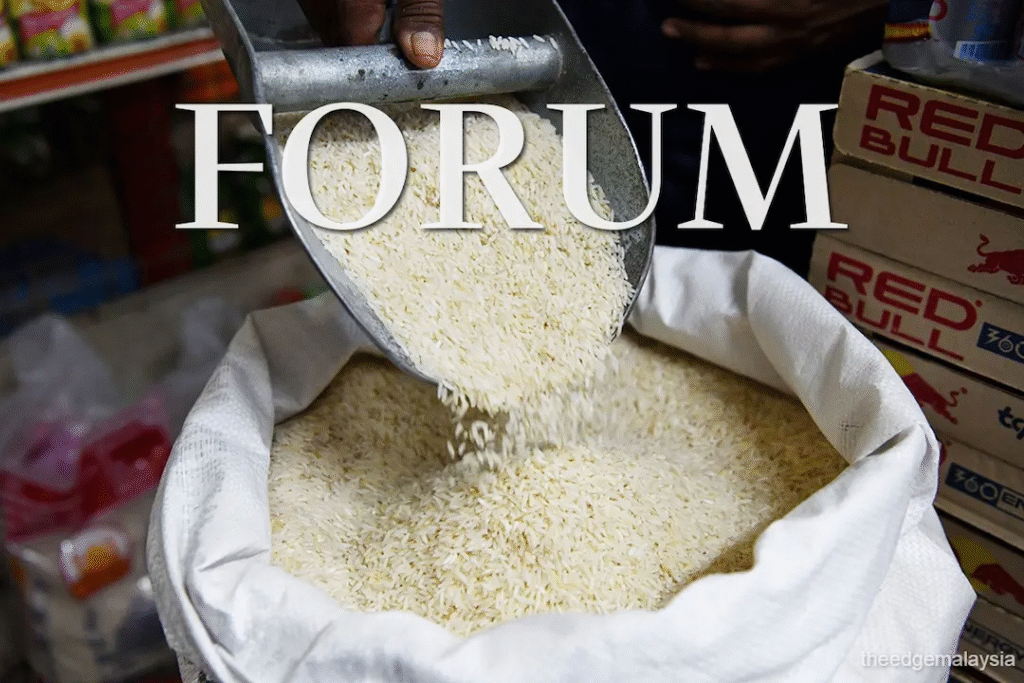
This article first appeared in Forum, The Edge Malaysia Weekly on June 8, 2026 – June 14, 2026
Chinese wisdom teaches us that “within danger lies opportunity”. Likewise, the looming rice crisis may represent a critical inflection point — an opportunity to reset our course after half a century of sustained decline.
Crises come and go, but we need rice on the plate. Rice is a non-negotiable staple in every Malaysian household — uniting all our communities. Although Malaysia has navigated past rice crises, the impending one appears unprecedented in its scale and complexity.
Rice crises are a recurring phenomenon in international markets, shaped by the interaction of fundamental forces (supply and demand) and technical dynamics, including herd behaviour among market participants. Malaysia has weathered multiple such episodes — most notably in 1973-1975, 1998, 2008, 2020-2021, 2023 and 2026. The present crisis stands out as unprecedented in scale, determinants and complexity.
The present crisis exhibits reinforcing market dynamics that create a self-perpetuating vicious cycle, with the potential to escalate into acute food insecurity, including hunger and famine across the most vulnerable regions globally. In Malaysia, its impact could spread to low-income households and other vulnerable groups — urban and rural alike — as seen during the Covid-19 period (2020-2021).
The crisis reflects reinforcing feedback triggered by the geopolitical fallout from the US/Israel-Iran conflict. The closure of the Strait of Hormuz has significantly disrupted global energy flows, pushing crude oil prices up roughly 10% to 30%. Diesel prices have risen by around 15%, while fertiliser costs have recorded the steepest surge, increasing by about 50% to 80%.
In rice production, fertiliser is an indispensable input; without it, yields and overall output would decline significantly, leading to reduced rice availability. Energy — particularly petrol and electricity — is equally essential for machinery operation, milling, transport, shipping and other supply chain activities, all of which contribute to higher retail rice prices. At the same time, rising energy costs place broader inflationary pressure on the economy, eroding consumers’ real incomes and severely constraining affordability.
As a result, both food availability and access may be compromised, increasing the risk of poor nutrition, as observed during the Covid-19 period. Without effective policy responses, these pressures could extend beyond a food crisis and contribute to broader macroeconomic instability, including stagflation and recession. In short, these factors can reinforce one another in a vicious cycle, potentially spiralling into famine if left unchecked.
The scale of this looming crisis is immense, as fuel and fertiliser are the lifeblood of grain production — rice, wheat, soybeans and corn — across the world. As seen in 1973 and again in 2008, sharp increases in wheat prices were accompanied by rising rice prices.
Lurking in the background are climatic pressures — such as El Niño, prolonged dry spells and extreme heat — that can significantly disrupt rice production. These risks are not confined to a single season; they can carry over into subsequent cycles, as seed availability for the next planting depends on the current harvest. Taken together, these factors pose a serious and potentially catastrophic threat to the country’s rice production.
While the crisis is still unfolding, the rice sector points to a troubling trajectory, with declines in all dimensions — yield, area and production growth, self-sufficiency level and poverty among farmers. On the rise are: water footprint, soil degradation, market inefficiencies (oligopolistic and monopolistic markets) and irregularities (mixing grades of rice and rampant presence of cartels), water footprint, government subsidies and imports.
Given this landscape, the rice industry is evidently too weak to withstand crises, especially the complex and compounding challenges of today. A business-as-usual approach would likely exacerbate existing problems exponentially.
A systemic reset is the most viable solution. In the short term, one can’t hurry rice production. The government has to intervene to ensure rice production is sustained and reaches all consumers. Measures on the supply side include: supporting the producers with additional subsidies to encourage production including organic paddy, increasing imports and banning exports, buffer stock monitoring, and collaboration with Asean partners. On the consumption side, the measures include: rationing, price controls, specific programmes for the poor and monitoring paddy and rice systems.
All the above efforts should be supported by integrated big data and digital applications to track supply, prices, distribution, movement and supply-demand forecasts and policy simulations. Ideally, a comprehensive database covering production, import, farmers, millers, intermediaries, wholesalers and retailers should already exist to enable forecasting and minimise oversight. Towards that end, the government should own the paddy and rice, which are currently in the hands of the private sector.
In the past, Malaysia chose “firefighting” strategies to address shocks. Consequently, Malaysia’s paddy sector is stagnating while countries that implemented structural reforms exhibit big successes. These include commune liberation and market liberalisation in China and Vietnam in the mid-1980s; Bangladesh opted for market liberalisation, which resulted in impressive growth; India — with massive support in digitisation and digitalisation of rice systems and start-ups — enabled it to become the world’s largest rice exporter within just a decade.
Malaysia should emulate these success stories. Calls for rice liberalisation have been made by both domestic academics and international experts — particularly the World Bank and the Food and Agriculture Organization — since the 1980s, yet they have largely been ignored. Political will has been stifled by self-interest and fear.
Numerous reports and studies have recommended “guided liberalisation” to ensure a smooth transition while maximising returns for farmers and other market participants. This approach would involve policies aimed at strengthening farmers’ capacity through improved extension services, fostering a more competitive seed market by expanding the number of distributors (including farmer-led channels) and supporting the development of small- and medium-scale mills.
It would also include reducing market barriers such as restrictive licensing to allow greater farmer participation in milling and distribution, opening up import channels, and strengthening rice grading and specification systems, among other reforms.
To protect farmers from market volatility, the government could establish a stabilisation framework to smooth income fluctuations. One option is a farmer stabilisation fund, where producers are encouraged to save during periods of favourable prices and draw on these savings during downturns.
Second, a “price loss coverage” mechanism could be introduced, where payments are triggered if the yearly average price falls below a government-determined reference price, or alternatively when net farm revenue drops below a defined threshold, such as 90% of a historical benchmark.
Third, access to low-cost financing could be expanded through concessional loans for farmers to support production and cash flow needs.
Fourth, improved stockpile management would help stabilise prices by releasing reserves during shortages and absorbing excess supply during surpluses.
Proven cases in India, China and Vietnam show how advanced technologies can facilitate agricultural growth with greater efficiency and impact. In India, for example, a wide range of digital applications have been developed to improve technical efficiency at a lower cost, reflecting the fact that information communications technology is largely neutral to farm size and can therefore benefit smallholders as well as larger producers.
These tools support farmers across multiple stages of production. They include:
● Soil and field analysis: 3D mapping for water management and nitrogen optimisation;
● Planting: drone-based planting systems;
● Crop spraying: aerial and ground-scan targeted spraying;
● Crop monitoring: time-series imaging and crop growth animation;
● Irrigation management: sensor-equipped drones to detect water stress and irrigation needs;
● Plant health assessment: infrared-based monitoring to detect early disease signals;
● Precision agriculture and nanotechnology: nanofertilisers enabling controlled and slow release of agrochemicals;
● Alternative production systems: hydroponics, algae-based feedstock and seawater farming;
● Food safety monitoring: biosensors for detecting pesticide residues;
● Internet of Things applications: predictive maintenance for farm equipment;
● Data analytics: decision support for yield optimisation and risk management;
● Digital finance tools: food-sharing platforms and crowdfunding systems; and
● Blockchain systems: traceability and supply chain transparency.
In addition, Geographic Information Systems (GIS) are widely used for irrigation and terrain mapping, drainage modelling, livestock monitoring, flood and erosion control, drought management, land degradation assessment and pest and disease surveillance. Together, these technologies demonstrate how digitalisation can transform the rice sector into a more resilient, efficient and data-driven system.
Unlike in the past, the 21st-century ecosystem for paddy and rice production is overwhelmed with a wide range of advanced technologies that can increase yields, improve supply chain efficiency, enhance value creation through innovation and reduce exposure to climate-related and natural risks.
In such an environment, empowering farmers and market participants is often more effective than centralised control, provided strong institutions, infrastructures and safeguards are in place.
https://theedgemalaysia.com/node/806209Published Date: June 11, 2026


 READ
READ