Downloads
 Login
 Register

Tags
India’s Rice Production Rises, but Prices Continue to Climb
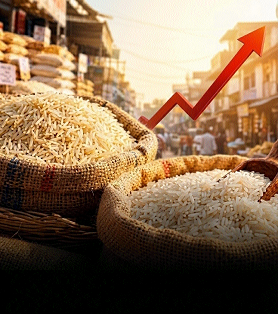
Rice prices have risen substantially over the past few months, with sharp increases in several southern states during the second half of 2026. Prices also vary widely across states. These increases have occurred alongside growth in national production, supported by higher yields and an expansion in cultivated area.
Context
Rice is a staple in meals across India, making changes in its price a concern for household budgets. Even a small increase in the price per kilogram can add to monthly food expenditure, particularly for families that depend on rice for their daily meals.
Recent increases have brought rice back into discussions on food inflation, alongside concerns about lower paddy acreage and the outlook for the coming harvest. According to the report of the Department of Consumer Affairs’, the all-India average wholesale price of rice reached ₹4,380.49 per quintal on 2 November 2026, up 16.9% from ₹3,747.44 a year earlier. It was also 6.7% higher than the previous month, indicating a recent acceleration in prices. The all-India average retail price of rice stood at ₹48.64 per kilogram on the same day.
These concerns come against a backdrop of growth in India’s rice production and yields. Examining production alongside wholesale and retail prices provides a broader view of how the rice market has evolved and how price trends differ across states.

Who compiles this data?
The Department of Consumer Affairs, under the Ministry of Consumer Affairs, Food and Public Distribution, compiles daily retail and wholesale prices of essential commodities, including rice, through its Price Monitoring System. The production and yield figures used in this article come from the Ministry of Agriculture & Farmers Welfare’s Agricultural Statistics at a Glance.
Key Insights
- Average reported retail rice prices have risen substantially over the past decade, although the extent of the increase differs across states.
- In Telangana, the average rose from ₹27 per kilogram in 2014 to ₹54.7 in 2025 and ₹56.2 during 2026, an increase of about 108% over this period. Data for 2026 covers the period from 1 January to 1 November. Andhra Pradesh recorded a similar rise, from ₹25.5 to ₹51.4 per kilogram, while Tamil Nadu’s average increased from ₹31.1 to ₹57.5, or about 85%.
- The increases were smaller in some other states. Bihar’s average retail price rose from ₹29.1 per kilogram in 2014 to ₹38 in 2026, while Himachal Pradesh’s increased from ₹30.5 to ₹39.1. Both recorded increases of around 30%.
- In 2026, monthly average retail prices show a clear shift in Karnataka, Telangana, Andhra Pradesh and Tamil Nadu. Prices were relatively stable or declined during the early months, before increasing in the second half of the year.
- Karnataka recorded the sharpest increase from January to October among these states. Its monthly average rose from around ₹48 per kilogram to nearly ₹69, with the highest reported daily price reaching ₹74.4 on 31 October. Telangana’s prices initially declined before climbing from June onwards. Its daily average peaked at ₹79 per kilogram on 20 and 21 October.
- Andhra Pradesh and Tamil Nadu also saw successive increases from the middle of the year, with both recording their highest daily prices of the period from January to October on 31 October. Across these four states, October monthly averages were substantially higher than a year earlier.
- The trend was less pronounced elsewhere. Assam and Mizoram recorded relatively stable monthly averages. Gujarat, meanwhile, saw prices rise gradually despite its average for the full January to October period remaining slightly below the corresponding 2025 level.
As of 31 October 2026, Karnataka reported the highest retail rice price among states and UTs with available data, at ₹74.4 per kilogram, followed by Telangana at ₹73.9 and Tamil Nadu at ₹68.9. Meghalaya reported the lowest price at ₹36.4, making Karnataka’s price more than twice as high.
- India’s rice output has increased by about 42%, from 105.48 million tonnes in 2014-15 to 150.18 million tonnes in 2024-25. The long-term price, as noted in this piece, therefore occurred alongside an expansion in production.
- Both higher yields and an expansion in cultivated area contributed to this production growth. Average yield increased by about 23% over the decade, while the area under rice cultivation expanded by 16%.
Why Does It Matter?
The longer-term growth in India’s rice output and rising consumer prices show why food availability and affordability need to be examined together. Higher production strengthens supply, but it does not automatically protect households from price increases. The sharp rise in several states during the second half of 2026 also shows how annual averages can conceal emerging pressures.
The recent increases appear linked to concerns about the coming harvest. CRISIL’s October assessment links rising rice prices to expectations of lower paddy production because of reduced acreage and weaker yields. Concerns about possible El Niño conditions add uncertainty to the outlook, particularly if rainfall and water availability are affected in subsequent growing seasons. The Agriculture Ministry has also reviewed possible El Niño conditions as part of its crop monitoring. These apprehensions could keep prices under pressure, although further increases are not inevitable. The eventual harvest, fresh market arrivals and availability of stocks will influence whether prices remain elevated or ease.
Key numbers
- Telangana’s average retail rice price (₹/kg): ₹27 → ₹56.2, 2014 → 2026 (+108%).
- Karnataka’s monthly average retail rice price (₹/kg): ₹48.1 → ₹68.9, January → October 2026 (+42.6%).
- Highest and lowest reported retail rice prices, 31 October 2026: Karnataka ₹74.4/kg; Meghalaya ₹36.4/kg.
- India’s rice production (million tonnes): 105.48 → 150.18, 2014-15 → 2024-25 (+42.4%).
- India’s rice yield (kg/hectare): 2,391 → 2,929, 2014-15 → 2024-25 (+22.5%).
Published Date: November 4, 2026


 READ