Downloads
 Login
 Register


India’s non-basmati rice export surges 6.7% in April-October
Up on demand for white and broken varieties as exporters offer the cereal at competitive prices
By Prabhudatta Mishra
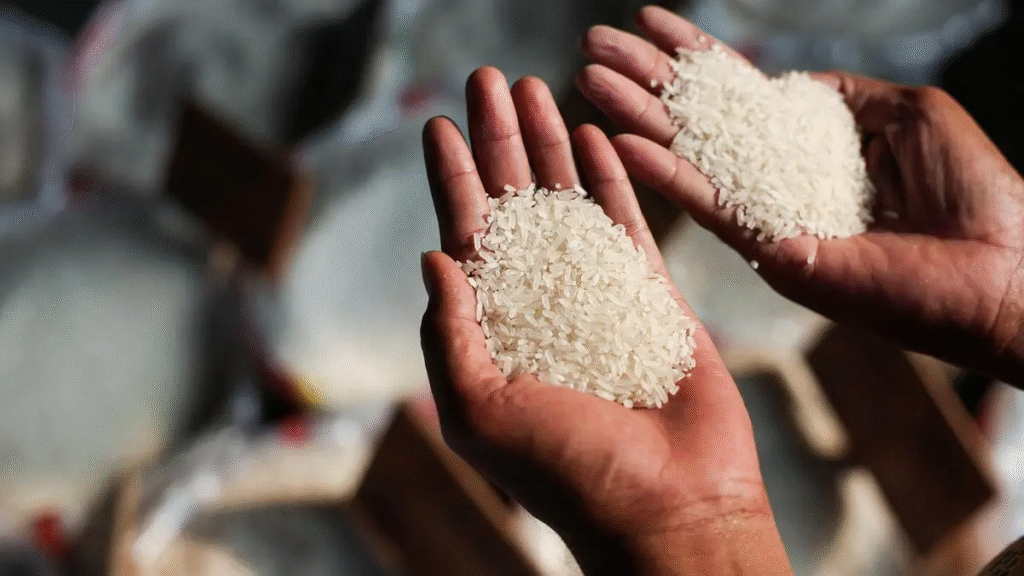
India’s non-basmati rice exports during the first seven months of the current fiscal increased 6.7 per cent to 8.84 million tonnes (mt) from 8.28 mt a year ago due to demand for white and broken varieties in view of competitive prices offered by Indian exporters.
Latest official data show that exports of non-basmati white rice recorded 18.3 per cent growth at 2.82 mt during April-October of 2026-27 against 2.38 mt in the corresponding period last year. Similarly, broken rice shipments surged 73.5 per cent to 0.98 mt from 0.56 mt.
Parboiled rice shipment, once a dominant item of Indian exporters, has slipped 4.6 per cent to 4.9 mt from 5.1 mt, official data show. The parboiled rice export also included 42,558 tonnes of GI-tagged premium varieties.
Lower per unit price
In 2025-26, India’s non-basmati rice exports grew 6.4 per cent to 15.04 mt (worth $5.87billion) from 14.13 mt (worth $6.53 billion). Indian exporters sold on an average $390/tonne in FY26, compared with $462/tonne in FY25.
In basmati rice also, though in volume terms exports increased 7.6 per cent to 6.52 mt in FY26 from 6.06 mt, the average realisation dropped 13 per cent to $870/tonne. Trade sources said that export of basmati rice is flat at about 3.6 mt during April-October of 2026-27.
Experts said that Indian exporters are not able to keep prices high despite the country has production advantage with a huge exportable surplus whereas in similar situation in pulses and edible oils Indian importers are paying rates what the sellers are deciding, in both cases India has not been able to to take a consistent position.
“You have to decide price either as buyer or seller, but unfortunately that is not happening for India,” said a trade policy expert.
Options to curb
As reported by businessline earlier this week, the government is considering a host of options including curbing exports to cool domestic prices after retail inflation in rice recorded 12.51 per cent, exporters have sought to make a distinction on prices of common rice varieties and some of those premium types like Kalanamak (Uttar Pradesh), Katarni (Bihar), Seeraga/Jeera Samba (Tamil Nadu), Samba Masuri (Andhra Pradesh and Telangana) and Gobindobhog (West Bengal).
A top official of a non-basmati rice exporters’ body said that there is stability in prices of common rice varieties, which are exported, as the government also distributes the same quality rice through ration shops.
The price rise has been witnessed mainly in premium varieties that fetch higher rates to farmers, the official said, adding the production of these premium rice varieties has not matched the rise in demand.
He faulted the Odisha and Chhattisgarh government’s decision to buy common paddy varieties at much above the minimum support price (MSP) paying a bonus.
India banned exports of broken rice and imposed a 20 per cent export duty on paddy, husked (brown) rice, and non-basmati white (non-parboiled) milled rice in September 2022. Later in July 2023, shipment of non-basmati white rice (excluding parboiled rice) was prohibited.
Further, in August 2023, a 20 per cent export duty on parboiled rice and a Minimum Export Price (MEP) on Basmati rice were introduced. However, during September-October 2024, all curbs, including MEP, were lifted. But the export ban on broken rice continued until March 2025.
https://www.thehindubusinessline.com/economy/agri-business/indias-non-basmati-rice-export-surges-67-in-april-october/article71738885.ecePublished Date: November 25, 2026



 READ