Downloads
 Login
Login
 Register


Tags
High Exchange Rate Drives Surge in Rice, Fruit, Oil Prices
November inflation hits 2.4% as agricultural, petroleum costs soar; processed foods, dining-out prices at risk.
By Yu Jun-ho
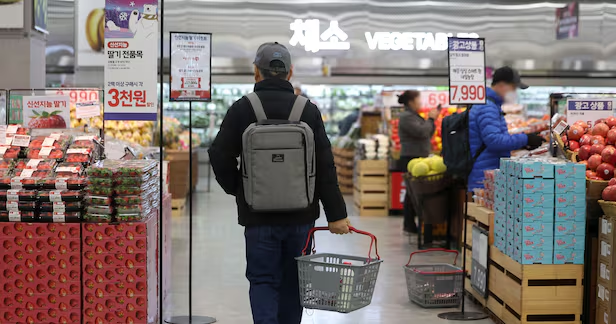
Due to the high exchange rate, petroleum products and imported fruits and seafood prices rose significantly, leading the consumer price inflation rate last month to record a mid-2% range. The government is concerned that if the high exchange rate persists, the rise in processed food and dining-out prices could also increase.
According to the ‘November Consumer Price Trends’ released on the 2nd by the Ministry of Data and Statistics, last month’s consumer price index was 117.20 (2020=100), up 2.4% from a year ago. The consumer price inflation rate, which was 1.7% in August, rose to 2.1% in September, slightly exceeding the Bank of Korea’s inflation target, 2%, and has recorded a mid-2% range for two consecutive months since October, 2.4%.
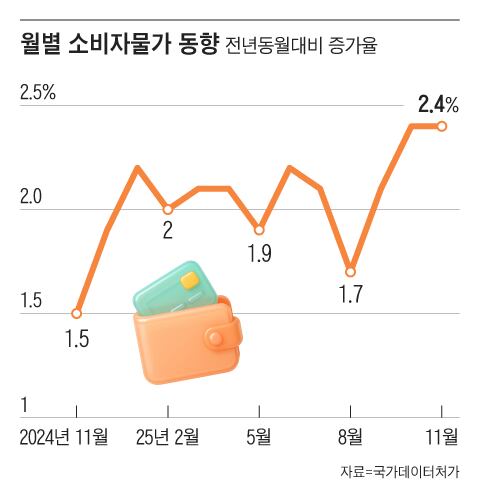
In particular, agricultural, livestock, and fisheries product prices surged by 5.6% due to frequent autumn rains and the high exchange rate. The upward trend, which started in October, 3.1%, has expanded for two consecutive months, showing the largest increase in 1 year and 5 months since June of last year. Significant increases were seen in grains, 18.7%, fruits, 11.5%, seafood, 6.8%, and livestock products, 5.3%. Vegetable prices, however, fell by 4.7%.
Particularly for grains, delays in rice harvesting due to frequent rains caused the staple food rice price index to rise by 18.7%, with brown rice, 25.8%, glutinous rice, 34.2%, and barley, 33.1%, also seeing significant increases. Consequently, prices have shown double-digit growth for five consecutive months since the 7th, 12.2%. Fruit prices rose centered around mandarins, 26.5%, which began to see concentrated consumption ahead of winter, as well as apples, 21%, watermelons, 16.4%, and strawberries, 14.5%, marking four consecutive months of increasing price hikes since August. Amid this, items with high import proportions such as almonds, 13.6%, kiwis, 12%, mangoes, 8.8%, and blueberries, 4.5%, showed notable price increases due to the high exchange rate.
Livestock product prices also continued to rise for major items such as eggs, 7.3%, pork, 5.1%, and chicken, 4%, while imported beef prices surged by 6.8% due to the high exchange rate. Although the increase was only 0.1% in July, the upward trend has expanded for four consecutive months since August. In contrast, domestic beef prices, which rose by 4.6%, have shown a slowing trend since August, 6.6%. Seafood prices also rose due to the high exchange rate, with imported species like hairtail, 11.2%, and mackerel, 13.2%, seeing over 10% increases.
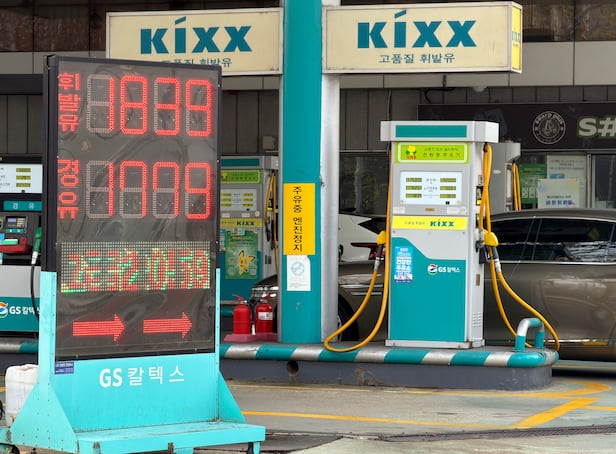
Petroleum product prices also rose by 5.9% due to the high exchange rate, driving overall price increases. Despite falling international oil prices, the reduction in fuel tax cuts combined with the high exchange rate led to a larger increase in petroleum prices compared to October, 4.8%. Last month’s petroleum price increase was the highest in nine months since February, 6.3%. The petroleum price index has risen for three consecutive months since September, 2.3%. Diesel prices surged by 10.4%, the highest increase in 1 year and 4 months since July of last year, 10.5%. Gasoline, 5.3%, and butane gas, 2.4%, also saw significant price hikes.
Lee Du-won, an economic trend statistics deliberation officer, stated, “Petroleum products and imported agricultural, livestock, and fisheries products are most sensitive to exchange rate increases,” adding, “In the medium to long term, processed food and dining-out prices could also become factors for increases due to rising raw material costs.”
With rising agricultural, livestock, and fisheries product prices, as well as increases in exchange rates and oil prices, the processed food price inflation rate reached 3.3%, exceeding the Bank of Korea’s inflation target. Bread, a substitute for staple foods, rose by 6.5%, while prices for ramen, 6.8%, coffee, 15.4%, and convenience store meals, 4.7%—items commonly consumed by the public—also increased consecutively. Last month’s dining-out prices rose by 2.8%, led by increases in jjajangmyeon, 6.2%, boxed meals, 4.8%, dining-out coffee, 4.4%, hangover soup, 4%, and chicken, 3.1%. The living price index, which is close to the perceived inflation rate as it is composed mainly of frequently purchased items, increased by 2.9%. This is the highest increase in 1 year and 4 months since July of last year, 3.0%.
https://www.chosun.com/english/market-money-en/2025/12/02/TXABR6W64BGIVBT3DOGYGNBAMI/Published Date: December 2, 2025


 READ
READ