Downloads
 Login
Login
 Register

Tags
Gov’t to produce 11,000 tons of seed rice in Africa by 2027
By Ko Dong-hwan
K-Ricebelt aims productivity to reach 6 tons per farm
Korea is expanding assistance to African nations to boost rice production. The Rural Development Administration (RDA), through its K-Ricebelt project, aims to produce 11,000 tons of seed rice across the continent by 2027.
The initiative is part of Seoul’s official development assistance (ODA) program for Africa, designed not only to address food shortages but also to strengthen long-term agricultural self-reliance. It includes training local farmers in rice cultivation and harvesting techniques and introducing advanced farming machinery developed by Korean companies.
The RDA, an agricultural research agency under the Ministry of Agriculture, Food and Rural Affairs, is seeking to expand participation as widely as possible. Currently, 31 African countries are members of the Korea-Africa Food & Agricultural Cooperation Initiative (KAFACI), with several already adopting rice varieties developed from Korean strains.
As of last month, African governments have imported Korean agricultural machinery worth a combined $2.3 million to enhance farming capacity.
RiceSPIA
The RDA expects that by 2027 the seven participating countries — Senegal, Gambia, Guinea, Uganda, Ghana, Cameroon and Kenya — will collectively produce 11,140 tons of seed rice annually under the K-Ricebelt project.
The projected output, up from 2,300 tons in 2023, would be sufficient to cultivate 223,000 hectares of farmland and yield about 2.16 million tons of rice. Based on an average annual consumption of 70 kilograms per person, the harvest could feed roughly 30 million people across Africa.
Rice grows in a paddy field cultivated by farmers in Uganda in November 2024. The KOPIA Uganda Center and a local farmers’ cooperative organized 100 farming groups to produce rice using seed developed by the center and to identify those with the highest yields and best quality. Courtesy of Rural Development Administration
K-Ricebelt is a five-year project scheduled to conclude in Ghana in 2027 and in the remaining participating countries in 2028.
Another key objective of the RDA is to raise rice farm productivity in Africa to 6 tons per hectare. Average yields stood at 2.2 tons per hectare before the project began, rising to 3.7 tons by the end of 2023 and to 4 tons in 2024.
The initiative is jointly implemented by the agriculture ministry and its affiliated agencies, with each assigned distinct roles. The RDA is responsible for developing new rice varieties and helping partner countries establish their own seed production systems under the Rice Seed Production Improvement for Africa (RiceSPIA) program.
The Korea Rural Community Corp., another ministry-affiliated agency specializing in agricultural infrastructure, supports partner countries with development projects, while the ministry oversees overall coordination.
“K-Ricebelt started with six countries in 2023 and produced 2,321 tons of seed rice by year’s end — 114 percent of our target, demonstrating the project’s effectiveness,” an RDA official said.
“Output increased to 3,600 tons across seven countries in 2024 and reached 2,300 tons in the first half of 2025 alone. Results for the second half are expected next month, and we anticipate exceeding our annual goal of 4,752 tons.”
The project, rooted in Korea’s broader development cooperation with Africa, was launched as the continent’s agricultural sector faced mounting vulnerabilities.
Rice, the second most important staple after cassava, has suffered from low productivity due to limited farming techniques, inadequate infrastructure and machinery and declining crop resistance to pests and diseases.
According to a 2021 report by the Food and Agriculture Organization of the United Nations, Africa’s average rice yield was 2.3 tons per hectare — less than half of Asia’s 4.9 tons.
KOPIA Ghana Center hosts a rice tasting session for local farmers in Dawhenya, Ghana, July 2024. At the event, participants tasted 12 different rice varieties that were grown from either Korean or local seeds. Courtesy of the Rural Development Administration
Rising demand driven by population growth and urbanization has deepened rice shortages across Africa. The RDA said rice consumption on the continent has been increasing by about 6 percent annually, while 21 of the 39 rice-producing countries depend on imports for up to 90 percent of domestic need. According to the Food and Agriculture Organization of the United Nations, Africa imported roughly 17 million tons of rice worth $7.5 billion — a heavy financial burden for many countries.
To help address the crisis, Korea introduced Tongil rice, a high-yield hybrid developed from Indica and Japonica varieties. In cooperation with the Senegalese Institute for Agricultural Research, Korean officials tested two Tongil strains and registered them as Isriz-6 and Isriz-7.
Field results have been promising. In Senegal, the Tongil varieties produced more than double the yields of the local Sahel rice and gained market acceptance, selling at about 400 CFA francs per kilogram compared with 350 francs for Sahel rice.
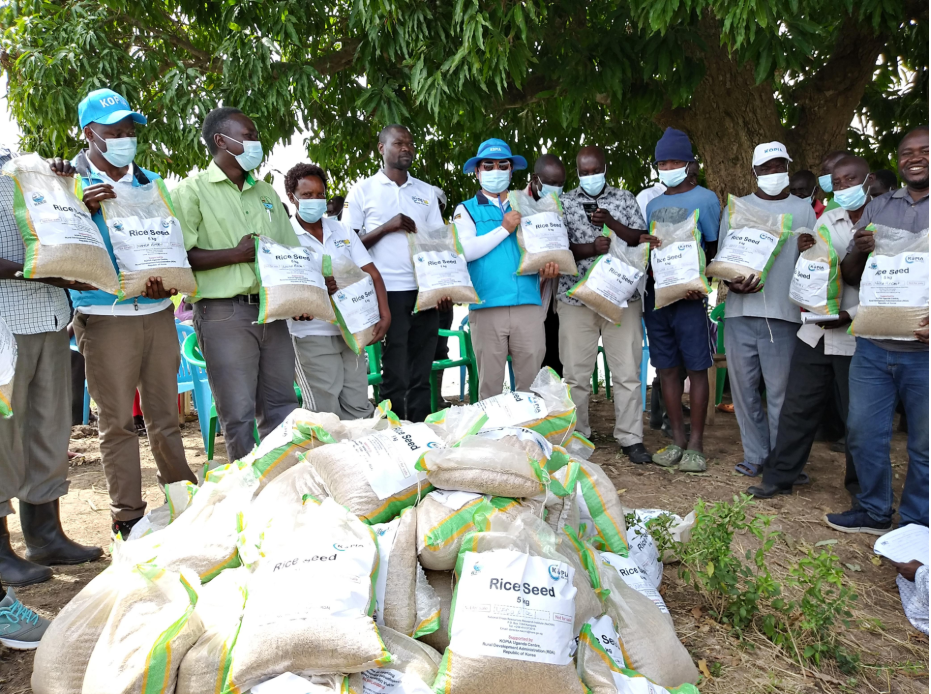
The RDA oversees the RiceSPIA program through its Korea Program for International Cooperation in Agricultural Technology (KOPIA), which operates regional centers in seven African countries. These offices coordinate with partner governments and monitor local rice production on a weekly basis.
“We have dispatched KOPIA officials to partner countries to oversee seed production, packaging and distribution to private firms and farms,” an RDA official said. “They have also trained about 5,000 local personnel in agricultural techniques across the production chain.”
Participants of an international rice seed symposium in Gambia watch a demonstration of Korean combines made by Daedong at a K-Ricebelt site in Sapu, Gambia, December 2024. KOPIA Senegal Center and Gambia RiceSPIA Office jointly organized the symposium and showcased Korean farm machines. Courtesy of the Rural Development Administration
Korean farm machines
Expanding rice production also requires modern farming equipment and technical expertise. So far, five African countries have imported Korean tractors, rice transplanters, combines and dryers to support the K-Ricebelt project.
Machinery exports not only reinforce the initiative’s effectiveness but also help Korean agricultural equipment makers expand into new markets. About 30 companies — including major firms such as Daedong, LS Mtron and Asia Technology, as well as small and medium-sized manufacturers — are currently exporting to Senegal, Gambia, Guinea, Ghana and Kenya.
As of last month, the companies had supplied about 250 types of equipment to the participating countries. Each KOPIA center assesses local demand and works with the Korea Agricultural Machinery Industry Cooperative to identify suitable machinery, which is then procured from Korean exporters.
“Korean farm equipment improves efficiency in African agricultural systems while allowing our companies to demonstrate performance in real field conditions,” an RDA official said. “This helps build local trust and supports expansion into global markets.”
The impact has been particularly notable in Guinea. Previously, farmers had to dry rice under natural sunlight due to a lack of dryers, limiting output to about 300 tons per cultivation cycle. The introduction of Korean rice dryers shortened processing time and improved seed quality, significantly boosting production capacity.
https://www.koreatimes.co.kr/amp/business/companies/20260226/govt-to-produce-11000-tons-of-seed-rice-in-africa-by-2027Published Date: February 26, 2026


 READ
READ