Downloads
 Login
Login
 Register


Tags
Govt issues fresh permits to import 2 lakh tonnes of rice
An agro economist questions timing of the approvals.
By Sukanta Halder
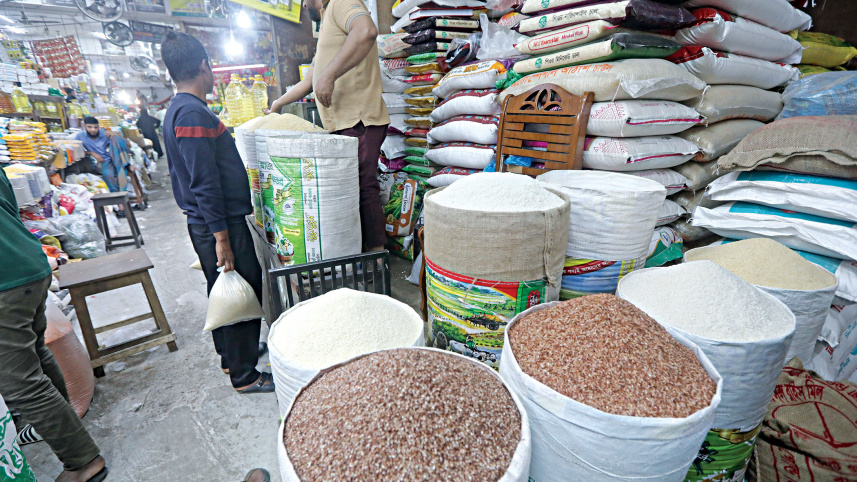
The food ministry has issued fresh permits allowing private traders to import 2 lakh tonnes of parboiled rice, amid comfortable public food stocks, an above average Aman harvest forecast and no sharp spike in the food staple prices.
Besides, around 6 lakh tonnes of rice approved earlier in the current fiscal year has already entered the country.
Even so, fine rice prices have edged up in recent weeks. The ministry has read this as an early warning for medium and coarse varieties, according to a notice issued on Sunday.
Agro economists, however, have questioned the move, calling it “unnecessary” as it could depress domestic prices and hurt the growers of Aman — the second largest rice crop in Bangladesh.
In August last year, the General Economic Division said rice played a bigger role in pushing up food prices and headline inflation. The grain’s contribution to food inflation rose from 40 percent in May to 51.55 percent in July last year.
As the government tries to rein in consumer prices, which have hovered above 8 percent for several months, total import permissions for private traders now stand at 8 lakh tonnes with the latest round.
Department of Agricultural Marketing data shows that on January 19, fine rice was sold at between Tk 70 and Tk 95 per kilogramme in retail markets, up from Tk 65 to Tk 90 a month earlier. That marks a 6.45 percent rise.
Md Firoz Sarkar, secretary of the Ministry of Food, told The Daily Star that the intervention is meant to steady the market after signs of rising rice prices.
Chitta Majumder, managing director of Majumder Group of Industries, a large rice miller and importer, said his company has received approval to import 4,000 tonnes and has started procurement from South India.
Majumder said the recent approvals have created challenges for large millers who usually buy and store paddy during the Aman season to supply the market throughout the year.
The government has attached several conditions to the permits. Importers must sell all imported rice in Bangladesh by March 10 and submit details of quantity, storage and distribution to district food controllers. They must also sell the rice in the original imported sacks and cannot repackage it under another company name.
Alongside private imports, the government is also bringing in rice for public stocks.
Data from the Directorate General of Food shows that authorities have initiated imports of 600,000 tonnes of rice so far this fiscal year, with 120,000 tonnes already delivered.
As of January 19, government rice stocks stood at 18.71 lakh tonnes, more than double the 8.69 lakh tonnes recorded on the same date last year.
Bangladesh needs around 3.7 crore to 3.9 crore tonnes of rice a year, most of which comes from domestic production, according to official data.
As per the UN’s Food and Agriculture Organisation (FAO), Aman production in 2025 was forecast at an above average level. Boro output was estimated at a record 31.7 million tonnes. Although Aus production was expected to fall below average, total paddy output in 2025 was projected at an above average 62 million tonnes.
Jahangir Alam Khan, an agricultural economist, said large-scale imports at this stage are unnecessary given the strong Aman harvest and healthy public stocks.
He said there is no risk of shortages or supply disruptions during the harvest season, and that small price swings are normal.
“Business syndicates are pushing for imports because they can buy paddy cheaply from farmers and sell rice to the government at higher prices, while also profiting from the gap between lower international prices and higher domestic market rates,” he said.
Khan added that a government serious about supporting farmers would expand domestic paddy procurement, rather than capping it at 50,000 tonnes at a reduced price.
He also said the interim government’s move to fast-track imports ahead of elections weakens the role of the next political government, which should assess market conditions and decide whether imports are needed.
https://www.thedailystar.net/news/govt-issues-fresh-permits-import-2-lakh-tonnes-rice-4087296Published Date: January 22, 2026


 READ
READ