Downloads
 Login
 Register


Tags
Enhancing the value of Hanoi’s rice-growing region through mechanization.
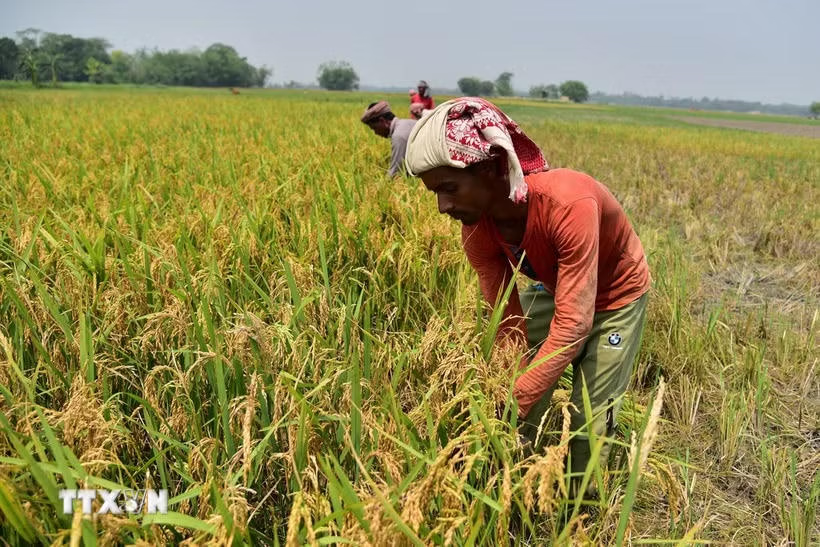
Mechanization is not only replacing human labor with machinery, but is also gradually changing the way rice production is organized in Hanoi. From tray seedling cultivation and machine transplanting to drones and the formation of specialized farming areas spanning hundreds of hectares, a concentrated and synchronized production method is being established. It is evident that, as the city’s support policies are implemented, the problems of labor shortages, high costs, and fragmented production are gradually being resolved, paving the way for improved quality and value of Hanoi’s rice.
The benefits of machine-planted rice fields.
In the fields of Chuyen My commune, the noticeable changes in recent production seasons are not only the new rice varieties but also the way the rice plants are transplanted. In the spring of 2026, the Hanoi Agricultural Extension Center, in coordination with the local authorities, implemented a model of applying tray seedling and machine transplanting on a scale of 100 hectares with 405 participating households, using the Dai Thom 8 variety. The results showed that the yield of machine-transplanted rice reached approximately 63.7 quintals/hectare, 7.5 quintals/hectare higher than hand transplanting, equivalent to an increase of 10-13%. The cost of sowing seedlings and transplanting was about 9.43 million VND/hectare, lower than the traditional method by 3.16 million VND/hectare; the average profit increased by about 10-12 million VND/hectare/season.
However, the value of a rice transplanter is not just about the few million dong saved in costs. When rice is transplanted evenly in rows and at the correct spacing, the field is more open, making care, water management, fertilization, and pest control easier. Importantly, when rice is planted in the same area within the same planting season, the conditions for mechanizing subsequent stages are also expanded.
Mr. Nguyen Van Ta, a farmer from Ha village, Chuyen My commune, said that people receive 50% support for seeds and fertilizers, and are guided by agricultural extension officers and the Phu Chuyen Agricultural Cooperative on technical procedures from planting and caring to pest and disease control. Based on his experience, Mr. Nguyen Van Ta’s family assessed that organizing machine transplanting in concentrated areas is more convenient than traditional farming methods; the rice plants grow well, and farmers reduce labor significantly.
Also during the spring of 2026, the Hanoi Agricultural Extension Center implemented a model of applying tray seedling and machine transplanting on 300 hectares in the communes of Dai Xuyen, Chuyen My, Da Phuc, and Trung Gia, with 1,667 participating households. The average actual yield reached 61.9 quintals/hectare, 6.8 quintals/hectare higher, equivalent to 11-13% compared to manual transplanting; economic efficiency increased by approximately 10-11 million VND/hectare/season; and production costs decreased by approximately 3.8-4 million VND/hectare…
Along with mechanization, Hanoi is also experimenting with another approach: linking high-quality rice-growing areas with safe production processes and markets. In Thu Lam commune, the TBR225 rice variety production model following VietGAP standards has been implemented on 100 hectares with 477 participating households; the average yield reached 66.8 quintals/hectare, with a total production of approximately 668 tons; about 40% of the production is purchased by affiliated businesses; the economic efficiency is about 4.3 million VND/hectare/season higher than conventional production. These statistics show that mechanization is only truly effective when combined with the reorganization of production.
From machinery support to production reorganization
According to the Hanoi Department of Agriculture and Environment, the city’s agricultural sector grew by 3.54% in the first nine months of 2026. Specifically, during the spring crop season, the entire city planted 99,871 hectares, including approximately 78,500 hectares of rice, with an average yield of 64.5 quintals/hectare and a total production of about 506,000 tons. During the autumn crop season, the city planted 58,200 hectares of rice.
The scale of production shows that rice still holds an important position in the agricultural structure of the capital city. However, the workforce directly employed in the fields is decreasing and aging. Tasks requiring a large workforce in a short time, such as sowing seedlings, transplanting, and spraying pesticides, become a major pressure, especially during the peak season. Therefore, mechanization aims not only to increase productivity but also to address structural issues in agricultural production.
According to Nguyen Thi Kim Que, Director of the Hanoi Agricultural Extension Center, the city’s orientation is to promote the application of advanced technology, synchronized mechanization, and the use of new rice varieties with high yield and quality, aiming for green, sustainable production that adapts to climate change.

When there is a concentrated production area, it is possible to form seedling centers and machine transplanting service centers; drones can spray simultaneously over large areas; harvesting machines operate more smoothly; and businesses can also easily sign purchasing contracts when there is “one region – one variety – one process” and a large output.
According to Nguyen Manh Phuong, Deputy Director of the Hanoi Department of Agriculture and Environment, the Department has requested Chuyen My commune to continue reviewing the effectiveness of each policy, leveraging the city’s support resources, promoting mechanization and the application of science and technology, aiming towards a modern, efficient, and sustainable agricultural system.
According to Mr. Nguyen Manh Phuong, the city aims for approximately 80% of its cultivated area to use high-quality rice varieties, with the remaining 20% being high-yield varieties for processing and livestock farming. The agricultural sector also aims to support the construction of seedling tray production centers at the local level, establish machine transplanting service groups, and increase technical training for producers. This shows that the goal is not mechanization at all costs, but rather to improve product quality and production efficiency.
Source: Hà Nội Mới
https://www.vietnam.vn/en/nang-gia-tri-cho-vung-lua-ha-noi-bang-co-gioi-hoaPublished Date: October 25, 2026


 READ