Downloads
 Login
Login
 Register


Tags
Demand surges for traditional puffed rice during Ramadan in Barishal division
Women in 21 villages keep earthen ovens burning from dawn to dusk.
Sushanta Ghosh and Sohrab Hossain
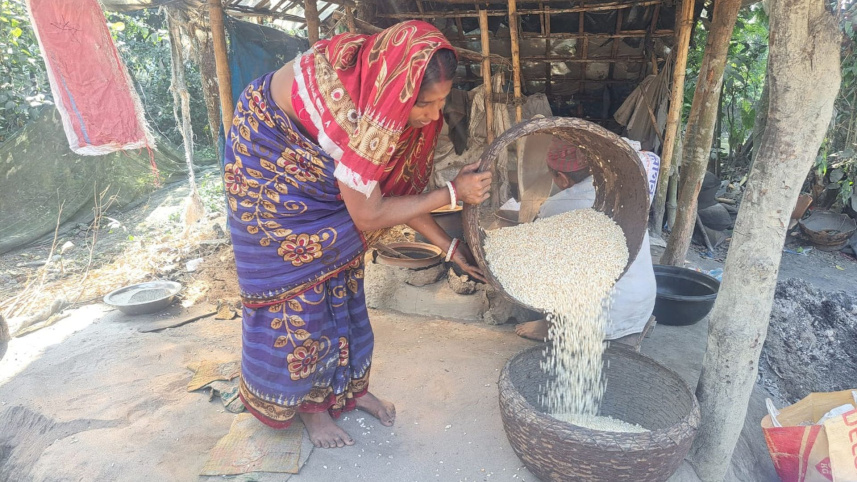
Traditional puffed rice from the southern districts of Barishal, Jhalakathi and Patuakhali witnessed a surge in demand during Ramadan as it is a popular ingredient for iftar.
The makers, mostly women, are passing a busy time making the puffed rice, locally known as ‘muri’, and transporting it to Dhaka and other parts of the country by launches and trucks.
Being hand-fried and without chemical additives, the traditional muri is more popular and considered much safer compared to regular puffed rice that is commercially-prepared using machine and often contains chemicals.
In at least 21 villages across Bakerganj upazila of Barishal and Nalchity upazila of Jhalakathi, women are engaged in making muri using coarse local Aman rice on rows of earthen ovens from dawn till dusk. Each family can produce up to 60 kilogrammes of muri a day.
Beli Rani Das of Daspara Muri Palli under Bakerganj upazila said the demand has tripled during Ramadan.
“We start very early in the morning and continue till evening, producing up to 60 kg a day,” she said.
Lakhan Chandra Das, another maker from the same village, said rice varieties such as “Nakuchi” and “Bahuri” were once used for puffed rice production.
“Those varieties have disappeared. Now we use coarse Aman rice,” he added.
In Bharatkathi village of Nalchity upazila, wholesale trader Buruj Ali Khan said he sends muri worth at least Tk 2 lakh daily to different parts of the country.
Dipali Rani of the village said she earns about Tk 400 in profit from a sack of puffed rice. Rise in prices of firewood and coarse rice has lowered the profit margins in this trade, she added.
In Patuakhali, several hundred families in Galachipa, Kalapara, Dumki, Patuakhali Sadar upazilas earn their livelihoods by producing traditional puffed rice. Women usually play the key role in the process, while other family members assist them.
In Dakshin Pangashia village under Dumki upazila, four families from the Saha Bari have been involved in making puffed rice for generations. Among them are Anil Saha, 70, and his wife Babita Rani Saha, 55, who support their five-member family through this ancestral trade.
“When we started working in this trade, a maund (around 37 kg) of paddy cost only Tk 40, while a seer (around 933 grammes) of puffed rice sold for about Tk 2.5. Now paddy costs between Tk 900-1,000 per maund, and we sell puffed rice at Tk 80-90 per kg,” Babita Saha said.
She also said their family can make around 100 kg of puffed rice a day. “The puffed rice is usually sold at weekly markets in Patuakhali and Dumki, while many wholesale traders also buy it directly from us. There is demand throughout the year, but it increases during Ramadan,” she added.
Anil Saha said, “After paddy harvest, we buy Aman paddy from the market, process it into rice, and use it to produce puffed rice round the year.”
Seema Rani Saha, a maker from Lohalia village under Patuakhali Sadar, said she learned the craft from her mother and has grown deeply attached to it.
“Producing puffed rice requires several traditional tools, including a clay stove with four burners, earthen pots, pans, baskets, and bamboo trays. The process begins by mixing coarse rice with salt water and roasting it in a clay pot for about 15 minutes, while sand is heated in another pot,” she said.
“For every 50 kg of rice, about 1 kg of salt is required. The heated sand is then poured into another pot, and the roasted rice is added and stirred for about 10 to 15 seconds to produce puffed rice,” Seema added.
Wholesalers usually buy a 50-kg sack of puffed rice from makers for around Tk 4,000, and sell it in markets for Tk 4,500-4,750, while retail prices range between Tk 100-140 per kg.
Ujjal Saha, a retailer at Patuakhali New Market, said hand-fried puffed rice has long been popular among consumers. However, machine-produced puffed rice has affected the traditional trade to some extent.
“Makers often have to sell their product at lower prices and earn less profit. Still, many customers prefer hand-fried puffed rice because it tastes better and is safer compared to machine-made ones,” he added.
Nalchity upazila nirbahi officer Md Zubayer Habib said the muri-palli, a cluster of villages in the upazila where families are engaged in making puffed rice, generates at least Tk 3 crore in revenue during Ramadan.
“If entrepreneurs come forward, the government will extend support to them in the sector,” he added.
Rebecca Sultana, vice-president of Women’s Business Forum (WBF), said more than 100 families in Bakerganj and Nalchity upazilas are involved in producing and shipping puffed rice worth around Tk 50 lakh daily.
Md Nazrul Islam, deputy general manager of Bangladesh Small and Cottage Industries Corporation (BSCIC) in Barishal, said workers in the sector can seek loans for economic self-reliance.
He, however, noted that no formal database on the sector is currently available due to absence of institutional management.
https://www.thedailystar.net/news/bangladesh/news/demand-surges-traditional-puffed-rice-during-ramadan-barishal-division-4124186Published Date: March 9, 2026


 READ
READ