Downloads
 Login
 Register


Tags
Pakistan Targets Uganda’s $300 Million Rice Market With Direct Trade Push
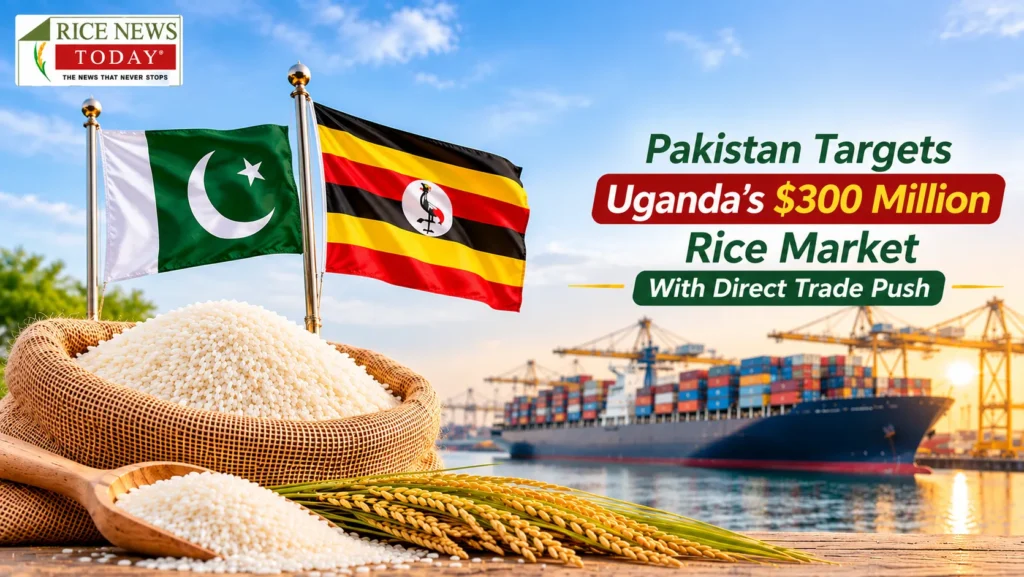
ISLAMABAD: Pakistan is pressing for direct rice sales to Uganda, a market that imports roughly $300 million of rice a year but where Pakistani exporters supply only about $3 million, or around 1 percent. The proposal came during talks on Monday between Federal Minister for National Food Security and Research Rana Tanveer Hussain and Uganda’s Minister of State for Agriculture, Animal Industry and Fisheries, Desire Muhooza, according to an official statement.
The meeting covered agricultural trade, research cooperation, market access and institutional ties. It also aimed at setting up a formal mechanism for sustained engagement between the two countries.
Pakistan Pitches Direct Rice Trade
Rice was the main area of opportunity. Hussain said Pakistan can supply high-quality rice at competitive prices and proposed direct commercial links between Pakistani exporters and Ugandan importers.
The statement said Pakistani rice often reaches Uganda through third markets, including Tanzania, which adds to costs. Both sides recognised that trading directly could make prices more competitive, strengthen commercial relationships and open new opportunities for exporters. A meeting between Ugandan buyers and Pakistani rice exporters in Karachi was also proposed.
The push comes after a strong export year. The Rice Exporters Association of Pakistan reported that the country shipped about 5.82 million metric tonnes of rice worth $3.35 billion worldwide in fiscal year 2024-25.
Trade Balance Favours Uganda
Overall bilateral trade currently tilts toward Uganda. Pakistan imports about $14 million of goods from Uganda and exports about $3 million. Pakistan said it wants to raise its agricultural exports while exploring imports of pulses and other farm commodities from Uganda.
| Indicator | Value (approx.) |
|---|---|
| Pakistan’s imports from Uganda | $14 million |
| Pakistan’s exports to Uganda | $3 million |
| Uganda’s annual rice imports | $300 million |
| Pakistan’s share of Uganda’s rice imports | $3 million |
Proposed Joint Working Group
To give cooperation a formal structure, Hussain proposed a Joint Working Group (JWG) on Agriculture. It would serve as a platform for regular consultations, identifying trade opportunities, resolving technical issues and carrying out joint initiatives. Relevant institutions would meet periodically, with technical consultations as needed.
Pending Agriculture MoU
The two sides also discussed fast-tracking a Memorandum of Understanding on agricultural cooperation, first exchanged through diplomatic channels in 2017. They agreed that remaining institutional and procedural issues should be handled through coordination between the relevant ministries and diplomatic missions.
Uganda’s Avocado Request
The meeting reviewed Uganda’s pending request to export fresh avocados to Pakistan. The Pakistani side said Uganda must submit the technical information needed for a pest risk analysis, and both sides stressed closer coordination between their plant protection authorities.
Research, Seeds and Olive Oil
Agricultural research, climate-resilient seeds, crop improvement, mechanisation and livestock development were named as areas for future cooperation. Hussain highlighted the capabilities of the Pakistan Agricultural Research Council (PARC) and the National Agricultural Research Centre (NARC). A visit by the Ugandan delegation to NARC was proposed to explore partnerships, particularly in wheat, rice, potato and seed technologies.
Hussain also promoted Pakistan’s emerging olive industry, noting that Pakistani olive oil won a silver medal at a quality competition in New York. The sides discussed introducing it to the Ugandan market.
What Comes Next
The ministers acknowledged the value of business-to-business contacts, including those expected from the Ugandan delegation’s participation in a food and agriculture exhibition in Karachi. Both sides reaffirmed their commitment to closer agricultural ties through trade, institutional cooperation, technology exchange and better market access. They stressed turning the discussions into practical steps: the working group, the MoU, direct rice trade and closer links between research and regulatory bodies.
Published Date: November 23, 2026


 READ