Downloads
 Login
 Register


Tags
India’s Broken Rice: Export Curbs Back on the Table as Prices Clear $360
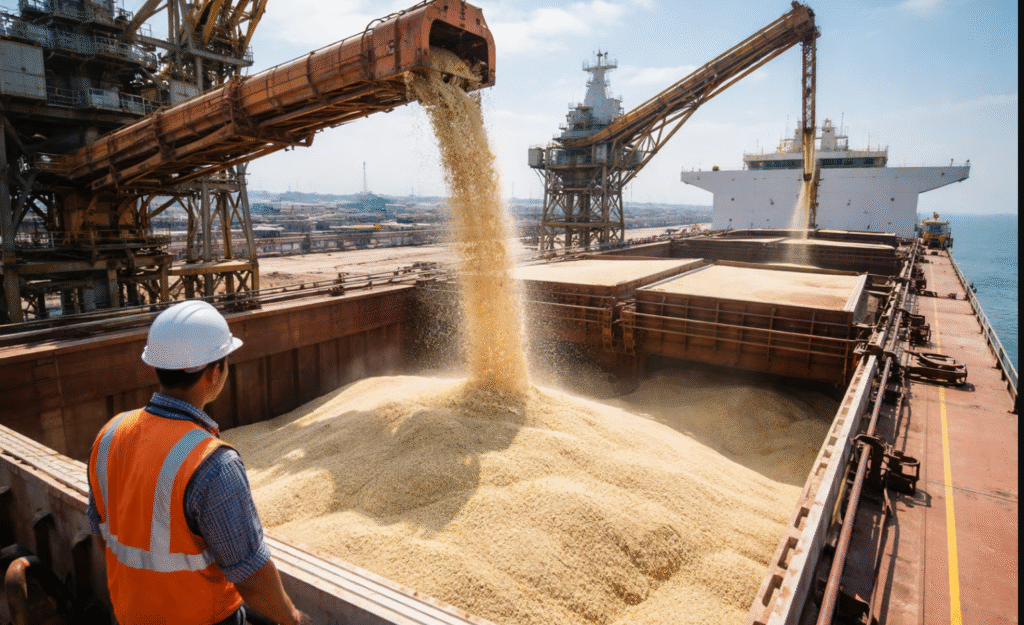
India’s broken rice prices above $360/tonne and stronger ethanol, feed demand revive the risk of export curbs, with rising inflation and 2027 state polls in focus.
India’s broken rice market has flipped back into the political risk zone as international prices move above $360 per tonne and domestic wholesale values jump over 5% in three weeks, reviving the prospect of export curbs. While no formal measures have been announced, exporters now face a policy overhang similar to the 2022–2025 ban period. Rising demand from ethanol manufacturers and poultry-feed producers is tightening availability just as overseas buyers step up purchases. This squeeze is feeding into domestic inflation metrics and heightening government sensitivity ahead of key state elections in 2027. India’s aggregate rice balance remains comfortable after another record crop, but broken rice has become a strategic industrial feedstock with its own, much tighter, supply–demand dynamics.
Prices
International prices for 100% broken rice have reportedly crossed the USD 360 per tonne threshold, a level industry views as a trigger for policy scrutiny by New Delhi. At the same time, the all‑India average wholesale price of broken rice climbed to about ₹3,036 per quintal on 2 November, up roughly 5.3% from mid‑October, confirming swift domestic firming.
This pace of appreciation is also reflected in the Wholesale Price Index, where broken rice inflation accelerated to around 5.4% year‑on‑year in September from about 4.4% in August. The combination of stronger global quotes and visible domestic inflation pressure significantly raises the risk premium on forward pricing and shipment commitments for Indian origin broken rice.
Supply & Demand
India’s overall rice balance sheet is still comfortable, with 2025–26 production estimated at a record 154.02 million tonnes versus 150.18 million tonnes the previous year, and exports around 21.57 million tonnes keeping the country firmly in the top‑exporter position. However, broken rice is a by‑product of milling with a much narrower supply base and is now heavily contested by multiple user segments.
The rapid expansion of the ethanol‑blending programme has made broken rice, alongside maize and surplus Food Corporation of India stocks, a major grain‑based feedstock. Commercial distilleries are increasingly sourcing from the open market, putting them in direct competition with poultry‑feed manufacturers and exporters. This tightening tug‑of‑war over limited broken rice supplies is amplifying price moves even against the backdrop of ample headline rice production.
Fundamentals & Policy Risk
Industrial demand growth is central to today’s market dynamics. Broken rice has shifted from being a low‑value by‑product to a critical input for ethanol manufacturing and animal feed, structurally lifting its demand floor. As procurement by these sectors rises, exporters find themselves squeezed both on availability and on margins, especially when global buyers are willing to pay higher prices.
On the policy side, the government’s past interventions provide a clear precedent. Broken rice exports were fully prohibited in September 2022 over domestic availability concerns and only restored to the “free” export category on 7 March 2025. With domestic prices and WPI inflation for broken rice now trending higher and Assembly elections due in major consuming states in 2027, authorities are likely to be more intolerant of further food‑linked price spikes, particularly where industrial ethanol demand is perceived to crowd out food and feed uses.
Weather & Crop Context (India)
India’s aggregate rice output for 2025–26 is projected at a record level, indicating that recent price strength is not driven by a nationwide crop failure. However, regional weather remains relevant for the ongoing rabi and summer rice cycles, especially in southern and eastern states that rely on northeast monsoon showers for irrigation replenishment.
Seasonal guidance for November points to some spatial rainfall variability across south India, but no immediate nationwide weather shock that would materially alter the 2025–26 production estimates. As a result, current market tightness in broken rice is better explained by structural demand growth and policy uncertainty than by acute weather‑driven supply losses.
Market & Trading Outlook
In the near term, broken rice prices are likely to stay under upward pressure as long as international values hold above USD 360 per tonne and domestic wholesale prices remain elevated. Any official signal on export policy—such as consultations, notifications or informal guidance to trade—could trigger sharp price reactions and rapid repricing of export spreads.
Given the strong domestic pull from ethanol and feed, export availability of 100% broken rice is expected to stay tight even without formal curbs. Should restrictions be reimposed, Asian and African buyers dependent on Indian broken rice would be forced to pivot quickly to alternative origins or substitute grades, likely at higher delivered prices.
Focused Trading Guidance
- Exporters: Limit long‑dated forward sales in 100% broken rice and build in policy‑risk clauses where possible. Closely track domestic wholesale prices, WPI data and ethanol‑sector offtake as leading indicators of potential intervention.
- Importers (Asia & Africa): Diversify origin exposure away from a pure India dependence and explore coverage using alternative grades (e.g. higher brokens or different origins) while Indian policy is unresolved.
- Domestic users (ethanol, feed): Consider securing medium‑term supply contracts before any formal move on export curbs, as tighter export availability could quickly pivot into higher domestic offer levels if overall rice sentiment remains firm.
Published Date: November 4, 2026


 READ