Downloads
 Login
 Register

Tags
Jumla’s prized Marsi rice is in demand, but production is declining
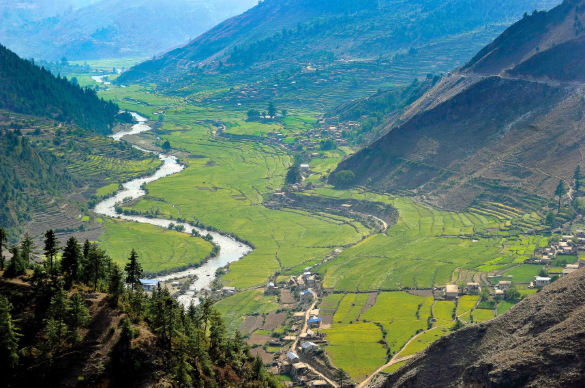
From village kitchens to urban hotels and international markets, demand for the indigenous rice is rising, but pest outbreaks and rising cultivation costs are adding to farmers’ woes.
Author: Krishna Prasad Gautam
Purna Chandra Neupane of Jumla, in mid-western Nepal, has cultivated Marsi paddy on around five ropani (0.25 hectares) of land. His family of five is currently busy harvesting the crop. Having produced nine quintals of paddy last year, he expects a similar harvest this year.
Last year, he earned Rs150,000 by sending seven quintals of the paddy to Nepalgunj and Surkhet. The reddish-brown, aromatic rice is a prized crop grown in the Himalayan region.
“I should have got the harvesting done two weeks ago,” he said. “I finally found time after the Dashain festival, but the rain delayed the work. I think I’ll be able to finish the work in another two or three days.”
He does not have to look for buyers. Traders from Nepalgunj have already placed an order for five quintals this year. Last year, he sold the rice to traders from Nepalgunj and Surkhet at Rs210 per kg.
Neupane is not alone.
Most farmers in Jumla are currently busy harvesting, threshing and winnowing Marsi paddy. Those who completed harvesting before Dashain are now occupied with milling the grain.
Jayashankar Devkota of ward 3 of Chandannath Municipality in Jumla said traders have started buying Marsi paddy directly from farmers’ fields. According to him, they are offering Rs180 per kg in Khalanga, the district headquarters.
“Growing it is difficult for us, but traders start placing orders even before we have finished harvesting,” he said. “It is becoming increasingly difficult to meet demand.”
Devkota has cultivated Marsi on seven ropani (0.36 hectares) and says production was good this year because of favourable rainfall. Last year, he sent nearly nine quintals of Marsi rice to Surkhet. Selling it for Rs200 per kilogram earned him Rs180,000.
Farmers in the Himalayan districts are now busy storing their harvest following Dashain. Even before they can finish harvesting, they are receiving orders for both paddy and rice. Local producers are supplying the rice to markets through various cooperatives and agricultural companies.
Kali Bahadur Rokaya of ward 7 of Simkot Rural Municipality in Humla has cultivated Marsi on seven ropani. Last year, he earned Rs150,000 from the crop.
“Neither the price nor the market is a concern,” he said. “The problem is that cultivation itself is difficult, making it hard to produce enough to meet demand.”
In recent years, major hotels in Birendranagar, the provincial capital, and neighbouring Nepalgunj have also added Marsi rice to their menus.
“There is no question of leaving Marsi off our hotel’s menu,” said Krishna Neupane, chief executive officer of Siddhartha Group of Hospitality. “As it combines health benefits with taste, this indigenous product of Karnali is becoming the first choice of customers.”
According to him, Siddhartha hotels primarily use Marsi rice to prepare steamed rice and rice pudding.
Ramesh Shahi, proprietor of Hotel Dukku in Birendranagar, said customers particularly enjoy Marsi sel (sweet ring-shaped fried bread made from rice flour), steamed rice, and rice pudding. The hotel prepares a special menu featuring Marsi dishes for six months of the year.
“Production is not sufficient to meet demand throughout the year,” he said. “So we serve Marsi dishes only from November to April.”
Demand for Marsi is also growing in Kathmandu and other major cities.
Harikrishna Bhandari, a Jumla native who runs the Karnali Organic Shop in Thamel, Kathmandu, said Marsi rice sells for Rs250 to Rs300 per kg.
“Once it is included on the menu, demand naturally follows,” he said. “With production low and demand high, it has become difficult to fulfil orders.”
Bhandari sold 15 tonnes of Marsi rice last year, of which three tonnes were exported to Japan, South Korea, the United States, and the United Kingdom.
The Chandannath Multipurpose Cooperative in Jumla has already collected Marsi rice worth around Rs3 million this year. The cooperative supplies the rice to Kathmandu, Bhairahawa, Butwal, Chitwan, Pokhara, Biratnagar, and Dharan, among other cities, said its manager, Rishiram Pandey.
“Demand has also increased in international markets because Marsi is considered beneficial for health,” he said. “It sells for as much as Rs2,000 a kilo in international markets.”
According to the Karnali Province Ministry of Land Management, Agriculture and Cooperatives, Marsi paddy is cultivated on 5,280 hectares across the province. Production reached 9,725 tonnes last year.
In Jumla, the crop was cultivated on 2,888 hectares and 6,125 tonnes was produced last year. The ministry’s data show that Marsi is grown on 1,060 hectares in Mugu and 1,340 hectares in Humla. Production last year stood at 1,590 tonnes in Mugu and 2,010 tonnes in Humla.
Ramesh Khadka, an agriculture development officer at the ministry, said Jumla produces 2.12 tonnes of Marsi rice per hectare, while yields in Mugu and Humla range from 1.5 to 1.8 tonnes per hectare.
The cultivation cycle of Marsi paddy in Karnali differs from that of other rice varieties. Farmers follow a specific calendar for cultivation, said Jayananda Pandey, a leading farmer in Jumla.
According to him, there is a popular belief that Hindu sage Chandannath Baba discovered and domesticated the Marsi rice in Jumla around 1,000 years ago.
“Since his time, the cultivation process has been different from that of other paddy varieties,” he said. “Farmers follow the Marsi calendar, from transplantation to weeding.”
Agriculture technician Lachhiram Budhathapa said three varieties of Marsi paddy—Chandannath-1, Chandannath-3 and Lekali—are cultivated in the Karnali region. Marsi is grown in various parts of Jumla, including Chhumchaur Jiulo, which lies at an altitude of 2,850 metres above sea level.
In recent years, however, pest and disease infestations have taken a toll on Marsi production.
“Labour and expenses have increased, while production has declined,” said farmer Pandey. “As a result, farmers around the district headquarters have increasingly switched from Marsi to other rice varieties.”
He also said hailstorms destroyed the paddy crop last year just as farmers were preparing to harvest it, and they were unable to recover even their production costs.
“Most agricultural fields in Jumla are large, requiring considerable labour,” he said. “When expenses for fertilisers, seeds, and weeding add to the financial burden on farmers. Over the past two or three years, blast disease has further hit production.”
According to him, farmers spend an average of Rs4,965 to cultivate Marsi paddy on one ropani (508.7 sq metres) of land.
Agriculture technicians say Marsi paddy has been affected by neck blast disease over the past two to three years.
“Neck blast has caused a significant decline in paddy production. It is caused by a fungus called Magnaporthe grisea,” Budhathapa said. “The fungus damages all parts of the rice plant above the ground. Infected leaves develop small, elongated brown spots with whitish centres, after which the plants gradually dry up.”
He said the disease causes the stem nodes to turn brown and the panicles appear as if they have been broken off. The affected panicles eventually dry out and turn white or brown.
The disease not only reduces paddy yields but also affects the quality of the harvested grain, he said. The growing incidence of pests and diseases has also reduced farmers’ interest in Marsi cultivation.
With Marsi paddy cultivation increasingly under threat, farmers in Jumla have started insuring their crops. Following the success of apple insurance schemes, insurance companies began offering coverage for Marsi in 2022 through the Agriculture Development Office.
“We had stopped cultivating Marsi because it involved considerable hardship while yields kept declining,” said Krishna Bahadur Mahatara, a farmer from Patarasi. “Insurance has provided relief against losses caused by diseases, hailstorms, dry spells, and grain shedding.”
Mahatara has planted Marsi rice on five and a half ropani of land. He said he insured his paddy field six months ago by paying a premium of Rs335. If the crop suffers any damage before harvesting, he is entitled to compensation of Rs26,500.
His neighbour, Jokh Bahadur Mahatara, has also insured Marsi crop on nearly four ropani. After paying a premium of Rs260, he is eligible for compensation of Rs19,099 if his crop is damaged.
“We are harvesting the crop now, and there is no need to worry even if hailstorms or other incidents damage it before the harvesting is complete,” he said. “The insurance company will provide compensation if anything happens.”
Ram Bhakta Adhikari, chief of the District Agriculture Development Office in Jumla, said the insurance scheme was introduced to protect Kalimarsi (a Marsi variety) rice and was becoming increasingly effective.
According to him, farmers in Jumla spend an average of Rs4,965 per ropani to cultivate Marsi.
“With demand increasing even in international markets, it has become necessary to protect Marsi,” he said. “We are continuing the insurance programme in coordination with various insurance companies through the agriculture office.”
He said farmers have to pay only Rs50 per ropani in insurance premiums after the government subsidy.
Following the formation of the Karnali provincial government, its first Cabinet meeting on February 18, 2018, declared the province an organic agricultural region. To implement the decision, the government introduced the Organic Agriculture Mission Programme Implementation Directive in the following year.
The directive includes provisions for the conservation, promotion and marketing of Marsi rice as part of efforts to promote indigenous crops produced in the province.
The Ministry of Land Management, Agriculture and Cooperatives said it spends between Rs10 million and Rs15 million annually through district agriculture development offices to expand Marsi cultivation and provide technical assistance to farmers in Jumla, Mugu and Humla districts.
According to the ministry, Marsi is one of nine indigenous crops found exclusively in Karnali province.
Ministry Secretary Sanjiv Kumar Karna said the government had launched a conservation campaign by branding Marsi rice with the ‘Mulyawan’ (valuable) logo.
“Farmers receive technical assistance from the preparation of seedbeds until the harvest,” he said. “We deploy agricultural technicians directly to farmers’ fields. Subsidies are also provided for seeds and organic fertilisers, along with support for agricultural equipment.”
According to him, the ministry has spent Rs130 million so far on Marsi cultivation and marketing.
The ministry said the Agriculture Development Office has designated 17 local governments across the three districts as production zones and is providing various forms of support to farmers.
This year, the ministry has allocated Rs43 million for Marsi cultivation and marketing.
The Food Management and Trading Company Limited is also purchasing and selling indigenous crops from Karnali, including Marsi rice, beans, chino (porso millet), kaguno (foxtail millet), and buckwheat, said Keshav Budha, the company’s provincial chief.
According to him, the company purchased nearly three tonnes of Marsi paddy from Humla and Jumla in the last fiscal year.
Although Marsi rice sells for as much as Rs300 per kg in the market, the state-owned company is selling it for Rs225 per kg, he said.
According to Purna Singh Kathayat, chairman of the Chandannath-Bhairavnath Guthi Management Committee, the Bishu festival is celebrated on Chaitra 20 (April first week) every year to commemorate the day Chandannath Baba began cultivating Kalimarsi rice in 1198 of the Bikram Sambat calendar.
“During the Rana regime, from 1904 to 2007 BS, one mana (a traditional Nepali measurement equal to 0.57 litres) of rice was sent to the royal palace every day through the postal service,” he said. “Its popularity has continued ever since.”Would you like this formatted into a concise news report summary or broken down into key trade and pricing data points?
https://kathmandupost.com/money/2026/11/02/jumla-s-prized-marsi-rice-is-in-demand-but-production-is-decliningPublished Date: November 2, 2026


 READ