Downloads
 Login
 Register


Tags
Korea’s Rice Sales Fall 10% Even as Prices Drop
By Cho Su-yeon, newsuyeon@sedaily.com
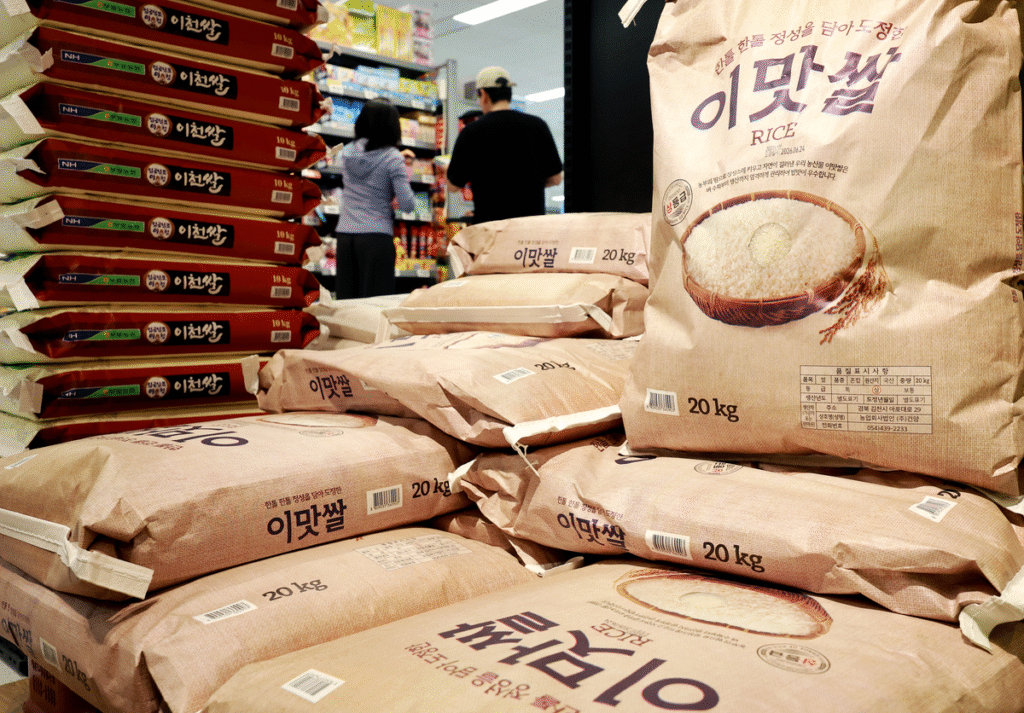
Demand for rice is weakening across South Korean households, restaurants and catering firms, raising questions about whether the slide will ripple through the country’s rice supply. Household rice consumption, which briefly rebounded in June and July, turned lower again.
Less Rice at Home and Out: Retail Sales Down More Than 10%
Retailers sold about 35,000 metric tons of rice last month, down 10.4% from a year earlier, according to the November rice edition of the Agricultural Outlook released on the 29th by the Korea Rural Economic Institute.
The figures draw on point-of-sale data from Market Link, covering sales information from more than 5,800 major retailers nationwide — including hypermarkets, convenience stores, supermarket chains, cooperative marts and independent grocers — along with sample surveys of smaller shops.
Household consumption also fell. In the institute’s August survey of food consumption, households consumed 61,000 tons of rice, including rice received free of charge, a decline of 5.7% from the same month a year earlier.
Rice that households purchased directly came to 52,000 tons over the same period, down 4.9% from a year earlier.
Household rice consumption had risen year-on-year for two straight months in June and July before falling again in August, indicating that the brief pickup in demand did not hold.
A similar pattern emerged in the food service sector. Restaurants and catering companies bought 73,000 tons of rice in August, down 6.8% from a year earlier. Among the industries that use the most rice, purchases declined in most categories except gimbap and other quick-service restaurants.
Sales by distributors that handle rice from producing regions were also weak. Regional distributors sold a combined 987,000 tons of rice from January through September, down 6.2% from the same period last year, a drop of 65,000 tons.
The institute said the decline is tied to shrinking rice consumption at households, food service and catering operators, and retailers.
Prices Lower but Demand Weak; Harvest-Season Prices Seen Firm
Rice has also grown cheaper than a year ago. The retail price this month was 63,577 won for a 20-kilogram bag, down 3.8% from the same period last year. The average price of a 10-kilogram product fell 1.2% to 35,044 won.
Prices in producing regions declined as well. As of the 15th, rice in producing areas sold for 57,580 won per 20 kilograms, down 1.2% from a year earlier.
The institute attributed the price declines to relatively ample inventories of rice harvested last year and to weaker demand from households and restaurants. A larger share of early-maturing rice varieties, which increased shipments, also played a role.
Whether the demand slump will keep pushing prices lower remains uncertain.
The institute said harvest-season prices could instead hold slightly above last year’s levels, citing an expected decline in this year’s output, the drawdown of existing inventories and additional demand to secure rice for repaying government grain loans.
On that basis, it projected that average prices in producing regions from October through December will be firm to slightly higher than a year earlier. Actual price movements could shift depending on crop conditions, compliance with rice contracts used to manage supply, and government measures to stabilize the market.
The government is also running programs to lift flagging rice consumption.
The Ministry of Agriculture, Food and Rural Affairs operates the “1,000-won breakfast” program, which offers university students and industrial complex workers a breakfast made with domestic rice for 1,000 won.
This year’s target is 5.4 million meals for university students and 900,000 meals for industrial complex workers. The program for industrial complex workers, after a trial run last year, has been expanded into a full pilot project this year.
The ministry is accepting applications to join next year’s program from the 26th of this month through the 10th of next month. It aims to spread breakfast habits within industrial complexes and encourage rice consumption.
https://en.sedaily.com/finance/2026/10/29/koreas-rice-sales-fall-10-percent-even-as-prices-dropPublished Date: October 29, 2026



 READ