Downloads
 Login
Login
 Register


Tags
Agricultural production enters the final sprint of the year.
At the end of the first nine months of 2026, the GDP of the agriculture, forestry, and fisheries sector increased by 4.02%; export turnover is estimated at 56.3 billion USD, an increase of 7.8% compared to the same period in 2025. To achieve the growth target of 4% and an annual export turnover of 74 billion USD or more, the remaining months of the year are placing higher demands on production, supply, and the ability to maintain market share.
Báo An Giang
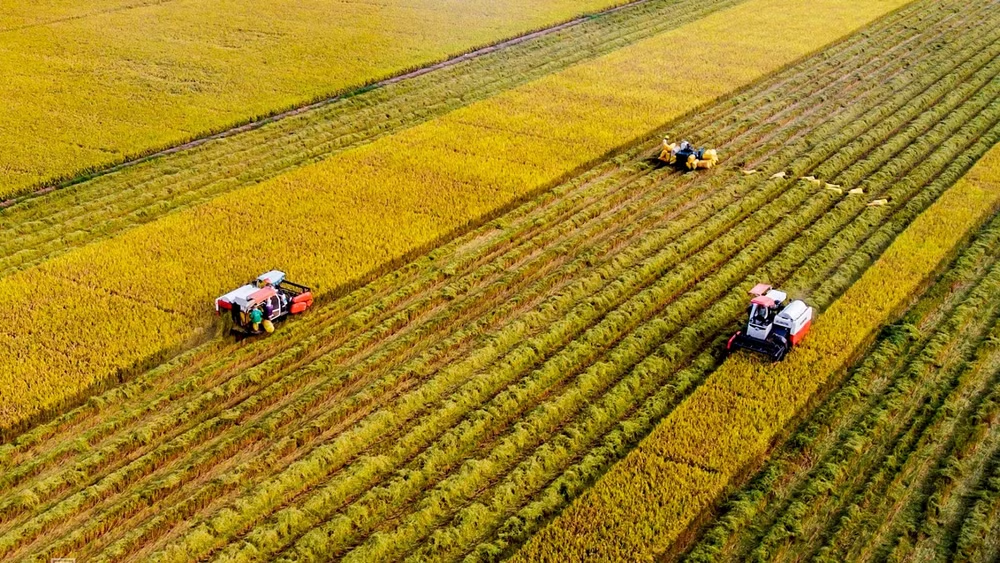
Stable production, accelerated exports.
Data from the General Statistics Office shows that in the first nine months of 2026, many agricultural product groups such as rice, fruit, livestock, and aquatic products continued to maintain high productivity and output, meeting domestic demand and creating export sources. Specifically, fruit and vegetable exports reached nearly US$7.35 billion, an increase of 19.9%; aquatic products reached US$9.17 billion, an increase of 12.3%; livestock products reached US$564.4 million, an increase of 24.6%; cashew nuts reached US$3.85 billion, an increase of 2%; and pepper reached US$1.4 billion, an increase of 10.2%…
However, the export picture is uneven across sectors, with coffee and rice showing a downward trend. In the first nine months of the year, coffee exports reached 1.4 million tons, worth $6.54 billion, an increase of 15.4% in volume but a decrease of 7.3% in value; rice exports reached 6.4 million tons, worth $3.11 billion, decreasing by 6.1% and 10.9% respectively compared to the same period in 2025. The main reason is the decline in export prices; specifically, the average export price of coffee in the first nine months was estimated at $4,537.3/ton, down 19.7%; the average export price of rice was estimated at $484.8/ton, down 5.1%. For rice in particular, pressure also comes from the main consumer market. In the first eight months of the year, the value of rice exports to the Philippines decreased by 16.8% compared to the same period. This shows that price movements and purchasing power in each market are having an increasingly clear impact on export results.
As an industry experiencing strong growth in the past three quarters and expected to reach $10 billion, Mr. Nguyen Thanh Binh, Chairman of the Vietnam Fruit and Vegetable Association, believes that one of the factors driving exports is the expansion of the Chinese market, with a significant increase in the number of approved growing area codes and packaging codes. Accordingly, in the first eight months of 2026, China accounted for 63% of the market share; the value of fruit and vegetable exports to this market increased by 38.8% compared to the same period in 2025.
To further standardize the quality and traceability of domestic goods aimed at serving exports, the agricultural sector is accelerating the development of data infrastructure and increasing the ability to control and verify product information. According to Deputy Minister of Agriculture and Environment Dang Ngoc Diep, by September 20, 2026, the agricultural product traceability system will have 820,723 products from 3,030 farming households and 208 businesses in 28 out of 34 provinces and cities registered; of which 158,796 products from 48 farming households and 20 businesses in 16 provinces have fully implemented traceability, with the ability to verify and cross-check throughout the entire chain.
Maintain market share and diversify supply sources.
In the first nine months of 2026, China continued to be Vietnam’s largest export market for agricultural, forestry, and aquatic products with a 24.4% market share, followed by the United States at 19.8% and Japan at 7.4%. To increase export turnover, industries need to maintain existing markets with strong purchasing power while proactively securing supply to fulfill signed orders and be ready to accept new orders.
Regarding the key Chinese market, Ms. Ngo Tuong Vy, General Director of Chanh Thu Fruit Import-Export Group Joint Stock Company, shared: Chanh Thu has proactively gone deep into each region of China to survey and directly observe how customers purchase goods, understanding actual needs, tastes, and consumer behavior. From there, we adjust the production, processing, packaging, and product development processes accordingly. In reality, China has a highly developed system of sorting and processing centers, so imported products can be further processed to suit the tastes and convenience needs of consumers. Therefore, to attract customers, Vietnamese businesses need to develop convenient product lines, even those that can be used immediately, to penetrate deeper into the value chain.
In some other sectors, besides product output, solutions for supply are also needed. According to Le Hang, Deputy Secretary General of the Vietnam Association of Seafood Processing and Export (VASEP), after a period of accelerated growth in the third quarter, seafood exports in the fourth quarter are forecast to slow down. Many orders for year-end consumption have been imported and delivered early, so the demand for additional purchases is unlikely to maintain the high levels seen in recent months. For example, shrimp, pangasius, and tilapia all face limitations in raw materials, while wild-caught seafood is also struggling to expand export volumes due to a lack of suitable raw materials and the capacity to meet origin requirements. “Therefore, even if some markets still have demand, the ability to fulfill orders may still be limited,” Ms. Le Hang emphasized.
A similar situation is occurring in the cashew industry, where export value is increasing but production is decreasing, partly due to pressure on domestic raw material sources. This is because major raw material suppliers are now stepping up on-site processing, so the supply of export goods is no longer abundant, requiring Vietnamese businesses to proactively secure raw material sources that meet requirements.
The fourth quarter is the final stretch of the year, a peak period for industries to boost exports, making a significant contribution to overall growth targets. To capitalize on this opportunity, a more rational production plan is needed in raw material areas to ensure sufficient supply, while also strictly controlling quality so that products reaching the market command a higher price.
According to Nhan Dan newspaper
Source: Báo An Giang
https://www.vietnam.vn/en/san-xuat-nong-nghiep-vao-cuoc-dua-nuoc-rut-cuoi-namPublished Date: October 12, 2026


 READ
READ