Downloads
 Login
Login
 Register

Tags
New Kashmir rice varieties yields over two times national average, offer farmers second-crop window
The yield is around 2.5 times the national average, highlighting the potential of the varieties to raise rice productivity in the valley, where paddy remains an important crop for rural households.
By Gulzar Bhat
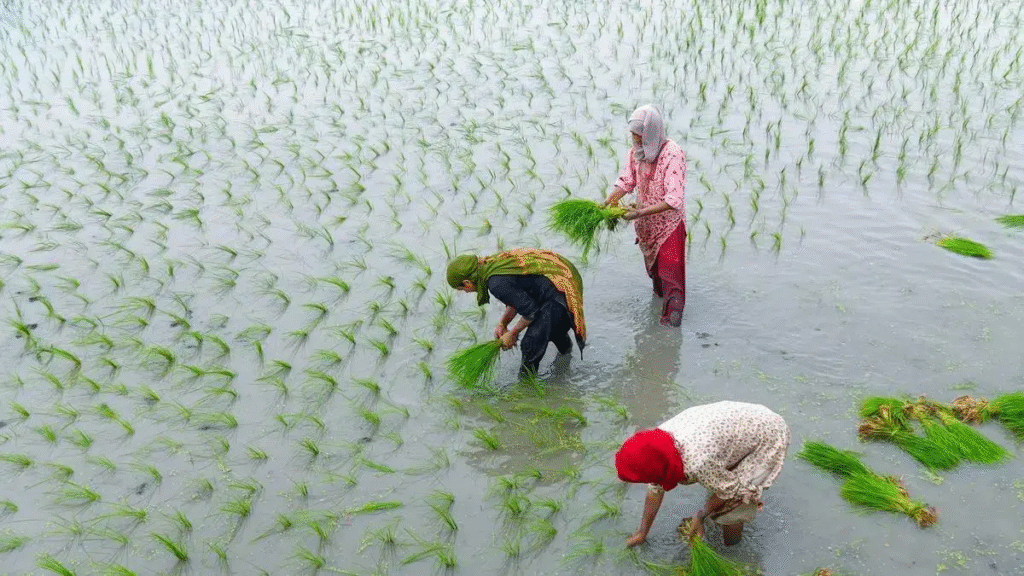
Paddy fields in Kashmir are producing yields more than twice the national average with two newly developed rice varieties, offering farmers the prospect of higher returns and an earlier harvest that could allow them to plant a second crop.
The varieties, Shalimar-4 and Shalimar-5, developed by the Mountain Research Centre for Field Crops (MRCFC) at Khudwani under Sher-e-Kashmir University of Agricultural Sciences and Technology-Kashmir, have recorded yields of about 7.2 tonnes per hectare, according to the centre.
The yield is around 2.5 times the national average, highlighting the potential of the varieties to raise rice productivity in the valley, where paddy remains an important crop for rural households.
Najeeb-ul-Rehman Sofi, associate director at MRCFC, said Shalimar-4 was developed for the plains, while Shalimar-5 was suited to higher-altitude areas.
Both varieties are resistant to blast, a fungal disease that can significantly affect rice production, Sofi said. They also mature earlier than conventional varieties, allowing farmers to harvest the crop between Sept. 15 and Sept. 25.
“This early harvesting could pave the way for farmers to take another crop,” Sofi said.
The shorter crop cycle could be particularly useful for farmers seeking to diversify beyond paddy and make better use of their limited agricultural land.
The development comes as agricultural scientists seek to improve crop productivity while helping farmers cope with rising input costs and changing weather conditions.
Official data shows a worrying decline in agricultural land, with nearly 34,000 hectares of cultivable land lost in the region between 1996 and 2023, raising concerns over the long-term sustainability of farming.
Additional income
The varieties also offer an additional source of income through straw, which is widely used in Kashmir.
The new varieties produce an approximately equal proportion of grain and straw, with grain accounting for about 50% of the total biomass and straw making up the remainder, Sofi said.
Paddy straw has commercial value in Kashmir, where it is used as cushioning material for packing apple cartons and as fodder for cattle during winter.
“Besides food grains, farmers also earn from selling the straw,” Sofi said.
He added higher yields, disease resistance and an earlier harvest make the new varieties attractive to growers, particularly in areas where farmers are looking to maximise returns from small landholdings.
https://www.thehindubusinessline.com/economy/agri-business/new-kashmir-rice-varieties-yields-over-two-times-national-average-offer-farmers-second-crop-window/article71411255.ecePublished Date: September 1, 2026


 READ
READ