Downloads
 Login
Login
 Register


Tags
Rice export prices recover, but competition remains intense
According to the Vietnam Food Association (VFA), export prices continued to rise this month.
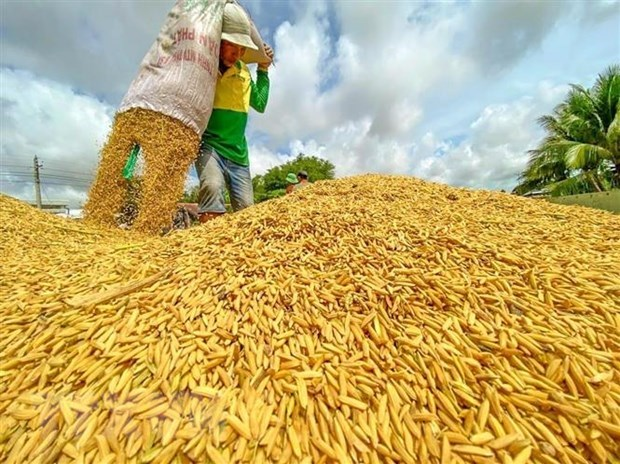
HÀ NỘI — Rice export prices have shown signs of recovery, supported by stronger demand from key markets such as the Philippines and China.
However, abundant global supplies, intensifying competition among major exporters and rising trade barriers continue to pose significant challenges for exporters.
According to the Vietnam Food Association (VFA), export prices continued to rise this month.
As of July 22, Vietnamese Jasmine rice was quoted at US$513-517 per tonne, up about $8 from a month earlier, while 5 per cent broken fragrant rice increased by $20-30 to $510-520 per tonne. Prices for 100 per cent broken fragrant rice also edged up by around $4 to $348-352 per tonne.
Vietnamese rice, particularly premium fragrant varieties, continues to command higher prices than competing products. Thailand’s 5 per cent broken rice was priced at $478-482 per tonne, while India’s equivalent stood at $350-354 per tonne.
According to VnEconomy online newspaper, despite the price recovery, the global rice market remains under pressure from ample supply. VFA noted that the Oryza White Rice Index (WRI) reached $432 per tonne in the final week of June, up $4 from the previous week and $15 from a month earlier, indicating a gradual recovery after a prolonged decline.
However, the International Grains Council (IGC) forecasted that the global rice market would remain in surplus during the 2026-27 crop year, with production expected to reach around 545 million tonnes, exceeding projected consumption of 543 million tonnes.
Global rice trade is forecast to hit a record 62 million tonnes, while ending stocks are expected to increase to about 199 million tonnes, largely due to abundant supplies from India.
Against this backdrop, Vietnamese exporters are being urged to improve product quality, diversify export markets and increase the value of their products to remain competitive.
Weather also remains a source of uncertainty. A strengthening El Nino, combined with a positive Indian Ocean Dipole (IOD) during the second half of this year, could intensify drought conditions across Southeast Asia and affect rice production in several countries.
According to the Customs, the country exported 5.02 million tonnes of rice worth $2.38 billion in the first six months of this year.
Export volume rose by 2.5 per cent year-on-year, but export value fell by 9.2 per cent as average export prices declined.
The average export price during the period was $459.6 per tonne, down 11.3 per cent from a year earlier, offsetting gains in shipment volume.
The Philippines remained Việt Nam’s largest rice market, importing 2.39 million tonnes worth $1.06 billion during the first half of the year.
China ranked second with imports of 915,466 tonnes valued at $454 million, followed by Ghana with 445,534 tonnes worth $229.7 million. Other major markets included Côte d’Ivoire, Malaysia and Singapore.
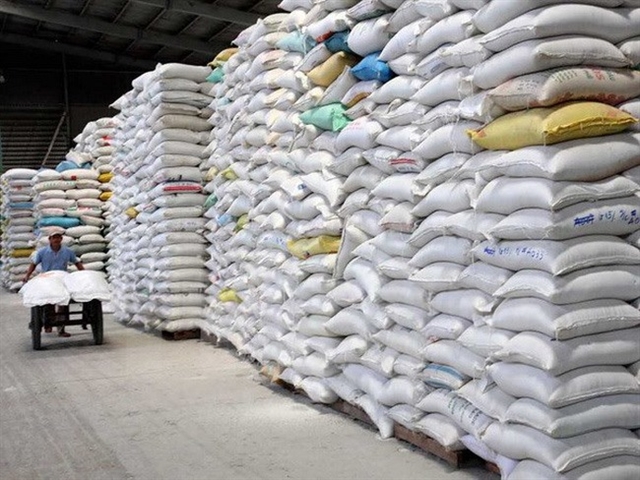 |
| Sacks of rice prepared for export. — VNA/VNS Photo |
Philippines continues to drive demand
The Philippines is expected to remain the key driver of Việt Nam’s rice exports despite efforts to boost domestic production and stabilise prices.
According to VFA, the Philippine National Food Authority (NFA) plans to release rice stockpiles worth about 1.9 billion pesos ($33.5 million) that have been stored for more than six months to support the government’s subsidised rice programme.
The move is intended to stabilise domestic prices, free up warehouse capacity for the new harvest and improve management of national reserves.
The US Department of Agriculture (USDA) forecasts that the Philippines will produce about 12.3 million tonnes of milled rice in the 2026-27 season, well below projected domestic consumption of 17.65 million tonnes. As a result, the country is expected to import around 5.2 million tonnes of rice.
At the same time, the Philippine government is strengthening price stabilisation measures, increasing domestic procurement and investigating safeguard measures on imported rice, reflecting a broader trend towards tighter trade protection.
USDA has raised its forecast for Việt Nam’s rice exports this year to 8.1 million tonnes, 200,000 tonnes higher than its previous projection, citing stronger demand from traditional markets, particularly the Philippines and China. China’s rice imports are now projected at 3.9 million tonnes, while the Philippines is expected to remain the world’s largest rice importer with demand of about 5.6 million tonnes.
The Philippines imported 2.75 million tonnes of rice during the first half of this year, up 20 per cent from a year earlier, with Việt Nam remaining its largest supplier.
According to the Vietnamese Ministry of Agriculture and Environment, the Philippines accounted for 45 per cent of Việt Nam’s rice exports during the period, while exports to China surged by 87 per cent year-on-year.
Despite the improving outlook, industry experts said Vietnamese rice exporters should invest more in production areas, improve quality, strengthen traceability and brand development, and proactively meet increasingly stringent trade defence requirements.
However, the export outlook remains challenging as competition among major exporters intensifies. India continues to enjoy a price advantage thanks to abundant supplies, while many countries are stepping up efforts to achieve greater food self-sufficiency. Vietnamese exporters therefore need to closely monitor market trends, diversify export markets and increase the value of their products to remain competitive. — VNS
https://vietnamnews.vn/economy/1796218/rice-export-prices-recover-but-competition-remains-intense.htmlPublished Date: July 27, 2026



 READ
READ