Downloads
 Login
Login
 Register


Tags
Hokkaido Rice Sees Growing Export Boom; GI Protection Label Expected to Give Further Boost
By Kai Noda and Rui Usui / Yomiuri Shimbun Staff Writers

Tetsuo Numata, chairman of Ashibetsu Rice, stands near a rice paddy in Ashibetsu, Hokkaido.
SAPPORO — Hokkaido rice is drawing keen attention from industry stakeholders after being registered in March under the Geographical Indication (GI) system that protects regional brand products.
It marks the first time rice has received the GI registration in Japan, with the designation applied to specific rice varieties approved by the Hokuren Federation of Agricultural Cooperatives.
In recent years, Hokkaido rice exports have been on the rise, raising expectations that the GI registration will provide a further boost.
500% increase over decade
At a panel discussion held in Sapporo on June 19 concerning the GI registration of Hokkaido rice, panelist Hideki Inamura, a 52-year-old farmer in Tobetsu, Hokkaido, expressed his optimism, saying, “This system guarantees quality when products are exported, which benefits us as well.”
At a panel discussion held in Sapporo on June 19 concerning the GI registration of Hokkaido rice, panelist Hideki Inamura, a 52-year-old farmer in Tobetsu, Hokkaido, expressed his optimism, saying, “This system guarantees quality when products are exported, which benefits us as well.”
This event, held in recognition of the historic registration, aimed to deepen understanding of and how to utilize the GI system among agricultural stakeholders, including producers, collectors, distributors and retailers. Benefits, such as brand protection and an increase in added value, were also highlighted during the event.
However, some participants pointed out challenges regarding public awareness and understanding of the GI system. As momentum for rice exports grows, effectively wielding the GI system could determine the future success of Hokkaido rice, which currently sees increasing demand.
The GI system is designed to protect agricultural goods and other products as intellectual property, such as those whose quality is rooted in a region’s climate and natural environment, or which meet specific criteria regarding raw materials or production methods. Subsequent unauthorized use of GI-labeled products is subject to penalties. Individual violators could face imprisonment for up to five years, a fine of up to ¥5 million, or both, while entities could be subject to fines of up to ¥300 million. Among Hokkaido goods, Yubari melons are protected under the system.
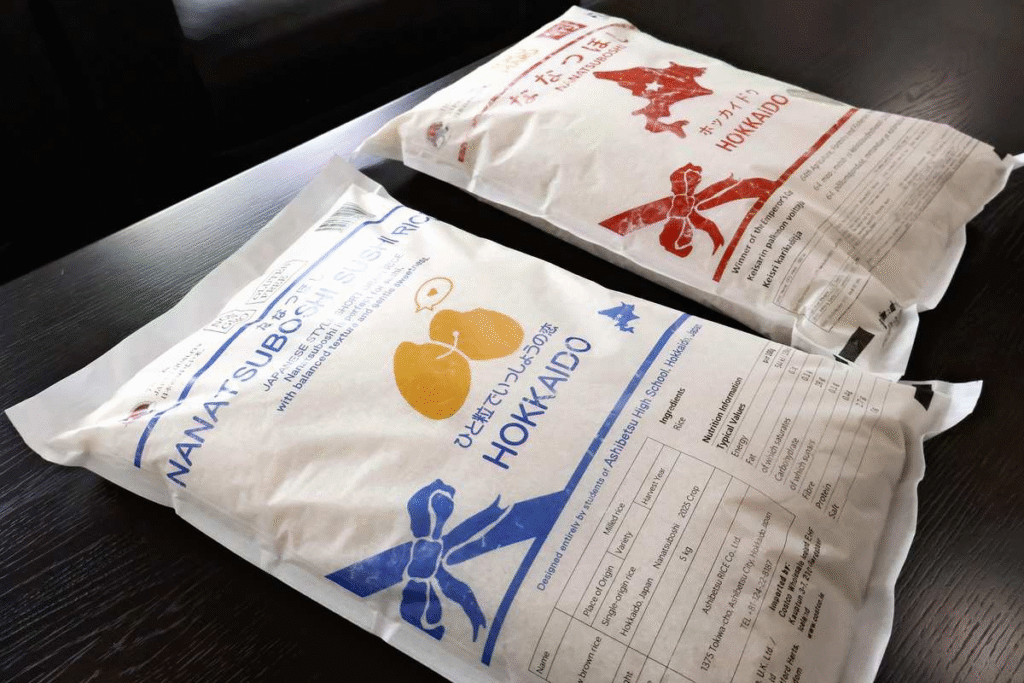
Nanatsuboshi rice brand products to be shipped overseas are seen bearing labels in languages such as English in Ashibetsu, Hokkaido.
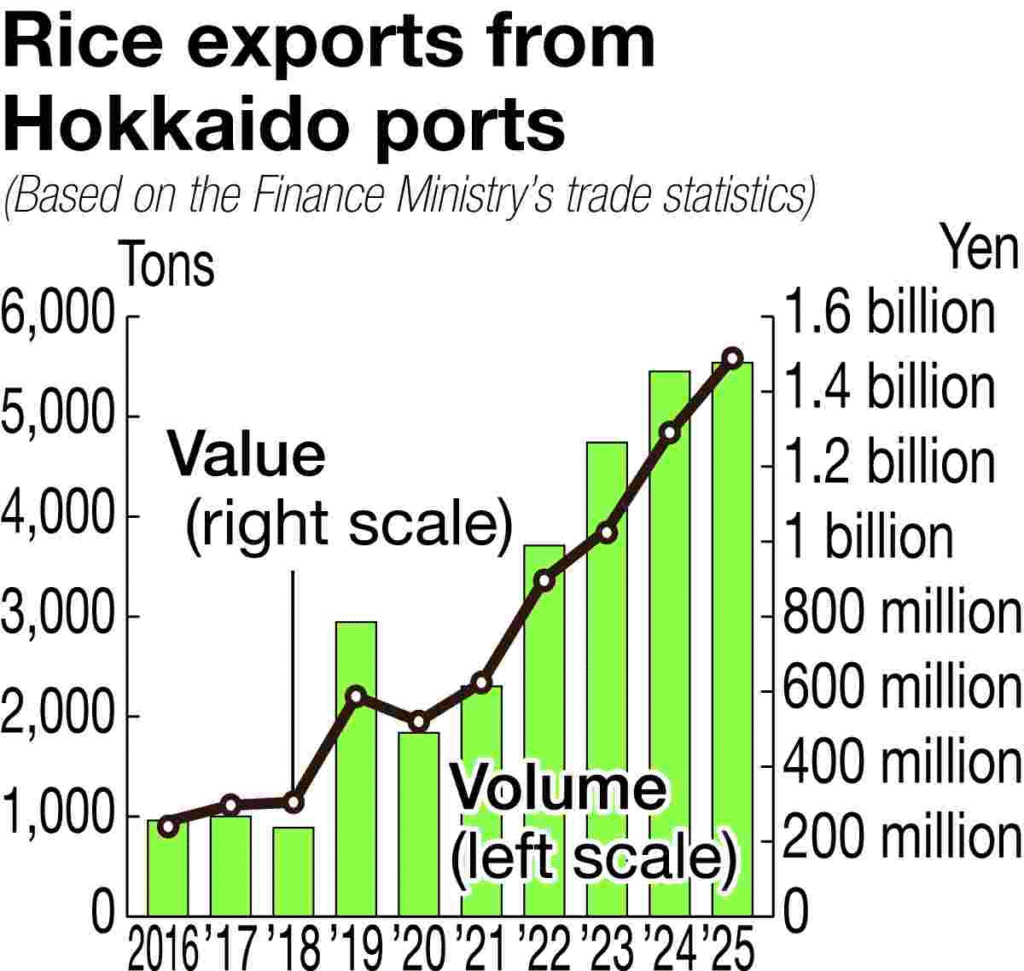
According to the Hokkaido Regional Agricultural Administration Office, rice exports from ports in Hokkaido totaled 5,539 tons in 2025, marking a 500% increase over the past decade. Driven by a global boom for onigiri rice balls, business inquiries for Hokkaido rice — particularly the Nanatsuboshi brand that retains its flavor even when cold — have been increasing in recent years.
Popularity with ‘no limits’
“The popularity of Hokkaido rice is growing with no limits. Right now, even if we would want to increase exports, production can’t keep up,” said Tetsuo Numata, 61, chairman of Ashibetsu Rice, a rice wholesaler for farmers in Ashibetsu, Hokkaido.
Numata began considering exporting Hokkaido-harvested rice about 20 years ago, anticipating a decline in Japan’s population and a resulting fall in demand for rice.
After washoku was added to UNESCO’s Intangible Cultural Heritage list in 2013, overseas demand for rice surged, with exports on a steady upward trend ever since.
Ashibetsu Rice launched a full-scale export business in 2015, selling Hokkaido’s leading Yumepirika and Nanatsuboshi rice brands. Last year, the company’s exports to five countries, such as the United States and Finland, hit a record high of 1,290 tons. As for the 2026 harvest, it aims to export 2,000 tons, up about 55% from the previous year.
Amid the growing popularity of Hokkaido rice, the prevalence of “counterfeits” is cause for concern — something the GI registration is expected to help tackle.
“As we’ve been engaged with the export business, we have a strong interest in issues related to misrepresentation of origin and intellectual property. If the GI system can help with countering these issues, it will likely result in a boost for us,” Numata said.
https://japannews.yomiuri.co.jp/business/companies/20260720-339093/Published Date: July 20, 2026



 READ
READ