Downloads
 Login
Login
 Register


Tags
How India interferes with global rice trade
What determines global rice prices? The answer is on the other side of the world.
Whitney Shannon, Staff Writer, Farm Press
At a Glance
- India’s ag policy has made the global rice market hard to compete in.
- The country subsidizes 86% of agricultural production.
- Unless something changes, the U.S. rice farmer faces a race to the bottom.
This is Part 2 of a three-part series on problems facing the U.S. rice industry this year.
Behind the turmoil within the U.S. rice industry lies a competitor that doesn’t play by the same rules: India.
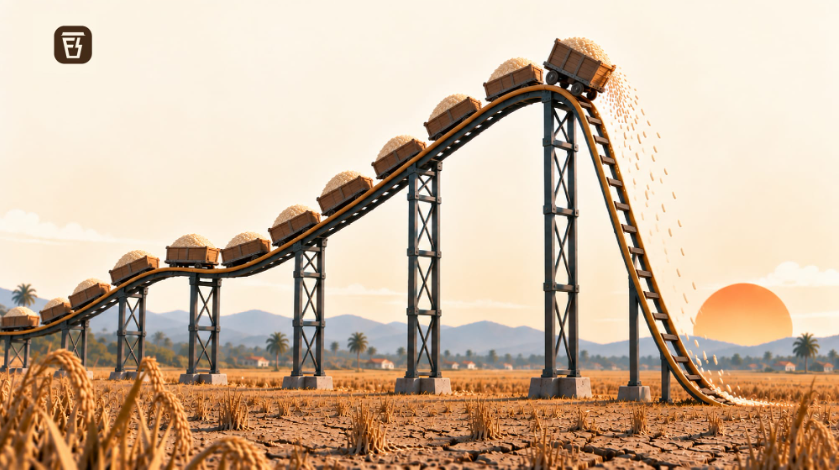
Through massive government subsidies and practices that would be illegal in the United States, India has fundamentally distorted the global rice market, making it virtually impossible for U.S. farmers and farmers in other countries to compete.
The scale of India’s intervention is staggering. According to Peter Bachmann, CEO of the USA Rice Federation, the U.S. Trade Representative recently revealed that, through India’s government policies, the country is funding its farmers at 86% of the cost of production.
“To put that in layman’s terms, if a unit of rice is worth $100 after it has been harvested, the Indian government is giving them $86 to make sure they are good to go,” Bachmann said. “The farmers are only on the line for $14 of that $100. All that is left uncovered is 14% of risk.”
This government-funded support system covers almost every aspect of production. “The Indian government is covering fertilizer, water costs, electricity costs, seed costs, and on top of that, they also guarantee they are going to buy their rice at a certain price,” Bachmann explained. The government purchases long-grain rice, stores it, then sells it to exporters “at cents on the dollar.”
This results in a flooded global rice market at prices U.S. farmers can never match. “Those exporters ship that rice all around the world at a price that we can’t ever compete with,” Bachmann said. “It is forcing other competitors of India to do the same or subsidize their farmers because it is called a ‘race to the bottom,’ in terms of price.”
Unfair trade practices
The impact on the American market share has been devastating. Nigeria, once one of the biggest markets for U.S. long-grain rice, provides a stark example. “We’ve now been completely replaced by India in that market, and we don’t sell anything into Nigeria,” Bachmann said. “That is just one small example of dozens where the U.S. had a foothold, and we no longer do because India has come in at half the price.”
India now controls 40% of the world’s rice exports, producing between 110 million and 115 million acres compared with the U.S.’ 2 million to 3 million acres. “Whatever their price is is what the market price is,” Bachmann said, explaining India’s dominant position in setting global rice prices.
The competitive disadvantage extends beyond subsidies. India doesn’t face the same regulatory oversight U.S. farmers do. “They don’t have an FDA or EPA that is looking over their shoulder,” Bachmann added, emphasizing that regulations add to the high cost of U.S. production.
Even more troubling, India appears as a frequent offender on lists for forced and child labor violations, which contributes to its cost advantage. “They use forced or child labor to hand-harvest and hand-weed the crops,” Bachmann said, which are practices considered to be criminal in the U.S.
The situation has created what Bachmann describes as an unsustainable dynamic. “The U.S. is never going to win that race. If we drop acreage any more, we are going to see permanent closure of our infrastructure in the Midsouth, and that is something we can’t afford to [have] happen.”
India’s motivations are understandable from its perspective. With more than 100 million rice farmers and a population nearing 1.5 billion, its government wants to keep farmers in rural areas rather and out of already crowded cities.
“While we know it is bad what they are doing, our government learned the same lesson,” Bachmann acknowledged, but he emphasized a critical difference. “The fact that they are exporting rice and impacting us in all of our markets, plus our own market here in the U.S., is what really concerns us.”
The India factor has transformed global rice trade from a competitive market into an unwinnable contest, leaving U.S. farmers searching for solutions to level a playing field dramatically tilted against them.
Part 3 of this series will dive into how the U.S. rice industry is fighting back, even if it means relying on global tariffs to gain a foothold in the domestic market share. Part 1 examined the state of the U.S. rice market and how falling projected acreage could cause a ripple effect across the entire industry.
https://www.farmprogress.com/rice/how-india-interferes-with-global-rice-tradePublished Date: June 3, 2026


 READ
READ