Downloads
 Login
Login
 Register


Tags
India, New Zealand to sign FTA on April 24
By Rohan Singh
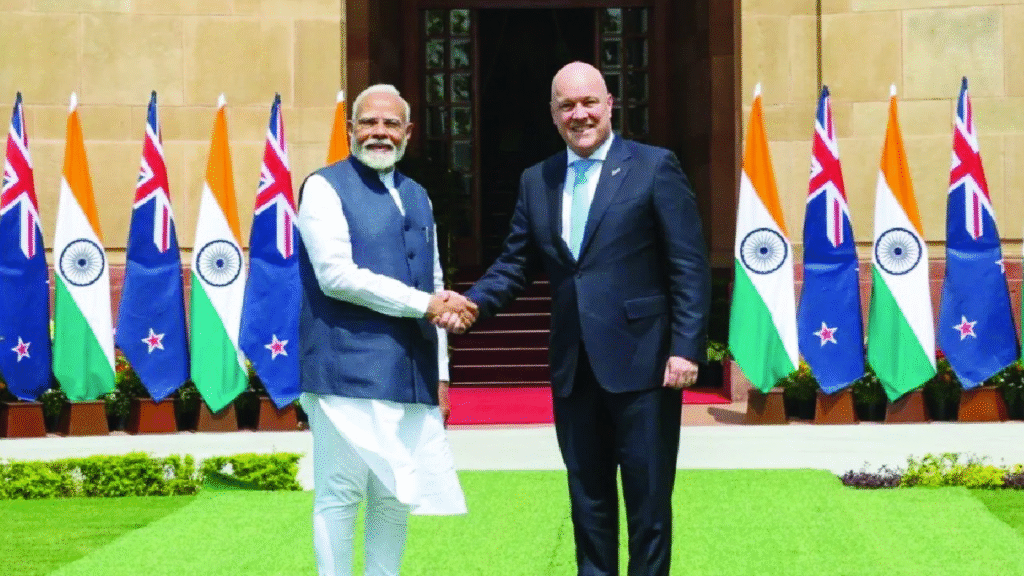
India and New Zealand are set to formalize a historic economic partnership by signing a Free Trade Agreement (FTA) on April 24, 2026. The signing ceremony is expected to take place at Bharat Mandapam in New Delhi, following the successful conclusion of negotiations that were fast-tracked in late 2025.
This agreement marks a major milestone, aiming to double bilateral trade to $5 billion within five years and unlock nearly $20 billion in investment from New Zealand into India over the next 15 years.
1. Key Highlights: Zero-Duty Access
The deal is structured to provide significant market openings while protecting sensitive domestic sectors in both nations.
| Feature | Details for India | Details for New Zealand |
| Market Access | 100% Zero-Duty Access for all Indian exports from day one. | 95% Tariff Reduction on exports to India. |
| Primary Gainers | Textiles, leather, gems & jewelry, and engineering goods. | Wool, coal, wood, wine, avocados, and blueberries. |
| Agricultural Deal | New Zealand gains duty-free access for sheep meat and forestry. | Sensitive items excluded (Dairy, sugar, onions, spices, rubber). |
2. The “Services” Boost: 5,000 Skilled Visas
One of the most significant wins for India is the creation of a dedicated Temporary Employment Entry (TEE) Visa pathway.
- Quota: Up to 5,000 Indian professionals annually.
- Duration: Stays for up to three years.
- Eligible Roles: The pathway covers high-demand sectors like IT, engineering, healthcare, and education, alongside specialized roles such as AYUSH practitioners, yoga instructors, Indian chefs, and music teachers.
- Youth Mobility: A separate quota for 1,000 Working Holiday Visas will be available annually for young Indians to live and work in New Zealand.
3. Safeguarding Indian Farmers: The “Dairy Barricade”
Despite New Zealand’s status as a global dairy powerhouse, India has successfully maintained its “Red Line” on dairy products to protect the livelihoods of millions of small-scale domestic farmers.
- Exclusions: No duty concessions were granted for milk, cream, whey, yogurt, or cheese.
- Exceptions: Limited concessions were made only for highly specific items like infant milk formula and milk albumins.
- Agricultural Protection: Other sensitive crops like onions, sugar, and edible oils also remain protected from tariff cuts.
4. Strategic Context: A Record-Breaking Timeline
The India-New Zealand FTA is notable for its speed, with negotiations formally launching in March 2025 and concluding in just nine months (December 2025).
- The Global South Push: This deal is part of India’s broader “Trade Diversity” strategy, which has seen the conclusion of FTAs with the UK, Oman, and the European Union (January 2026) in quick succession.
- Geopolitical Significance: Beyond trade, the deal strengthens India’s footprint in the Indo-Pacific. New Zealand has also committed to GI-level protection for Basmati rice, ensuring that only authentic Indian Basmati can be sold under that name in the Kiwi market.
5. What Happens After April 24?
- Ratification: In New Zealand, the agreement must be examined by Parliament and pass domestic legislation before the planned elections on November 7, 2026.
- Implementation: If ratified smoothly, the agreement is expected to come into force by early 2027, providing an immediate boost to the Diwali 2026 export season.
https://voice.lapaas.com/india-new-zealand-to-sign-fta-on-april-24/?amp=1“This is a once-in-a-generation agreement,” noted New Zealand Trade Minister Todd McClay. “It delivers unprecedented access for our exporters while acknowledging the unique sensitivities of the Indian market.”
Published Date: April 8, 2026


 READ
READ