Downloads
 Login
Login
 Register


Tags
Measures to expand rice consumption markets
The Mekong Delta provinces are entering the peak harvest period for the winter-spring rice crop. Amid rising domestic and global supply, declining export rice prices have continued to push down paddy prices.
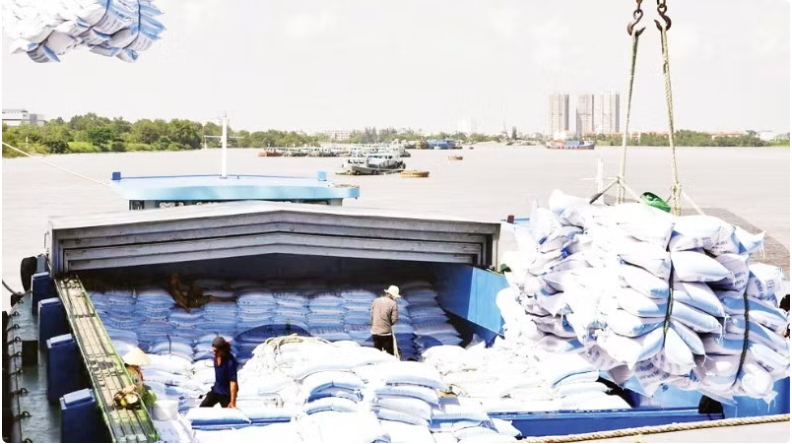
This situation requires urgent measures to accelerate paddy procurement, ensure farmers’ profits, and promote stable and sustainable rice exports.
From the beginning of the year to mid-March, Viet Nam exported approximately 1.74 million tonnes of rice, generating 826.2 million USD in export value. The average export price reached 477.6 USD per tonne, down 10.7% year-on-year.
Abundant supply, rising consumption pressure
After completing the harvest of his family’s rice crop, farmer Ho Phuoc Minh from Tam Nong Commune in Dong Thap Province said that paddy prices this crop ranged from 5,700 VND to 5,800 VND per kilogramme, compared to more than 6,000 VND per kilogramme in the previous crop. Although yields increased, higher input costs significantly reduced farmers’ profits.
A similar situation has been recorded in Can Tho City. Phan Van Chau, Deputy Director of the Kien Thanh Agricultural and Service Cooperative in Vi Thanh 1 Commune, noted that while paddy prices peaked at 9,100 VND per kilogramme in the previous winter-spring crop, prices this year have fallen below 6,000 VND per kilogramme, eroding farmers’ income.
In addition, rising fuel prices have forced some combine harvester operators to suspend operations, delaying harvesting in certain areas and posing risks to rice quality. Many farmers are also hesitant to start the upcoming summer-autumn crop due to concerns over potential losses as input costs remain high while yield and quality are lower in this season.
According to the Department of Crop Production and Plant Protection under the Ministry of Agriculture and Environment, Viet Nam’s total rice cultivation area in 2026 is estimated at more than 7 million hectares, with output projected at over 43.6 million tonnes. Of this, exportable paddy volume is estimated at around 15.46 million tonnes, equivalent to 7.73 million tonnes of milled rice.
Specifically, in the first six months of the year, rice supply for export is projected at more than 4 million tonnes, while the second half is forecast to reach over 3.7 million tonnes. Despite abundant domestic supply, rice exports are facing increasing challenges.
Chairman of the Viet Nam Food Association (VFA) Do Ha Nam said that the price of Viet Nam’s 5% broken rice currently stands at just over 350 USD per tonne. This is attributed to reduced import demand from traditional markets such as Indonesia, Malaysia, and the Philippines, which are strengthening reserves and food security.
Indonesia is also considering a gradual return to the regional export market as its domestic production improves. In addition, geopolitical factors have affected rice exports, as conflicts in the Middle East have disrupted transportation and increased logistics costs, impacting not only exports to the region but also shipments to Europe.
Promoting rice consumption
In the context of falling global rice prices and rising supply, boosting domestic paddy procurement is considered an urgent solution to stabilise prices and ensure farmers’ income.
The Prime Minister has instructed local authorities to direct relevant agencies to coordinate with enterprises and cooperatives to organise timely procurement, avoiding situations where harvested rice is left unsold.
The Ministry of Industry and Trade has requested rice exporters to strictly fulfil their obligations in purchasing paddy and rice for export, increase procurement and temporary storage to prepare for signed contracts, and remain ready to supply when import partners resume purchasing.
Chairman of the Board of Directors of Trung An High-Tech Agriculture Joint Stock Company Pham Thai Binh said that to boost paddy procurement, especially during peak harvest periods, enterprises need access to capital at reasonable interest rates. Preferential credit policies are also needed for enterprises with large storage and strong purchasing capacity, enabling them to enhance temporary stockpiling for farmers.
In the long term, Deputy Director of the Department of Crop Production and Plant Protection Nguyen Quoc Manh noted that production should be aligned with market demand, with a focus on high-quality and high-value rice varieties as well as specialty rice cultivation to strengthen market outlets.
The structure of rice varieties in the 2025–2026 winter-spring crop has continued to shift positively, with high-quality, fragrant, and specialty rice accounting for around 75%. However, the proportion of processed rice remains relatively low and requires further adjustment.
From a market perspective, Deputy Director General of the Multilateral Trade Policy Department Ngo Chung Khanh said that commitments on rice under free trade agreements (FTAs) offer significant market access opportunities.
Under the EU–Viet Nam Free Trade Agreement (EVFTA), the EU grants a tariff-free quota of 80,000 tonnes of rice per year. Similarly, the UK–Viet Nam Free Trade Agreement (UKVFTA) provides a quota of 13,358 tonnes at 0% tariff, allocated by rice categories. Under the Comprehensive and Progressive Agreement for Trans-Pacific Partnership (CPTPP), several markets have also opened significantly, with Mexico applying a zero tariff and Canada maintaining a zero tariff, albeit with specific technical requirements.
However, Viet Nam’s rice market share in these FTA markets remains modest. It stands at 2.7% in Canada, 1.5% in the EU, 1.3% in the UK and just 0.2% in Mexico.
Meanwhile, Thailand holds significantly higher shares with 23.9% in Canada, 5.2% in the EU, 4.6% in the UK,and 17% in Mexico. India’s rice also commands a strong presence in these markets, particularly in the UK with 26.7%.
Therefore, Vietnamese rice exporters need to place greater emphasis on origin certification and product quality to enhance competitiveness in FTA markets towards diversifying export destinations, reducing reliance on traditional markets, and ensuring more stable rice exports amid intensifying competition.
TIEN ANH
Translated by Duc Minh
https://en.nhandan.vn/measures-to-expand-rice-consumption-markets-post160763.htmlPublished Date: April 7, 2026


 READ
READ