Downloads
 Login
Login
 Register


Tags
West Asia conflict hits Punjab basmati traders, exports to Gulf fall 50%
Story by Rakshit Sharma, Ludhiana
Key takeaways:
- Shipping Disruptions: Exports to Gulf countries have fallen nearly 50% due to the Strait of Hormuz closure, forcing shipments to reroute via Abu Dhabi and Jeddah, increasing costs.
- Rising Freight Costs: Container rates surged from $350 to $2,000–$2,500, making transportation significantly more expensive for exporters.
- Impact on Traders: Punjab exporters, who supply around 40% of India’s basmati to West Asia, are facing reduced shipments and potential financial losses due to limited port access and higher logistics costs.
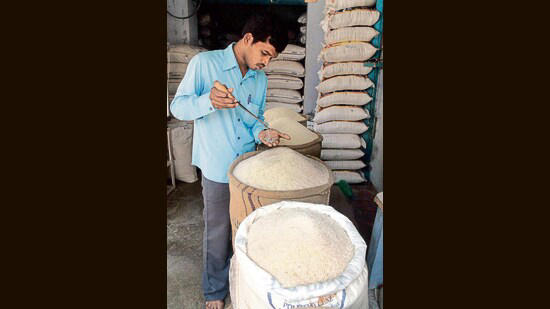
The basmati exports to West Asia have fallen by nearly 50% due to the ongoing conflict, exporters said on Saturday. India exports around 5 lakh tonnes of basmati to the region every month, and approximately 40% of this comes from Punjab, according to Bal Krishan Garg, president of the Basmati Millers and Exporters Association.
According to Garg, there are around 50 exporters in the state, and due to the war, the freight rates have almost shot up 5-6 times.
Garg said that with the Strait of Hormuz closed, the cargo vessels can no longer access Bahrain, Kuwait, and Qatar. The main port of Dubai is also not accessible.
He said the ships instead unload the cargo at the port of Abu Dhabi, and from there it’s being transported to the rest of the countries, costing more money.
“All ports in the Persian Gulf across the Strait of Hormuz are virtually not accessible at the moment. Delivering at Abu Dhabi and then transporting it to Dubai further increases the cost. Moreover, the freight rate has jumped from $350 (around ₹32,000) to anything between $2,000 ( ₹1.85lakh) to $2,500 ( ₹2.30 lakh) per container,” he said, adding that one of the biggest buyers, Saudi Arabia, is also diverting incoming traffic to Jeddah port across the Arabian Peninsula in the Red Sea.
“Earlier, the ships would take the rice to Dammam port in the Gulf. But now that is shut as well. The shipments to Saudi Arabia are now taken to Jeddah port in the Red Sea, and it becomes costly to transport the consignment via road,” he added.
Robin Goyal from GG Agrotech in Moga, who exports the premium grain to the region, said earlier they would send around 100 containers in a month, and now it has fallen to around 35 per month.
“Ships aren’t going to the Gulf. So we are left with Oman port and Jeddah port in the Red Sea. But the cost has risen significantly. Earlier, the rate was $350 per container. Now it is between $2000 to $2500. That is a massive rise. This makes transportation expensive. So we see our exports falling for now,” he said.
He added that when the war started on February 28, around 22 of their containers were at sea. “The shipping company charged us $2,850 per container extra to transport them to their destination,” he said, adding that with limited ports and high cost, the exporters are staring at losses.
https://www.msn.com/en-in/news/India/west-asia-conflict-hits-punjab-basmati-traders-exports-to-gulf-fall-50/ar-AA209ZrA?gemSnapshotKey=GM79AF432D-snapshot-4&uxmode=ruby&apiversion=v2&domshim=1&noservercache=1&noservertelemetry=1&batchservertelemetry=1&renderwebcomponents=1&wcseo=1Published Date: April 5, 2026


 READ
READ