Downloads
 Login
Login
 Register

Tags
Bhutan’s rice bowl under climate pressure
Rising temperatures and water scarcity threaten Punakha’s fragile rice sector.
Chencho Dema – Kuensel
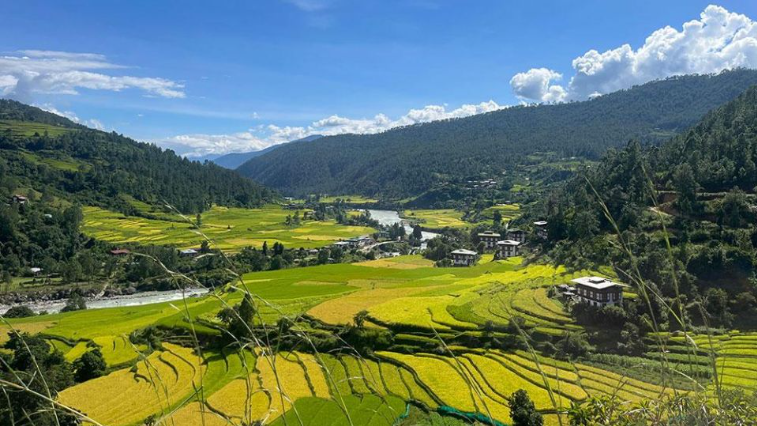
THIMPHU – The country’s rice bowl, Punakha, is warming at a pace that is putting vast swathes of paddy under strain. As irrigation sources dry up, this slow-moving climate shock is resulting in a decline in yields – testing the resilience of one of the country’s most productive valleys.
“The water is not like before,” says Aum Gyem, a 65-year-old farmer in Changyel, Punakha. The irrigation channel that once fed her paddies now runs thin when it matters most. The heat, she adds, “feels different”.
Across the valley, such observations are no longer anecdotal. They are now backed by data. A recent study by Karma Tempa, Assistant Professor at the College of Science and Technology, reveals a sharp rise in land surface temperatures in Punakha over the past three decades.
The findings of the study titled “Emerging heat stress and local prospects in Punakha, Bhutan: Opportunities and challenges of satellite-based observation”, suggest a growing climate threat to the valley’s centuries-old farming traditions.
Pre-monsoon maximum temperatures have risen by around 2.8°C per decade, while average maximum temperatures have climbed even faster, by roughly 3.55°C per decade. Post-monsoon temperatures have also increased by about 2.5°C per decade.
Punakha’s vulnerability lies in its geography. As one of Bhutan’s low-altitude valleys and a key rice-growing region, it is naturally warmer than much of the country. But that warmth is now intensifying.
An analysis of climate data from 1996 to 2025 reveals that the region is experiencing hotter summers and heavier monsoon rains. August 2024 recorded a peak of 33.6°C, while January 2013 saw the lowest minimum temperature of 4.0°C. Extreme rainfall events have become more pronounced, with August 2002 recording 257 mm of rainfall and August 2023 recording 204 mm, while winter months remain increasingly dry.
To capture how these shifts are felt on the ground, Karma Tempa combined remote sensing with community surveys. The results indicate a community under severe environmental stress.
Nearly 93 percent of respondents reported declining water resources linked to rising temperatures. More than half said farm productivity had fallen, while roughly 44 percent reported direct harm to their livelihoods. Almost all respondents (98.2 percent) agreed that rising heat poses a serious threat to their future.
However, the study did not find significant negative health effects reported yet, suggesting the primary impacts remain environmental and economic in nature.
For farmers, the changes are already tangible.
“Now, rains are unpredictable, and water sources have dried up,” said Aum Mindu, 61, from Talo. “If it keeps getting hotter, we don’t know how long this will work.”
In Yebesa in Chubu Gewog, Namgay Bidha, 37, said yields have fallen and more land is left uncultivated each year.
Older farmers note a more visceral change. “Before, we could work for hours,” said Dorji, 69, from Sirigang. “Now it is not possible.”
The data support these perceptions. According to the Integrated Agriculture and Livestock Survey 2025, while total rice production slightly plunged from 8,059.45 metric tonnes in 2022 to 7,760.55 metric tonnes in 2023 before recovering to 8,027.35 metric tonnes in 2025, the yield per harvested acre has steadily declined, dropping from 2.28 metric tonnes per acre in 2022 to 2.07 metric tonnes per acre in 2025. This suggests that despite an increase in cultivated area, productivity per acre is decreasing.
Water scarcity continues to be a major constraint. Farmers rely heavily on rivers and catchment streams, yet these sources are under pressure.
Nationally, of 7,399 identified water sources, around 0.9 percent have already dried up, and another 1,856 (25.1 percent) are in the process of drying up. Punakha is among the affected districts. At the local level, some villages now report having no reliable water source at all.
The consequences are visible in the growing extent of fallow land. In 2023, more than 1,455 acres across Punakha’s 11 gewogs lay uncultivated, including over 900 acres of wetland. Lingmukha, Shengana, and Talo gewogs recorded particularly high levels of fallow paddy fields, each accounting for 134.205 acres, 132.5 acres, and 122 acres of uncultivated wetland respectively.
Climate stress is also interacting with other risks. In 2023, hopper infestations damaged paddy in Shengana, with officials linking the outbreak to temperature fluctuations and intense afternoon heat. Such conditions can favour pests and diseases, compounding the difficulties faced by farmers.
Punakha’s agricultural landscape remains diverse. Farmers grow a range of rice varieties, from Nab-Ja and Tan-Tshering to the scented Bondey, which commands the highest prices. Yet even these traditional strengths are under pressure. Prices have risen, but not always enough to offset declining yields and higher risks.
Karma Tempa’s study highlights the broader vulnerability of Himalayan valleys. Punakha spans subtropical, temperate, and alpine zones, making it exposed to multiple climate hazards. Rising temperatures could accelerate glacial retreat upstream, increasing the risk of glacial lake outburst floods. They may also disrupt hydrological cycles, further reducing water availability for irrigation.
The study calls for urgent, localised climate-risk assessments and the adoption of climate-smart agriculture. These include improved irrigation systems, drought-resistant crop varieties, and better water management. It also stresses the need to align such efforts with Bhutan’s National Adaptation Plan and global commitments under the UN’s Sustainable Development Goal 13 on climate action.
Karma Tempa highlighted the need for long-term, sector-specific climate-resilient programmes and adaptation plans backed by strong financial support.
“Rising temperatures are inevitable and require place-based responses,” he said, adding that data-driven research, risk-informed governance, stronger institutional coordination, and early warning systems are essential to respond effectively.
For farmers, however, the issue is less about policy frameworks than about immediate survival. In Changyel, Aum Gyem said that one of her neighbours left land uncultivated last year due to water shortage.
Such decisions, repeated across the valley, gradually reshape the agricultural landscape.
Punakha’s predicament illustrates a quieter dimension of climate change. Unlike sudden disasters, rising heat, and dwindling water resources unfold slowly, often escaping urgent attention. Yet their cumulative impact can be profound, particularly in regions where livelihoods depend closely on natural cycles.
Farmers are forced to adapt, often improvising with limited means. The question is whether broader, coordinated action will follow, and whether it will come quickly enough to preserve the productivity of the country’s most fertile fields.
https://asianews.network/bhutans-rice-bowl-under-climate-pressure/Published Date: March 30, 2026


 READ
READ