Downloads
 Login
Login
 Register


Tags
Iran crisis leaves 60,000 t of Indian basmati rice stranded at ports
- Escalating tensions in the Middle East disrupt Gulf shipping routes
- Exporters seek relief on port charges, logistics costs as domestic prices soften
India’s basmati rice export trade has encountered a logistical bottleneck after escalating geopolitical tensions in the Middle East disrupted shipping routes to Iran, leaving nearly 60,000 tonnes (t) of cargo stranded at Indian ports.
The shipments, equivalent to roughly 3,000 containers, were scheduled for dispatch to Iran — one of the major buyers of Indian basmati rice. Exporters had already positioned the cargo at ports under previously signed contracts, but vessel movements to Gulf destinations have slowed significantly as shipping lines reassess operational risks in the region.
Industry sources indicate that several shipping companies are either avoiding the route or delaying sailings due to heightened security concerns in the Gulf corridor. The uncertainty has effectively halted fresh export contracts with Iranian buyers, while existing consignments remain stuck awaiting vessel availability.
Middle East remains key market for basmati
The disruption is particularly significant given the Middle East’s importance for India’s basmati trade. Export data indicates strong demand from Middle Eastern markets in early 2026.
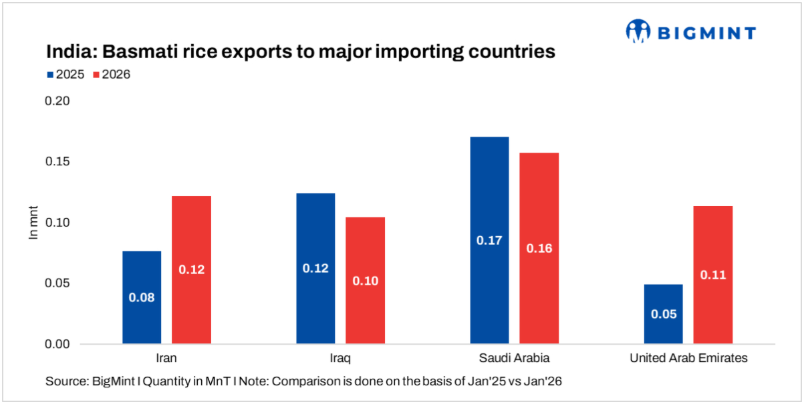
India exported about 0.12 million tonnes (mnt) of basmati rice to Iran in January 2026, up from 0.08 mnt in January 2025. Shipments to Saudi Arabia, the largest buyer among the group, stood at 0.16 mnt in January 2026, compared with 0.17 mnt a year earlier. Exports to Iraq were recorded at 0.10 mnt in January 2026, slightly lower than 0.12 mnt in January 2025, while shipments to the United Arab Emirates rose sharply to 0.11 mnt, more than doubling from 0.05 mnt during the same period last year, according to data maintained by BigMint.
The figures highlight the strong reliance of India’s basmati export trade on the Middle East, making the current shipping disruption particularly sensitive for exporters.
Freight surge adds pressure on exporters
The disruption has sharply increased freight costs and war-risk insurance premiums for shipments to the region. Exporters say logistics expenses have risen rapidly, making it difficult to execute contracts signed earlier at lower freight rates.
With containers accumulating at ports, exporters are also facing additional storage and demurrage charges. These costs are adding to working capital pressure, particularly for small and mid-sized exporters who depend heavily on the Iran trade.
Trade bodies have approached the government seeking temporary relief measures, including waiver of port charges and assistance in managing logistics disruptions.
Domestic basmati prices soften
The slowdown in export dispatches has started to weigh on the domestic basmati market. Traders report that basmati rice prices have declined by around 6-10% in recent days as cargo meant for export remains stuck and fresh buying interest weakens.
With Iran trade temporarily stalled, exporters are cautious about entering new contracts until shipping routes stabilise. Market participants expect trade flows to resume once vessel movements in the Gulf normalise, but near-term sentiment remains cautious as exporters monitor geopolitical developments and freight market volatility.
https://www.bigmint.co/insights/detail/iran-crisis-leaves-60-000-t-of-indian-basmati-rice-stranded-at-ports-728747Published Date: March 6, 2026



 READ
READ